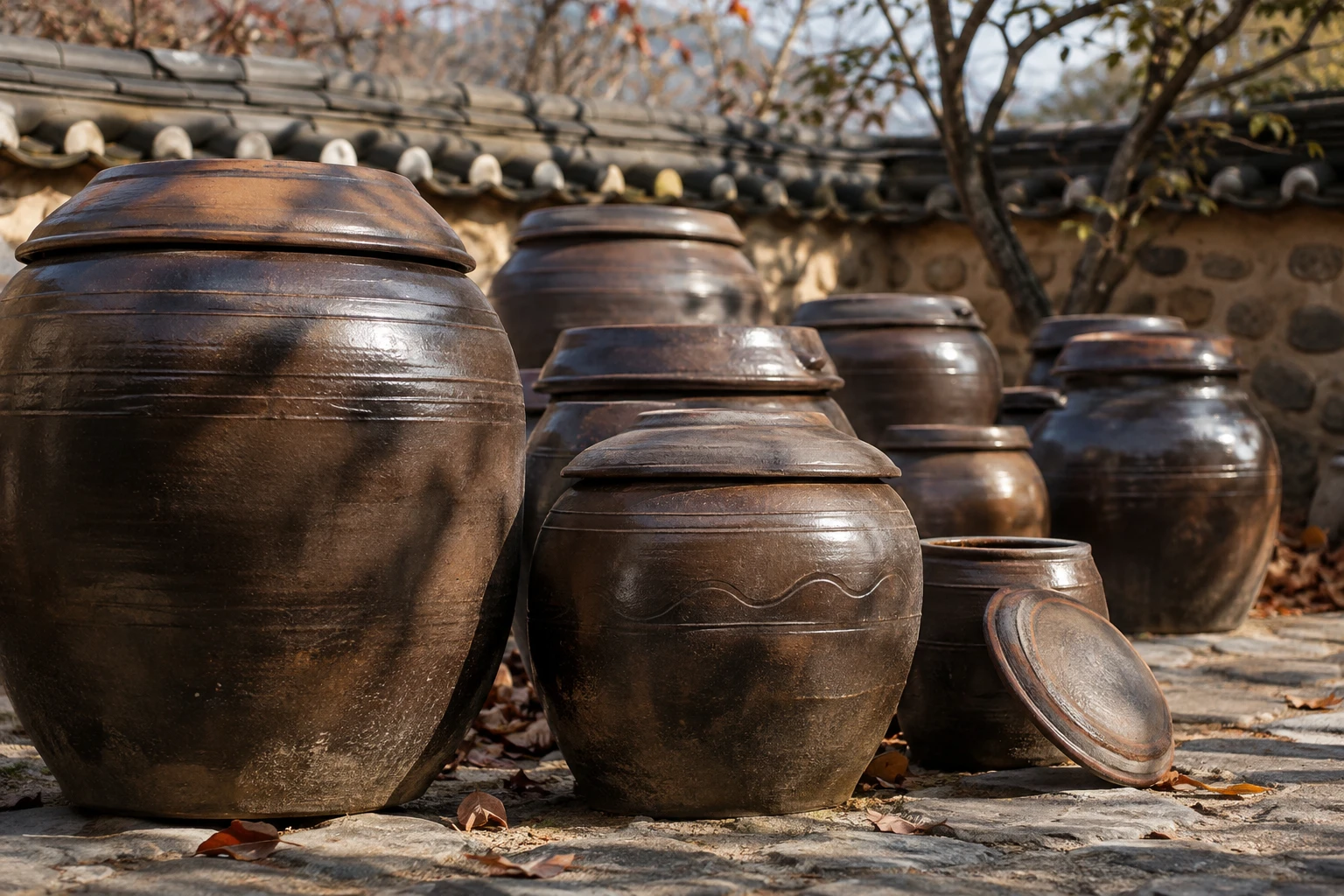
Three containers, three jobs
A bottle of ganjang pours a brown liquid. A tub of doenjang gives up a thick soybean paste with the mark of a spoon left behind. Gochujang is red and dense. Together they belong to the Korean family of seasonings called jang, but their apparent proximity on a shelf hides different preparation and cooking jobs. With doenjang, a cook introduces soybean solids into a soup. With ganjang, liquid spreads over leaves or vegetables. With gochujang, water and other ingredients can turn a concentrated paste into a flowing sauce.
Before asking how long a seasoning fermented, it helps to ask what happened to its material. Cooked beans, a dried block, pieces in brine, separated liquid and a crushed paste can be stages along a connected route. Following the finished foods backwards explains the relationship between soy sauce and soybean paste, and why grains and malt appear in a discussion of a red chili seasoning.
How beans become meju
Meju is material prepared for further jang making, rather than another name for finished doenjang. Korea.net's account describes beans cooked, crushed and formed into blocks that are dried before immersion in brine. Those operations make a workable material out of separate, hard beans: cooking softens them, crushing allows them to gather together, and shaping makes something that can be moved, hung and immersed.
The change has a physical character. Crushed beans contain fragments and softer material. Forming a block creates an outside and an inside. The surface can dry while moisture remains further in; forming the shape is therefore only part of the preparation. Drying, fermentation and attention to the material precede the later brine stage. An apparently simple block already contains several kinds of work.
Historical descriptions also vary. The Korean encyclopedia's doenjang entry discusses a bean-and-wheat preparation in Guhwang boyubang alongside a bean-meju account in Jeungbo sallim gyeongje. The useful point for a reader is that preparation has a history, including choices about ingredients, heating and form. A modern bottle does not by itself reconstruct the material that an earlier household made.
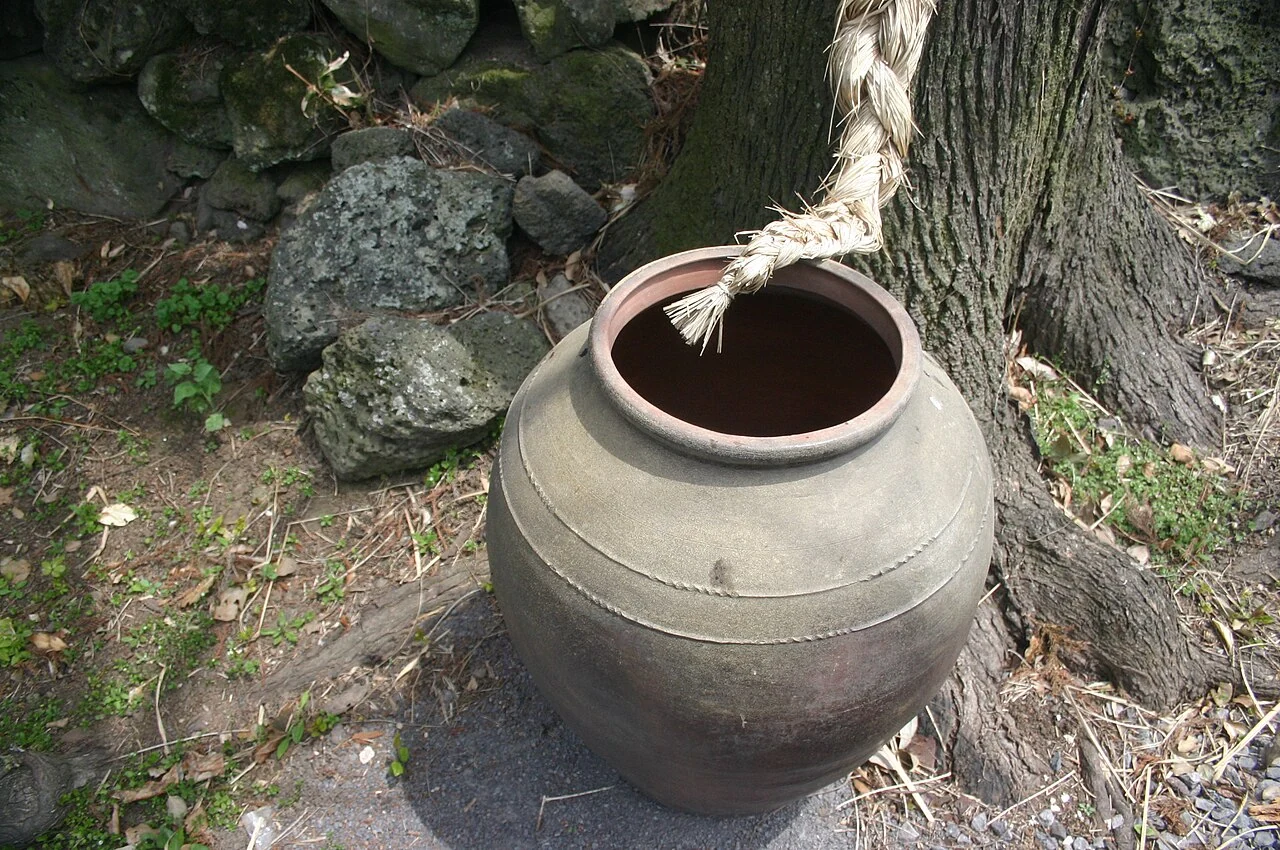
Liquid and solids take different routes
Putting prepared meju into brine begins another stage. In a route that later separates the contents, liquid becomes the basis for ganjang and the remaining bean material becomes the basis for doenjang. Jang gareugi, the separation, is therefore more than dividing one product between containers. It yields materials that behave differently in a kitchen.
Liquid can pass through a narrow bottle opening and disperse in other liquids. Bean solids must be lifted out and worked into a paste. When the paste enters a broth, its small particles enter too. Related beginnings do not give the two foods identical cooking roles.
The encyclopedia also describes doenjang routes without drawing off a separate soy sauce. The separation scene is still a useful starting image: it makes the shared route understandable, while a producer's own account establishes the route for an actual product. In either case, meju is preparation material and the seasoning is the later result.
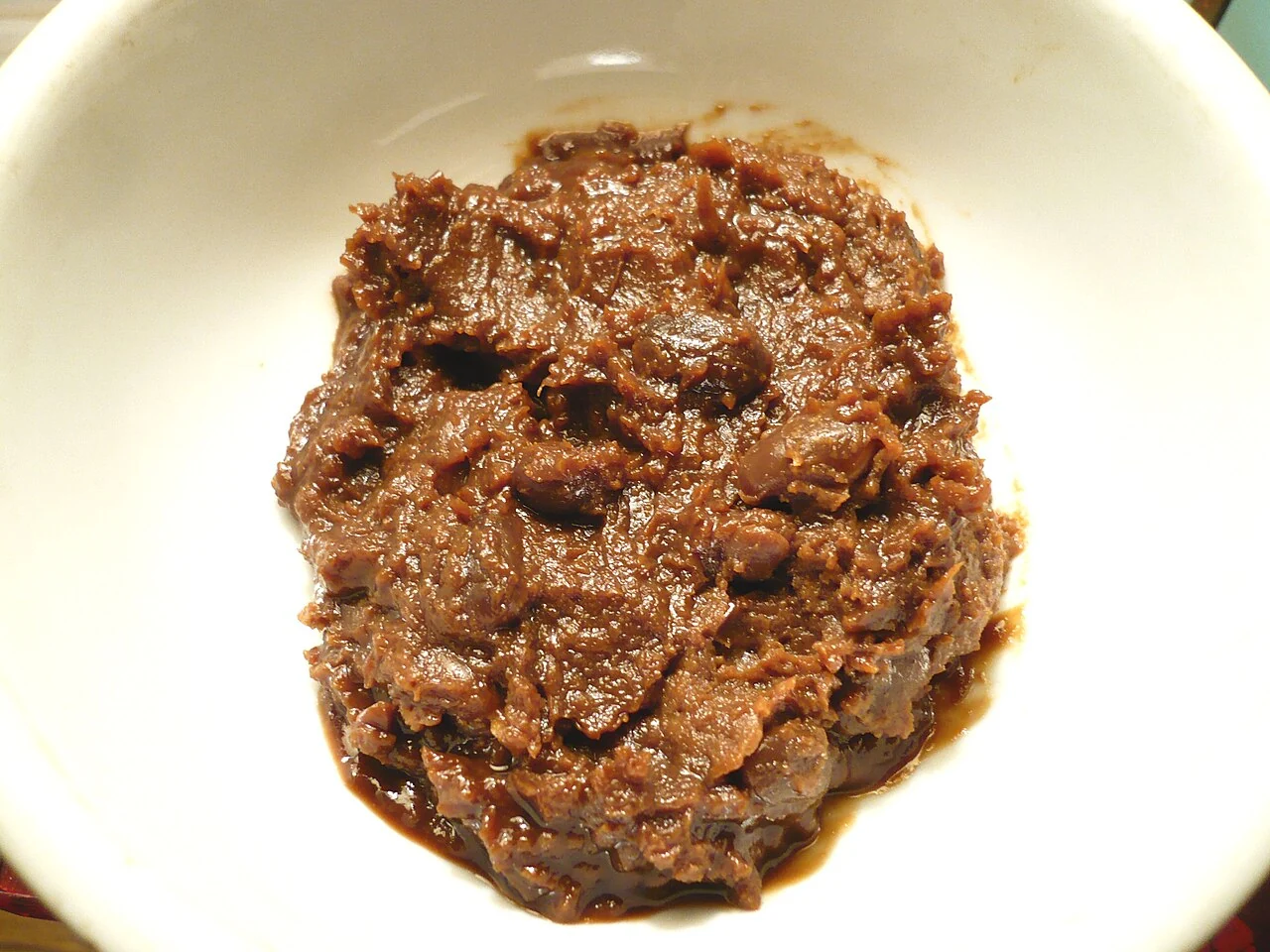
The grain behind a red paste
Chili powder explains redness and pungency, but not the presence of grain. Grain contributes starch; saccharification converts starch into sugars. The agriculture ministry's international-standard explanation identifies malt or microbial action in that conversion before fermentation and maturation. Sweetness can thus involve a transformation of an ingredient, rather than simply adding a ready-made sweetener.
Yeotgireum, malted barley, has a different role from sugar poured into a mixture. The Rural Development Administration's malt material discusses starch-degrading enzymes in germinated barley. Preparing a grain, cooking it and changing its starch are connected operations with different purposes. Following them makes the ingredient list less mysterious.
There are historical and regional routes with other preparations. The gochujang entry describes barley prepared and fermented before mixing into a barley gochujang route that omits malt. That example puts attention on the work before the red paste exists. The longer jang story follows the related documentary and production questions.
The work inside a factory bottle
Modern production offers another visible example. Sempio's brewed-soy-sauce account describes preparation of beans and wheat, inoculation and tank maturation. Beans are cooked while wheat is roasted and ground. Both enter the preparation, but those are different actions on different materials. The process starts with solids, not with brown liquid waiting for a bottle.
In the process Sempio publishes, the inoculated material matures with brine in a tank for six months before pressing. The recovered liquid is briefly heated, cooled and filtered before bottling. Before the press, the material still contains liquid to recover; afterwards, particles remain to remove from that liquid. Tank maturation, pressure-based separation and liquid filtration each give a piece of equipment a specific task.
The name jinganjang also requires context. Its historical use in the ganjang entry concerns older aging and concentration categories, while Sempio describes a modern blended product under the name. The name, ingredients and manufacturer's description together explain the bottle someone has bought. They provide a starting point for cooking rather than an automatic ranking of methods.
What a spoon does next
Doenjang in soup has to disperse through the pot. Working a little paste into some broth makes that change visible: the spoon presses and breaks up a lump before vegetables and tofu join it. The meal contains broth and ingredients, rather than a spoonful of paste on its own. Ganjang used on vegetables spreads as a liquid over their surfaces. Pouring, dissolving and mixing are the kitchen's continuation of the earlier production.
With tteokbokki, gochujang combines with water and other seasonings. The sauce that clings to rice cakes depends on the liquid remaining in the pan as well as the paste added at the start. A prepared gochujang sauce can already include some of that additional preparation. The cook therefore receives a different starting material from an uncombined paste.
These ordinary actions are worth explaining alongside aroma or colour. They allow readers to connect an unfamiliar seasoning to a recognizable cooking job: dispersing a paste, coating a surface or making a sauce. Jang becomes an ingredient someone can use, rather than only an image of Korean fermentation.
Knowledge carried into another meal
The jang-making entry identifies jang in the Samguk sagi account of King Sinmun's marriage gifts in 683. Later records and household work carried preparation knowledge forward. The domestic designation of 27 December 2018 and UNESCO’s 2024 inscription recognize knowledge and practices associated with making jang.
The transmitted skill involves preparing materials, watching their condition and deciding when to proceed. A household or community also distributes work and uses the resulting seasoning through later meals. Kimjang has its own sequence of preparation and sharing; jang frequently becomes the foundation of another dish rather than the stored dish served by itself.
When a spoonful of doenjang enters soup, earlier bean preparation joins another meal. Pouring soy sauce or loosening gochujang creates another such connection. For us, the interest lies in prepared flavour doing fresh work in ordinary food. Once the ingredients and the next cooking action are understandable, three unfamiliar containers become resources for a meal.
Prepared flavour gets another job when a paste enters soup, liquid coats vegetables or gochujang becomes a sauce.
Sources & scope
Jang making: historical records and national designation ↗Doenjang: meju and production routes ↗Gochujang: grain and regional preparations ↗Ganjang: production and historical aging names ↗How Sempio makes brewed soy sauce ↗UNESCO heritage list: Korean jang-making practices ↗2024Soybean-paste making and the proposed national designation ↗2018-11-05Sikhye malt: germination and starch-degrading enzymes ↗2019Gochujang standard: saccharification, fermentation and maturation ↗2020-10-13Modules independently explains the verified sources. The lead image is AI-generated for illustration; it is not a documentary photograph of an actual place, event or product.
Updates & corrections
Dates record changes to this document, separately from the reference dates of its sources.
- Content update
Rewrote the article with fuller production, history, examples and source explanations.
- First published
Created Korean and English documents from verified sources.