Before the photograph of the red hands
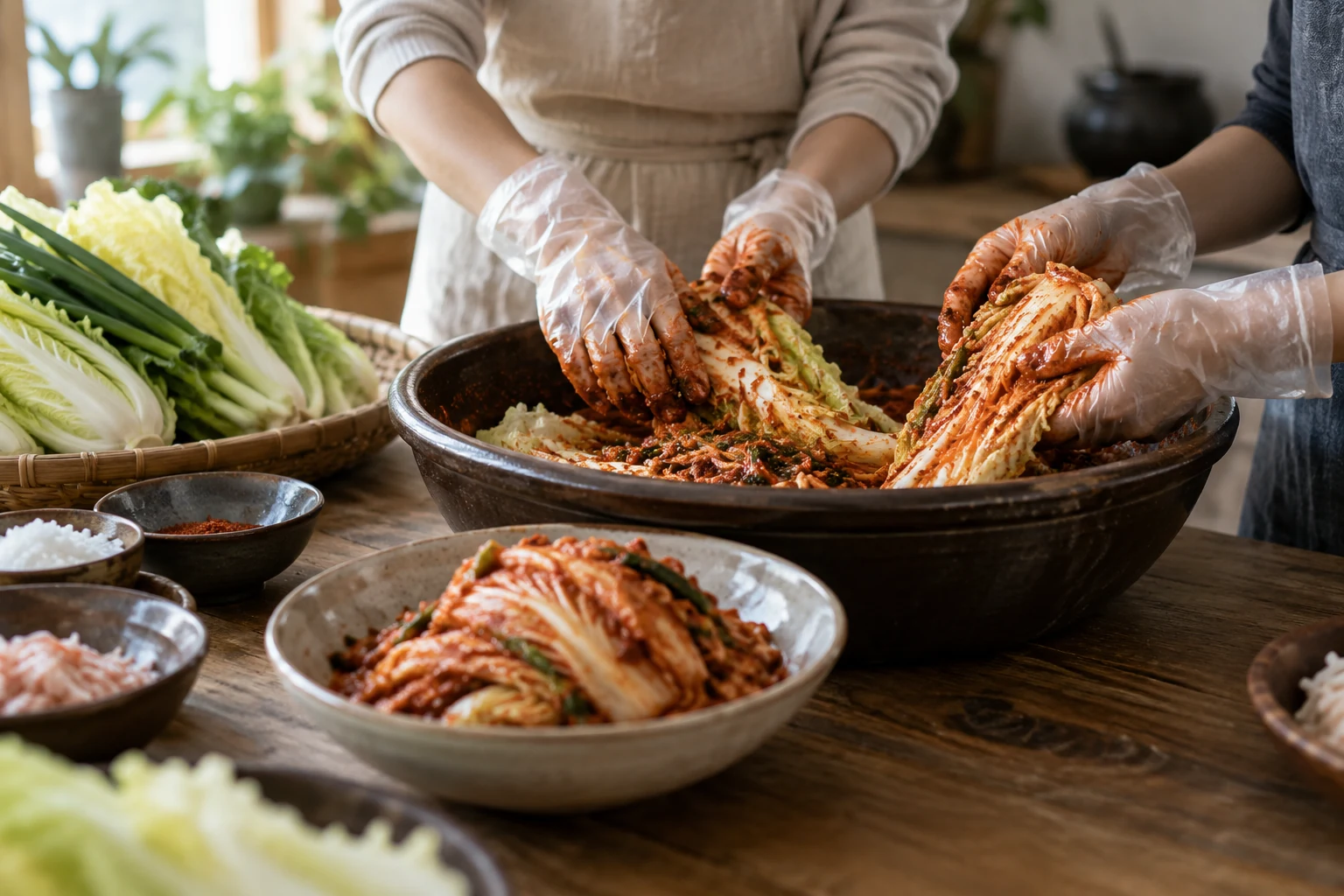
The familiar picture of kimjang shows hands spreading red filling between cabbage leaves. By that moment, much of the work has already happened. Someone has brought in the cabbage and radish, removed damaged outer leaves, salted the cabbage, washed it and found somewhere for the water to drain. However quickly the hands move at the seasoning table, they cannot finish another cabbage until one arrives ready to fill. Preparing a winter supply of kimchi connects several jobs whose starting and finishing times have to fit together.
Containers also shape that work. A portion for tonight, a portion travelling to another household and a supply to be opened later need different arrangements. Knowing how much refrigerator space a recipient has can change how a batch is divided. Alongside the vegetables, a household needs washing water, drainage space, a bowl for the filling and somewhere to put completed containers. Buying salted cabbage transfers some of that preparation to a supplier; it changes the route into the kitchen rather than removing the later work.
Making the thick white ribs bend
A cabbage is not equally thick throughout. Its thin leaf tips fold easily, while the white ribs near the base are firm. Dividing a head opens a route into the inner leaves. During salting, water leaves the vegetable and salt enters its tissues. The leaves become pliable, allowing a cook to open them and add filling without handling a rigid, brittle head of fresh cabbage.
The Rural Development Administration's 2011 Interrobang publication gives an example using quartered cabbage, followed by rinsing and draining in a basket. Rinsing removes excess surface salt and cleans between the leaves. Draining removes the water clinging to the cabbage before seasoning. If wet leaves carry too much water into the filling bowl, liquid collects below them and changes the mixture's consistency. Time spent draining can overlap with the preparation of radish and aromatics.
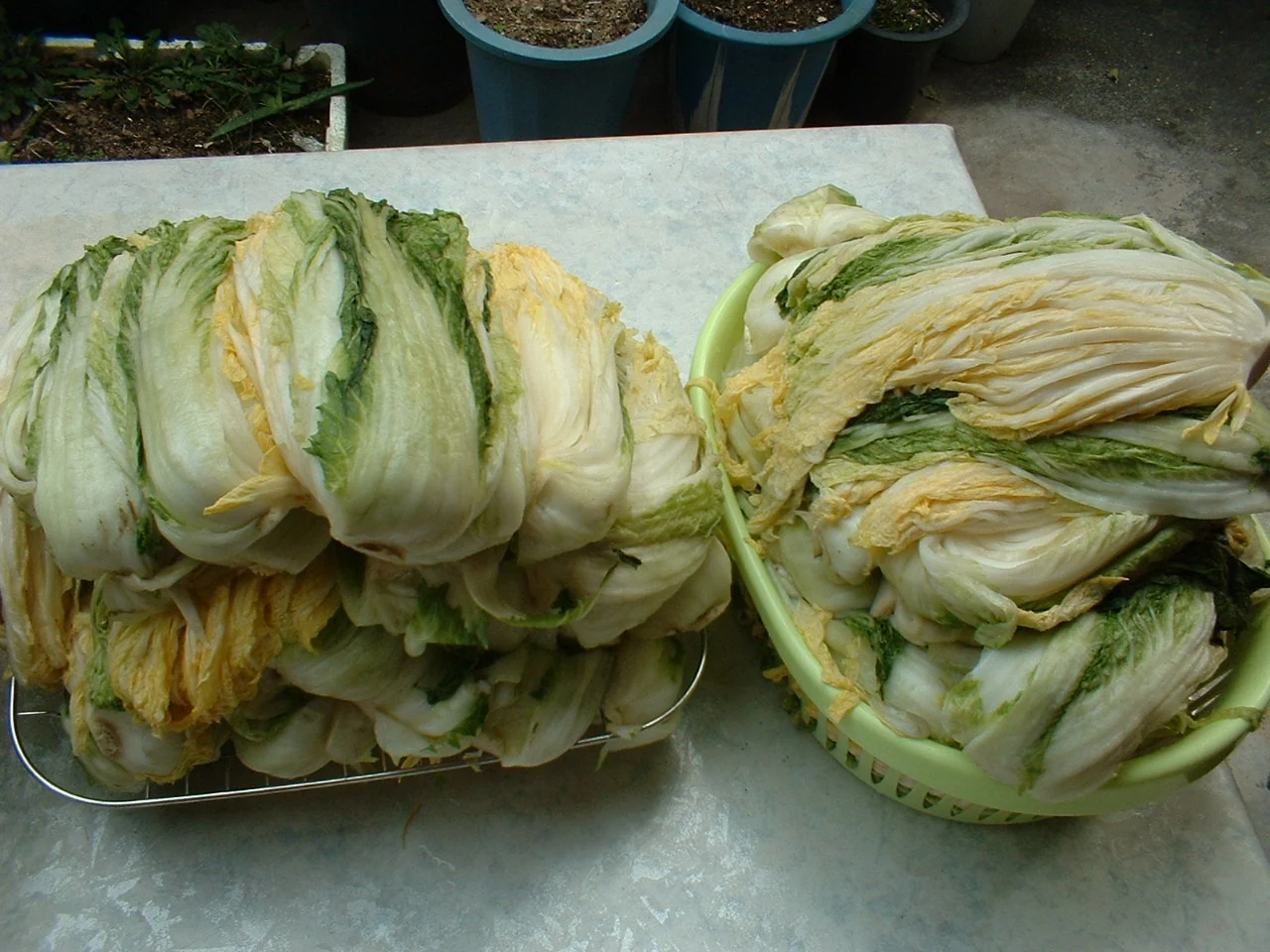
In the documentary photograph accompanying this article, pale cabbage leaves are stacked on draining baskets before red filling has been applied. Purchased salted cabbage may already have undergone washing; its producer's handling instructions determine the next step. A delivery of prepared cabbage and a fresh head at the beginning of the salting process reach the table by different routes.
The filling does more than make cabbage red
Different ingredients contribute different things. Radish cut into thin strips fits between the leaves and provides another texture. Scallions and mustard greens add their own aromas and bite. Minced garlic and ginger spread through the mixture, while chilli powder supplies colour and heat. Fish sauce or chopped salted shrimp contributes saltiness and savoury flavour. Adding more chilli does not supply all those functions at once.
Where rice paste is used, rice or flour is cooked with water to form a thickened base. Once cooled, it helps bring powder and chopped ingredients into a mixture that can be spread over the leaves. Radish releases moisture after mixing too. The person preparing the filling therefore works with the salt already present in the cabbage and the water that the vegetables will release, as well as the taste of the mixture in the bowl.
The RDA publication's cabbage-kimchi example combines radish and green vegetables with seasoning. Its white-kimchi example uses a filling without red chilli and adds kimchi liquid; its dongchimi preparation places radish and aromatic ingredients in brine. Winter provision can include a leafy kimchi with filling and another kimchi whose liquid is part of the meal. Their differences remain visible in how they are assembled and eaten.
Open, spread, fold and move to the next container
The cook lifts successive leaves, spreading filling over the thicker ribs and towards the tips. Radish strips are distributed rather than left in one heap. Colouring the outside alone leaves the inner layers untouched. A long outer leaf can then wrap the seasoned cabbage into a manageable bundle.
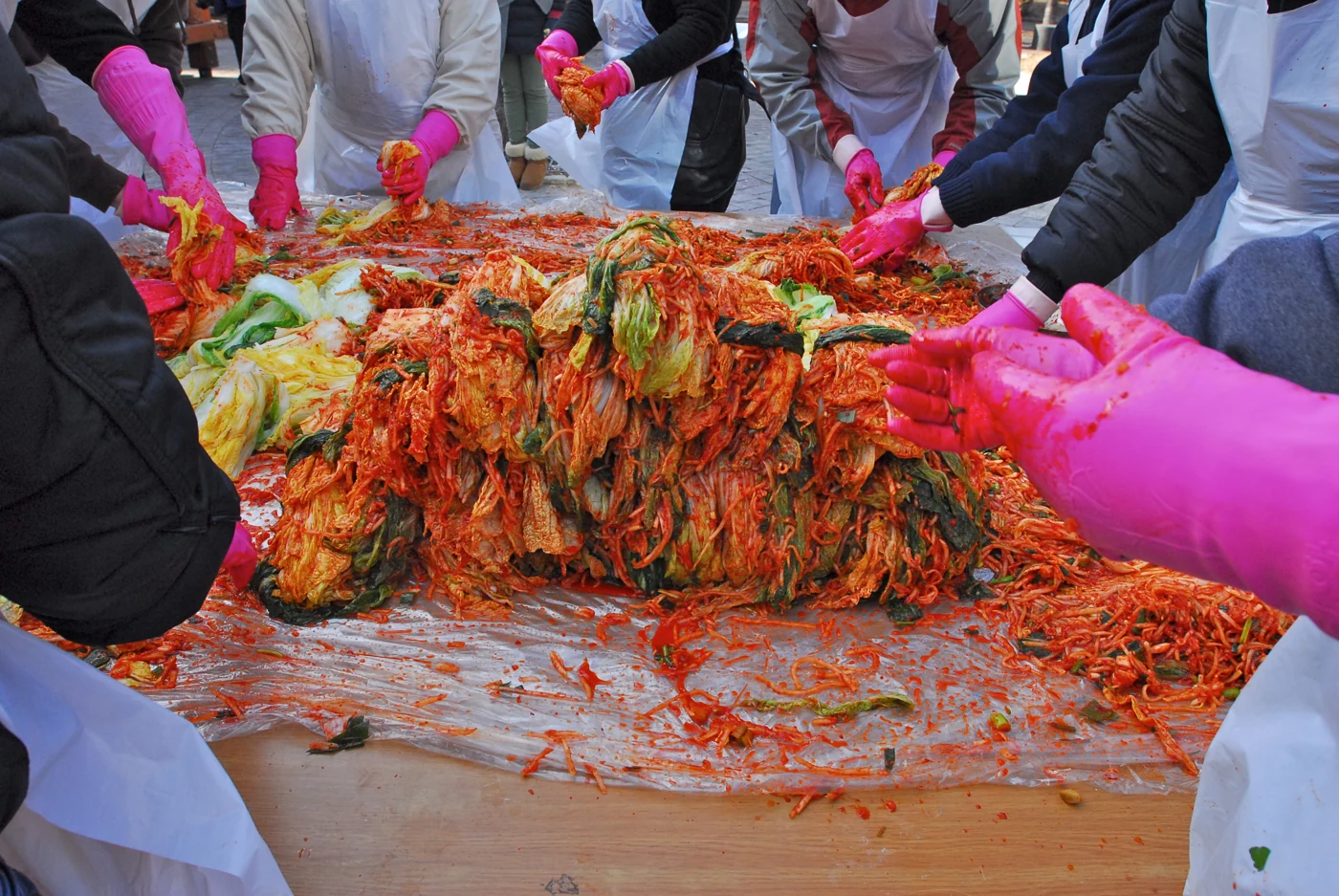
A photograph taken in Gaemi Village on 1 December 2012 shows pink-gloved hands, a broad shared work surface, filling mixed with radish strips and a central pile of cabbage. It records a particular group making kimchi together. Separate jobs help the work move: hands covered in filling can keep working on leaves while someone else moves containers and deals with clean handles. The route from the filling table to storage matters as much as the number of people seated around it.
Folded cabbages are arranged to reduce large gaps, with room left according to the container's instructions for liquid and fermentation. Dividing the supply into smaller containers makes it easier to take out a portion without repeatedly opening the largest one. Washing baskets and bowls and clearing the floor remain part of the day after the last cabbage has been packed.
What happens after the lid closes
Fermentation continues to alter the prepared food. Microbial activity produces organic acids and develops sourness. Ingredients, salt and temperature affect the pace. Two containers packed on the same day can reach different stages if one stays warm while the other is refrigerated.
A 1996 study by Shin Dong-hwa and colleagues followed factory-produced kimchi at different temperatures. Its abstract reports that the samples reached pH 4.2 after two days at 25°C, three days at 15°C and 23 days at 5°C. These are results for that experiment, showing a concrete difference in the time taken under cooler conditions. They explain why temperature affects the next meal without providing a universal timetable or a preferred flavour for every household.
Freshly mixed kimchi has crisp vegetable texture and individually noticeable seasoning aromas. As it ripens, acidity becomes more integrated into the food. Sour kimchi can be chopped and cooked in a pan before rice is added for fried rice, or simmered with meat or tofu to give a stew its base. One batch becomes material for several meals as its taste changes. Winter preparation extends beyond the moment of packing.
Older records contain work as well as recipes
The Encyclopedia of Korean Culture's article on kimchi making describes cucumber, aubergine, radish, winter melon and scallion preparations in Sangayorok, compiled around 1450, along with quickly prepared kimchis. That list offers a different view from today's dominant image of a red cabbage bundle. Earlier preserved vegetables included several materials and methods.
The tenth-month section of Nongga wollyeongga describes harvesting radish and cabbage, washing them, preparing kimchi and protecting storage jars with straw and burial against freezing. Harvest, seasoning and winter storage belong to the same sequence. The encyclopedia also describes food served to those helping with kimjang, including cabbage soup and boiled pork, and the sharing of fresh seasoned kimchi with neighbours. A demanding production day contained a meal of its own.
Share the work that remains
Kimjang entered UNESCO's Representative List in 2013. Korea designated kimchi making as national intangible heritage on 15 November 2017, without recognising a single designated holder or holder group, reflecting a widely transmitted everyday practice. Practical knowledge can move through showing someone how a salted rib bends or how filling is distributed, as well as through a written recipe.
The less picturesque jobs deserve attention too: carrying water, lifting containers and cleaning bowls. If the finished food goes to several homes but the clearing away stays with one person, the next winter's work becomes heavier for that person. Buying salted cabbage or reducing a batch can make continued preparation manageable. Sharing starts before a filled container changes hands, when people divide preparation and clearing away too.
A piece of cabbage taken out for a winter meal has passed through brine, hands and a storage container. Those material steps make an ordinary side dish worth looking at again. Follow its place in everyday meals in the kimchi and kimjang story and its company at the table in the story of banchan.
A winter supply connects cabbage preparation, filling, storage and later meals; sharing the food also means sharing the preparation and clearing away.
Sources & scope
Records and transmission of kimchi making ↗2024-05-28Cabbage, white kimchi and dongchimi preparations ↗2011-11-09Filling cabbage leaves during kimjang ↗Commercial kimchi fermentation at different temperatures ↗1996The 2013 announcement of UNESCO inscription ↗2013-12-05Modules independently explains the verified sources. The lead image is AI-generated for illustration; it is not a documentary photograph of an actual place, event or product.
Updates & corrections
Dates record changes to this document, separately from the reference dates of its sources.
- Content update
Rewrote the article with fuller production, history, examples and source explanations.
- Document connections
Organised representative-document links, search descriptions, paragraph links and revision history. No factual correction.
- First published
Initial creation of the Korean and English document.