Hangul is a script; Korean is a language
Hangul is the writing system used to record Korean. Korean is the language people speak and understand. Learning the letters does not instantly provide the meanings of unfamiliar words, grammar or conventions of politeness. A child can speak Korean before learning to write it. Keeping the two categories separate makes the achievement of learning the script easier to describe accurately.
Hanja means Chinese characters used in Korean contexts. A Korean word with a historical Chinese-character origin can be written in Hangul. Script and vocabulary origin are therefore different classifications. Hangul, Korean, Hanja and Sino-Korean vocabulary should not be treated as interchangeable names.
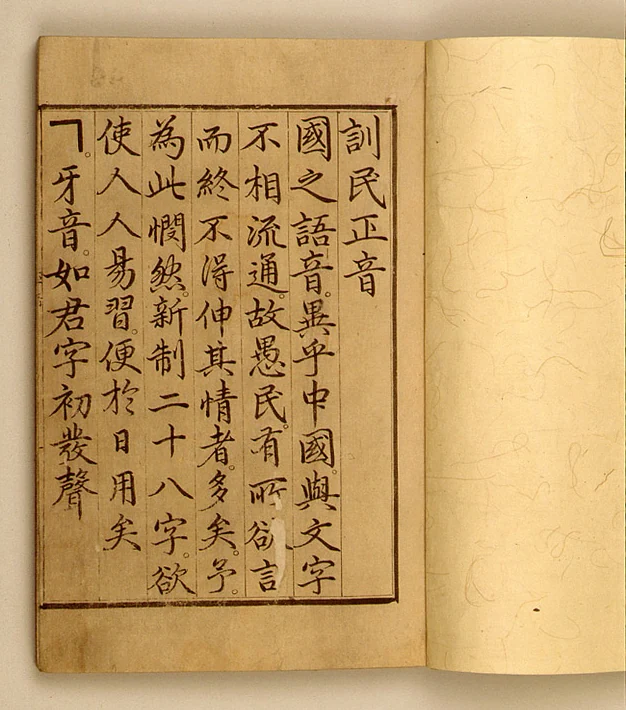
Hunminjeongeum can mean the script or its book
King Sejong created the script in 1443; its explanatory book was completed in 1446. Hunminjeongeum can identify either, depending on context. These dates should be attached to the appropriate event rather than used as alternatives for a single undifferentiated invention date. They do not establish the exact day on which promulgation occurred.
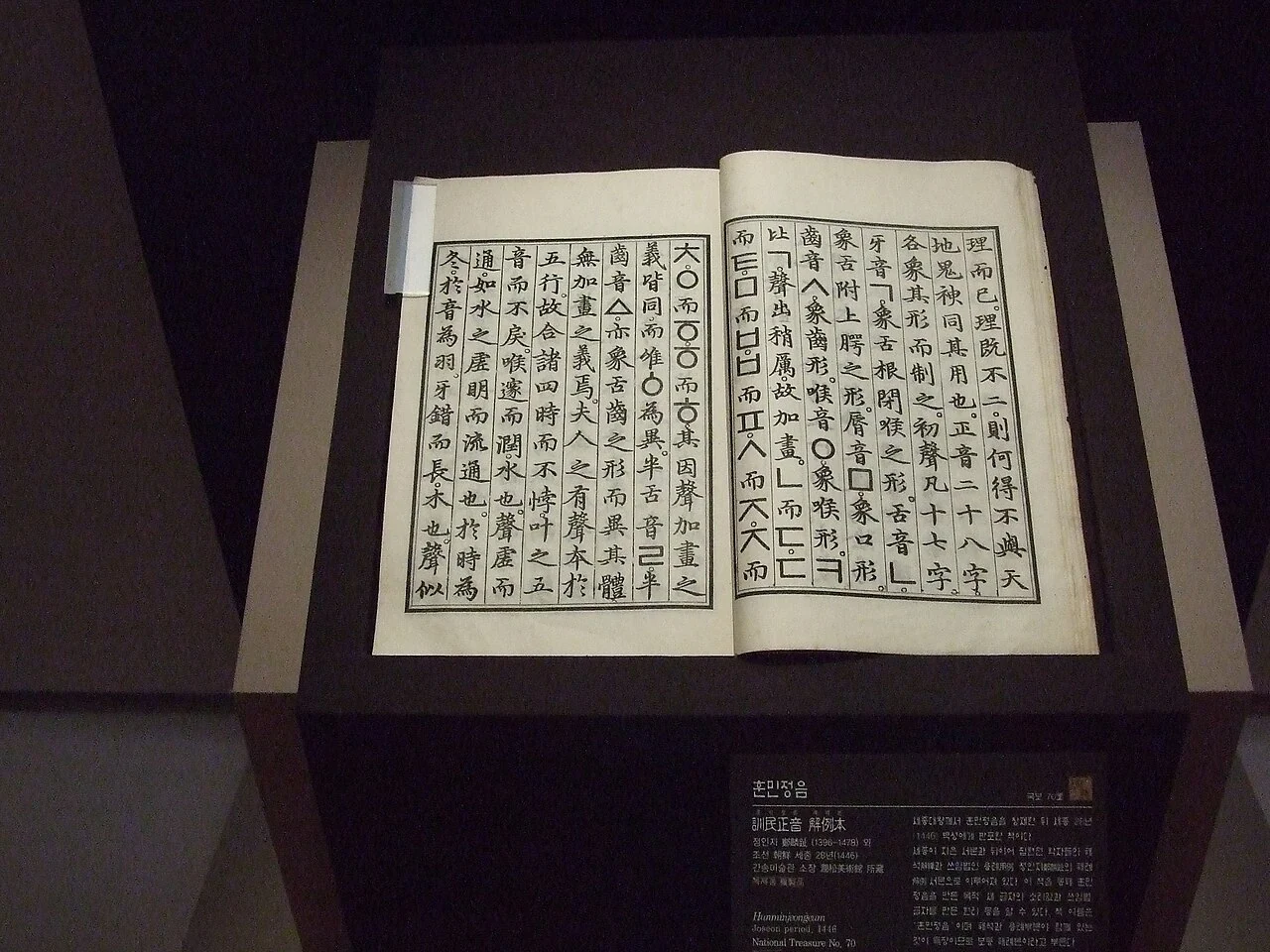
The Hunminjeongeum Haerye explains the system and its purpose. It was entered in UNESCO's Memory of the World Register in 1997. That recognition concerns a documentary heritage item, not the Korean language as a whole or every modern font. The longer story of Hangul in changing media connects the invention to correspondence, print and digital reading.
The Haerye is a woodblock-printed book of 33 leaves, not a single alphabet chart. Its introductory Yeui explains sounds and use; the explanations then address design, initials, vowels, finals, combination and word examples. Reasons for a shape, placement within a syllable and actual words occupy different parts of the book. The surviving Gansong copy became known around 1940; its missing first two leaves were subsequently supplied by hand. Printed pages and later handwritten replacements consequently coexist within one object.
Five shapes linked to the organs of speech
The basic consonants were not simply chosen as unrelated drawings. The National Institute of Korean Language connects ㄱ with the back of the tongue contacting the soft palate, ㄴ with the tongue tip contacting the upper gums, ㅁ with closed lips, ㅅ with the teeth and ㅇ with the throat. This is an explanation of the historical design. It does not imply that every description from the fifteenth century maps unchanged onto a modern phonetics lesson. Its material point is that the movement producing speech helped organize the written forms.
Compare ㄴ, ㄷ and ㅌ: strokes are added. Related shapes also connect ㄱ and ㅋ, ㅁ and ㅂ, and ㅅ and ㅈ. A new letter keeps a visible relationship with an existing one instead of becoming a completely independent picture. Modern ㄱ, ㅋ and ㄲ represent distinct sounds; adding a stroke and doubling a sign produce different visual relationships. Their phonetic contrast is not adequately explained as merely speaking softly or loudly. Aspirated and tense consonants require listening and practice in actual words.
For a reader, the design offers something specific to look for. Compare the line retained in ㄴ with the line added in ㄷ, rather than memorizing each as an arbitrary silhouette. Linking closed lips to the square of ㅁ also turns an abstract chart into a record of how a speaking body was analyzed. The shapes invite comparison, even before all their sounds have become familiar.
Vowels: a point, a horizontal line and a standing line
The historical basic vowel signs were ㆍ, ㅡ and ㅣ. They symbolized the round heaven, flat earth and an upright person, drawing on the idea of three foundational elements. This describes the design's historical framework, not a philosophical method for predicting all modern pronunciations. The point sign ㆍ is not in the modern basic inventory.
Placing the point above or below ㅡ produced ㅗ and ㅜ; placing it to the right or left of ㅣ produced ㅏ and ㅓ. In modern printed shapes the point appears as a short stroke. Doubling that element gives the relationships seen in ㅑ, ㅕ, ㅛ and ㅠ. In ㅘ and ㅝ, the combined forms of ㅗ plus ㅏ and ㅜ plus ㅓ remain visible. The direction and position of a short stroke are meaningful distinctions even when a designer changes the font's weight.
Now compare 가 and 과. The compound vowel ㅘ uses both horizontal and vertical areas, so the initial ㄱ occupies a different proportion of the block. Add final ㄴ to obtain 관: the final belongs beneath the combined initial-and-vowel arrangement. The parts are redistributed within the same syllable space. This is why Hangul typography involves relationships and proportions, not simply putting three isolated shapes inside a square.
Why 24 and 28 are both encountered
The modern basic inventory contains 14 consonant letters and ten vowel letters, a total of 24. The consonants are ㄱ ㄴ ㄷ ㄹ ㅁ ㅂ ㅅ ㅇ ㅈ ㅊ ㅋ ㅌ ㅍ ㅎ; the vowels are ㅏ ㅑ ㅓ ㅕ ㅗ ㅛ ㅜ ㅠ ㅡ ㅣ. Counting doubled consonants and vowel combinations for their roles in modern syllables gives different totals.
The original 28 included ㆆ, ㅿ, ㆁ and ㆍ, absent from the modern basic inventory but encountered in historical texts. Replacing the marked ㆁ with modern ㅇ, or ㆍ with ㅏ, changes the original spelling. Fonts and conjoining characters for historical writing therefore have actual work to do. An inventory of basic letters is different from a total of syllables: ㄱ is one component, while 가 combines ㄱ and ㅏ in a block.
Initial, vowel and final positions
Hangul represents consonants and vowels separately but arranges them in syllable blocks. The initial consonant position is called choseong; the vowel position jungseong; the final consonant position jongseong. A written final consonant is commonly called batchim. 한 contains ㅎ+ㅏ+ㄴ, while 글 contains ㄱ+ㅡ+ㄹ. The plus signs describe the parts; ordinary writing displays the combined blocks.
Compare 가 and 고. A primarily vertical vowel such as ㅏ is placed beside the initial consonant; a primarily horizontal vowel such as ㅗ goes below it. A final consonant occupies the lower part of the completed block. 간 and 곤 illustrate the arrangement with ㄴ added. A reader looks for letters with roles, rather than memorizing each entire block as a picture with its own meaning.
Initial ㅇ in 아 fills the initial position without adding a consonant sound. Final ㅇ in 강 represents the nasal sound often written ng in romanization. Position matters even when the component's visible shape looks the same.
A written final is not a complete pronunciation lesson
Batchim identifies a consonant at the bottom of a syllable block. Which letter is written there and how a word sounds in connected speech are related questions, but they are not identical. Adjacent sounds affect Korean pronunciation. The spoken form of 같이, pronounced [가치] (gachi), for instance, cannot be fully explained by assigning an unchanged sound to every letter in sequence.
꽃, “flower,” is pronounced [꼳] alone, 꽃이 as [꼬치], and 꽃만 as [꼰만]. The following component changes the ending sound, but the written noun remains 꽃. Replacing every sound change with a new spelling would split the same noun into different visible forms. Orthography carries word relationships as well as sound. A syllable heard differently from expectation while following printed lyrics can be explained through these connections.
Keyboard, input method, font and encoding
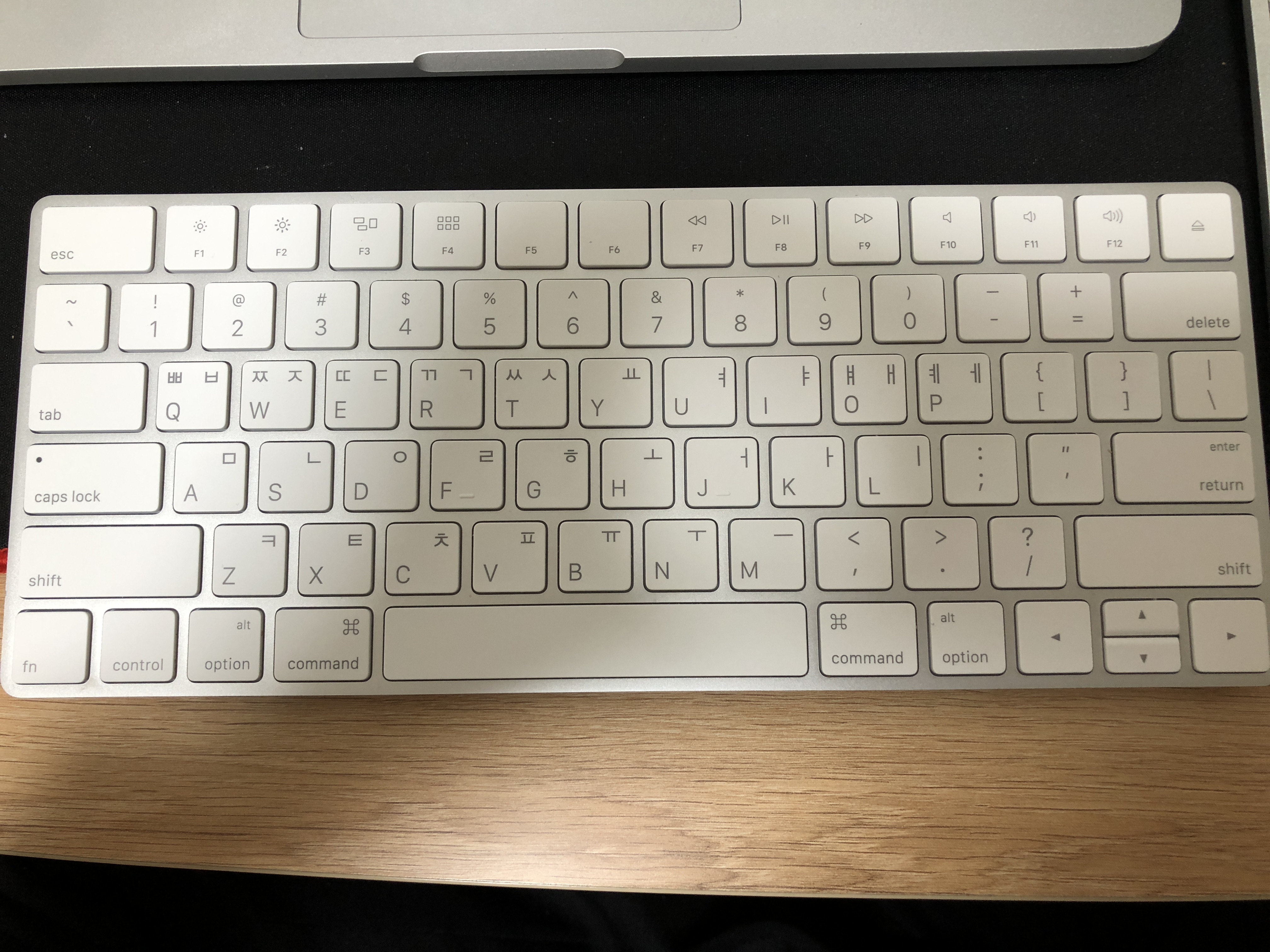
A keyboard layout determines which actions the user can make. An input method interprets those actions and composes syllables. A font determines the visible forms used to draw the text. Different fonts can display the same encoded characters, and transmitting text is not the same thing as sending an image of its letters.
Unicode includes 11,172 precomposed modern Hangul syllables. The total comes from 19 initials × 21 vowels × 28 final possibilities; the final possibilities include no final consonant. It counts a character repertoire, not Korean words or basic letters. Conjoining jamo and their rules also matter, particularly for forms beyond the modern precomposed inventory.
One visible 한, one code point or three
The visible syllable 한 can be stored as the precomposed Unicode character U+D55C. It can also be represented by conjoining initial ᄒ (U+1112), vowel ᅡ (U+1161) and final ᆫ (U+11AB), in that order. Those conjoining characters are not encoded identically to the separate compatibility signs ㅎ, ㅏ and ㄴ often printed on learning charts. Similar visible forms do not necessarily mean identical codes.
Unicode normalization connects the representations by a standard rule. NFD decomposes this syllable into the three conjoining characters; NFC can compose the appropriate sequence into the precomposed syllable. A program that compares only raw character sequences may therefore see a difference where a person sees the same name. Software handling search strings and filenames needs to account for such representations. The reader need not memorize code numbers to understand the consequence: a displayed block relies on agreed rules beyond its outline.
Composition during typing is another operation. With a two-set Korean input method, entering ㅎ, ㅏ, ㄴ and then ㅏ can turn the initially composed 한 into 하나, as the final consonant becomes the next syllable's initial. The input method manages a boundary still being typed; the font draws the resulting text. Normalization relates encoded representations of a syllable, while an input method revises an active sequence of keystrokes. Distinguishing those jobs explains both why a letter changes while typing and how the completed text can travel between devices.
Letters inside a balloon or title
In a narrow webtoon balloon, type size and line count work together. 가 and 관 each occupy one syllable position, yet contain different arrangements and numbers of strokes. Making lines too heavy reduces small openings inside 관; shrinking the text narrows spaces needed to distinguish components. Layout and font consequently influence the sequence in which dialogue is read on a screen.
An original title beside an English edition, jamo on a keyboard and blocks in a balloon place the same script in different settings. Initial, vowel and final relationships have to survive both typing and drawing in a small space. Our editorial interest lies in how an old design continues to address those concrete problems on today’s compact screens. Titles and dialogue within K culture today bring together the movements of speech, the arrangement of letters and rules for storing text.
Hangul's appeal lies in basic elements becoming actual names and sentences.
Sources & scope
Dating Hangul creation and its explanatory book ↗Hangul letters and syllable structure ↗Hunminjeongeum: a millennium of writing ↗Hunminjeongum Manuscript ↗Unicode 16.0, Chapter 3: Conjoining Jamo Behavior ↗Hangul consonants: speech organs and added strokes ↗Historical vowel signs and combinations ↗The Hunminjeongeum Haerye: contents and surviving copy ↗2026-01-06Historical Hangul: the four old letters ↗Flower: pronunciation forms ↗Apple Magic Keyboard with Hangul and Latin key labels. © revi, photographed on 23 January 2018.
© revi · CC BY 2.0 KR · Original JPEG used without modification