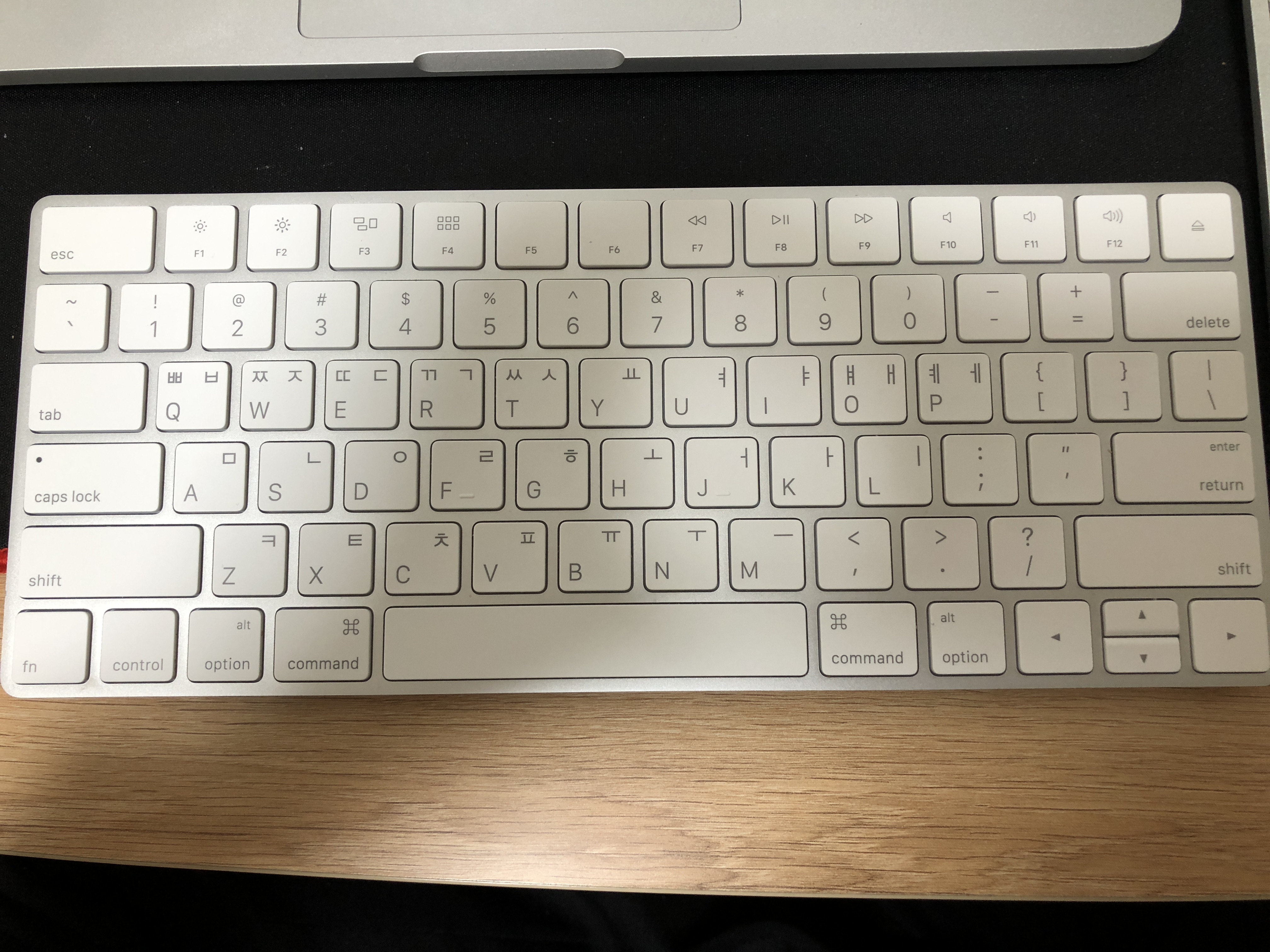
Before a letter is finished
Enter ㄱ, ㅏ and ㄴ in sequence using a Korean two-set input method. The screen ordinarily constructs 간. Add ㅏ and it can redistribute the last consonant to produce 가나. What appeared to be a final consonant becomes the beginning of the next syllable. A printed page presents the completed result. An input box exposes the time in which the boundary between syllables is still being decided.
Several systems participate. A keyboard layout assigns actions to keys; an input method interprets their sequence and assembles letters; a font draws the resulting characters. Seeing 간 does not necessarily mean that syllable has been committed. While composition remains active, the next vowel can alter its boundary. A handwritten block and a block being typed share an organisation but have different production processes.
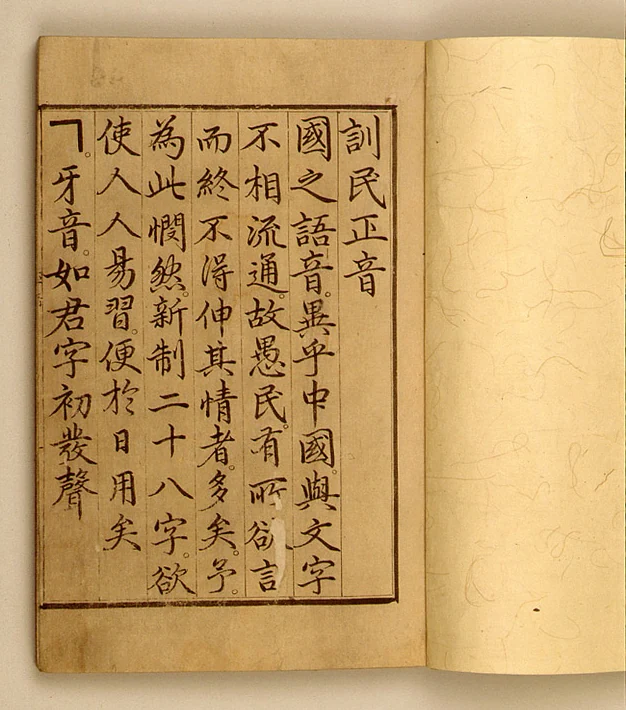
Our Hangul reference introduces the components. This story follows the things that deliver them to another reader: an explanatory book, printing machinery, editorial meetings and character data. After inventing letters, people still had to produce useful texts and ways of reading the same writing in different places.
What did the thirty-three-leaf book explain?
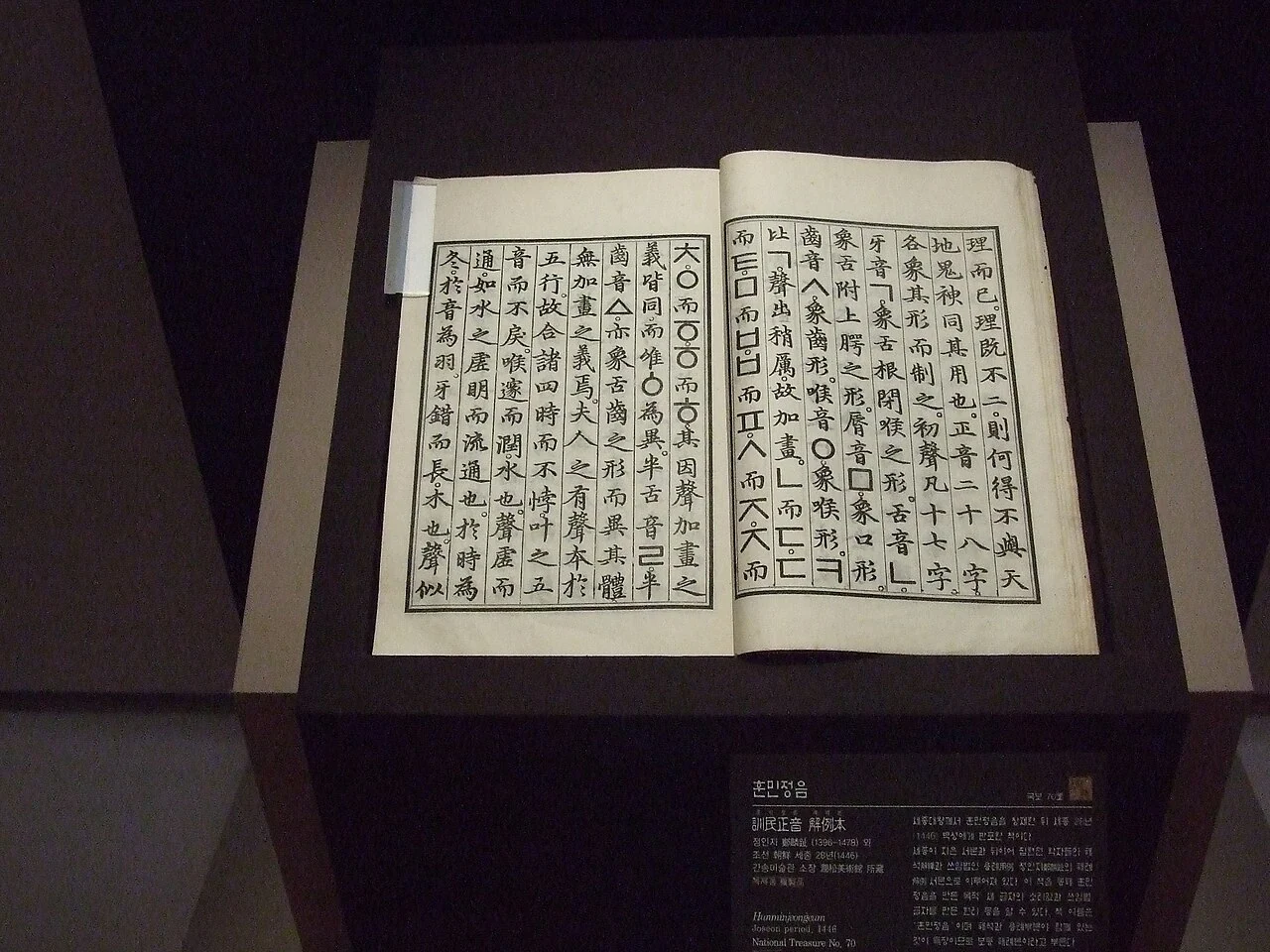
Sejong created the script named Hunminjeongeum in 1443; its explanatory book was completed in 1446. Distinguishing script from book turns the dates into design and explanation, rather than rival birthdays. Korean speakers already existed. What was newly made was a means of writing their language, not the language itself.
The Encyclopedia of Korean Culture describes the surviving Haerye volume as thirty-three leaves printed from woodblocks. Its Yeui section presents the purpose, sound values and operation of the letters. The explanations then address letter creation, initial consonants, vowels, final consonants, combination and examples of written words. A preface by Jeong Inji closes the volume. These are different tasks: explaining why an element has its shape, where a sound belongs and how elements become writing.
The combination section is more than a catalogue of finished shapes. Separate 한 into ㅎ, ㅏ and ㄴ, or 글 into ㄱ, ㅡ and ㄹ, and reusable components emerge. The book moves from parts to combinations and applications. That sequence has a recognisable counterpart in today's input box.
The object also preserves transmission work. Its first two leaves were missing and later supplied by handwriting, with mistakes in the replacement. Woodblock printing and handwritten restoration coexist within the surviving volume. A book can carry both the explanation of a system and evidence of somebody trying to repair its physical gaps.
A press and three sets of type
The Independent newspaper began publication on April 7, 1896. Looking beyond that date reveals machinery. Its encyclopedia account records Seo Jaepil buying a press and Korean, Chinese and English type in Osaka with government support, then establishing the newspaper in a government-owned building in Seoul's Jeongdong. A writer alone could not produce an edition: machinery, type and working space belonged to the operation.
The initial paper measured 22 by 33 centimetres and contained four pages. Three were Korean and the fourth English. It appeared on Tuesdays, Thursdays and Saturdays. Alongside editorials, official notices and foreign reports were prices, postal schedules, steamship arrivals and departures at Jemulpo, and advertisements. Written language was turned into selected information, arranged within a limited area and printed repeatedly for readers.
Ju Sigyeong handled Korean editing and production. Hangul-only text, spacing and accessible Korean were concrete editorial decisions. The paper's manufacture organised news and practical information for people reading Korean, rather than requiring literary Chinese throughout. This describes a production choice, without making one publication responsible for everyone's literacy. In 1897 the English edition became a separate four-page newspaper: the script could persist while the format and audience-facing contents changed.
The spaces that do not get printed
Consider 나는 오늘 학교에 간다: roughly, “I go to school today.” The particle 는 remains attached to 나, and 에 to 학교, while spaces separate the resulting words. A space is not a pronounced letter, but helps the eye locate units in a sentence. An uninterrupted string and a spaced line give the reader different work.
Spacing therefore is not merely using slightly less ink. Where type is not placed also structures a page. A private correspondent may use personal habits; a newspaper combining several writers must organise those habits on a shared surface. Editorial consistency has a physical expression in blank areas between words.
The distinction remains on a screen. An input method assembling 가나 has not thereby determined all the word boundaries of a sentence. Syllable composition and word spacing are separate stages. The writer builds a sentence; editing organises its progression for another person. Displaying syllables solves one problem, not the whole practice of writing.
The 1933 rules came through revisions
The Korean Language Society's unified orthography proposal did not spring fully formed from one person's desk. The encyclopedia traces a decision in late 1930, a draft completed in late 1932, deliberations by eighteen committee members in Gaeseong, revisions, and further meetings at Hwagyesa in summer 1933. Implementation was agreed on October 19 and the proposal published on October 29. Drafting, scrutiny and revision were successive processes.
Three general principles led into seven chapters containing 63 articles, followed by two appendices. The subjects included letters, sounds, grammar, Sino-Korean words, contractions, foreign-word spelling and spacing. The work coordinated an existing script rather than creating a new alphabet: how to recognise words, connect particles and endings, and divide sentences.
Specific spellings show the decisions. The account describes choosing 오빠 rather than 옵바, 빨리 rather than 빨니, and 굳이 rather than 구지. The last retains a word's written form instead of replacing it with a surface pronunciation. Rules concern what information a reader receives, not merely the simplicity of individual letter shapes. Subsequent revisions connect the 1933 document with present norms; that year did not freeze every detail permanently.
Two representations of the same 한
Digital text can transmit character data rather than a picture of writing. The visible 한 can be represented by the precomposed syllable U+D55C, or by conjoining letters U+1112, U+1161 and U+11AB: ᄒ, ᅡ and ᆫ. One visible syllable can therefore correspond to one encoded unit or several combining units.
Unicode normalisation handles these representations. Applying NFD to 한 yields those three letters; NFC recomposes the result as 한. These actual character operations can be checked directly. They differ from an input method moving ㄴ into the next syllable after receiving a vowel: one works on existing data, the other organises writing still in progress.
Modern precomposed syllables: 19 initials × 21 vowels × 28 final positions (including none) = 11,172. The total is an encoded combination range, not a count of Korean words. Shared representation makes exchanging text across devices possible. Under the visible block lies another set of production tasks involving codes and composition.
A speech bubble gives a font work
In a webtoon, dialogue occupies part of a drawing. Compare 가 and 관 within equal outer squares. 관 needs space for a compound vowel and a final consonant. A font adjusts stroke lengths and intervals within that area; copying every component at an unchanged proportion can crowd the interior. Reusable letters do not mean identical pasted pictures.
Fitting a sentence into a narrow bubble also involves choices. Shrinking type may fit the text while reducing internal spaces; changing line breaks changes the sequence and pauses of reading. A longer translation can require a different bubble or arrangement. Meaning and visual composition work together, but each needs its own decisions.
Subtitles add time. A reader can revisit a bubble before advancing a page, while a playing subtitle changes with the scene. Size, lines and duration organise another set of reading conditions. The letter system persists while the work of presenting it changes with the medium.
Remembering the work after invention
To me, the richer Hangul story goes beyond praising a small alphabet. Someone explained combinations in a thirty-three-leaf book; others acquired presses and type, organised blank space, negotiated spelling examples, and divided digital input from storage and drawing. Each performed a different job in delivering writing to another person.
A book's leaves, four newspaper pages, 가나 in an input box and 관 inside a bubble differ in scale, but expose production. The script supplies possibilities; contents, conventions and media make actual texts. Its long history contains the making and revising of things worth reading, as well as one original design. Writing a sentence on a screen continues that practical work.
A book's leaves, four newspaper pages, 가나 in an input box and 관 inside a bubble differ in scale, but expose production. The script supplies possibilities; contents, conventions and media make actual texts. Its long history contains the making and revising of things worth reading, as well as one original design. Writing a sentence on a screen continues that practical work.
Sources & scope
Structure and transmission of Hunminjeongeum ↗2026-01-06Printing and editing The Independent ↗2023-03-23Making the unified orthography proposal ↗2024-11-19Unicode Hangul composition rules ↗Korean and Latin keys on a keyboard. © revi, January 23, 2018.
© revi · CC BY 2.0 KR · Original JPEG used without modification