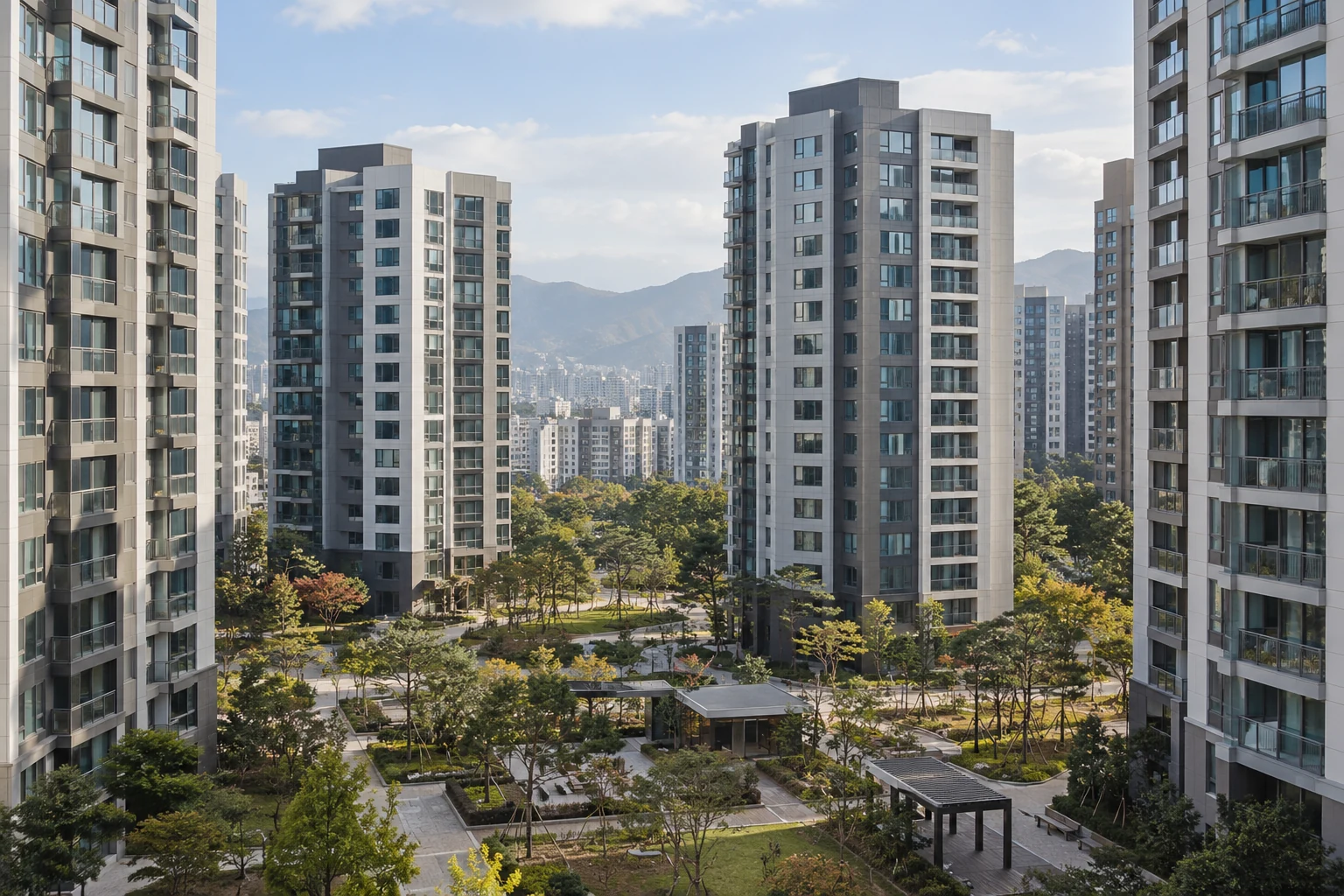
Two percentages, two views of the same country
Search for Korean apartments and tall buildings tend to arrive beside a large percentage. The official summary of the 2025 population and housing census contains two: apartments account for 65.8% of dwellings, while 54.5% of households live in apartments. If apartments are so numerous, why is their share of households lower? The tables count different things. One counts independent living spaces; the other counts the households using accommodation. The official republished results state both measures.
Imagine a block containing 60 apartment units. This is an explanatory number, not the measured size of a particular development. The dwelling stock does not count that block as just one apartment: it counts its separate units. Some may be vacant, and occupied units may contain different numbers of people. One building, sixty dwellings, its resident households and their individual members produce different tables from the same view outside the window.
Consequently 65.8% does not mean that 65.8% of Koreans live in apartments, or that apartments cover 65.8% of the land. Knowing what is counted makes the figure more interesting than a dramatic impression. It becomes a starting point for following the spaces available to households and the long process through which they were supplied.
One dagagu building and many apartment units
Buildings with similar vertical outlines can enter the statistics differently. The census definitions give a dagagu detached-house example with separate accommodation for five households. It counts as one dwelling in that building-based category; a supply measure incorporating its separate living quarters can treat it as five units. Apartments are counted by their independent residential units. Height and the number of visible windows cannot tell us how the two categories enter a stock table. The census definitions appendix explains the distinction.
Nor does a detached house mean the home of a person living alone. The name describes a classified building form; who shares a household is a different question. Several households occupying separate quarters in one building and a family sharing one apartment produce different patterns. Guessing residents’ family relationships from the housing category would erase that difference.
Closing an apartment door separates a household, but outside it the homes connect again. Corridors, stairs, water and plumbing systems, and lifts support several homes together. Bringing independent spaces into one building necessarily includes shared parts. A unit counted as one home is not a machine that operates completely alone. Its domestic life is easier to understand when the interior and those external systems appear together.
A vacant unit still exists in the stock
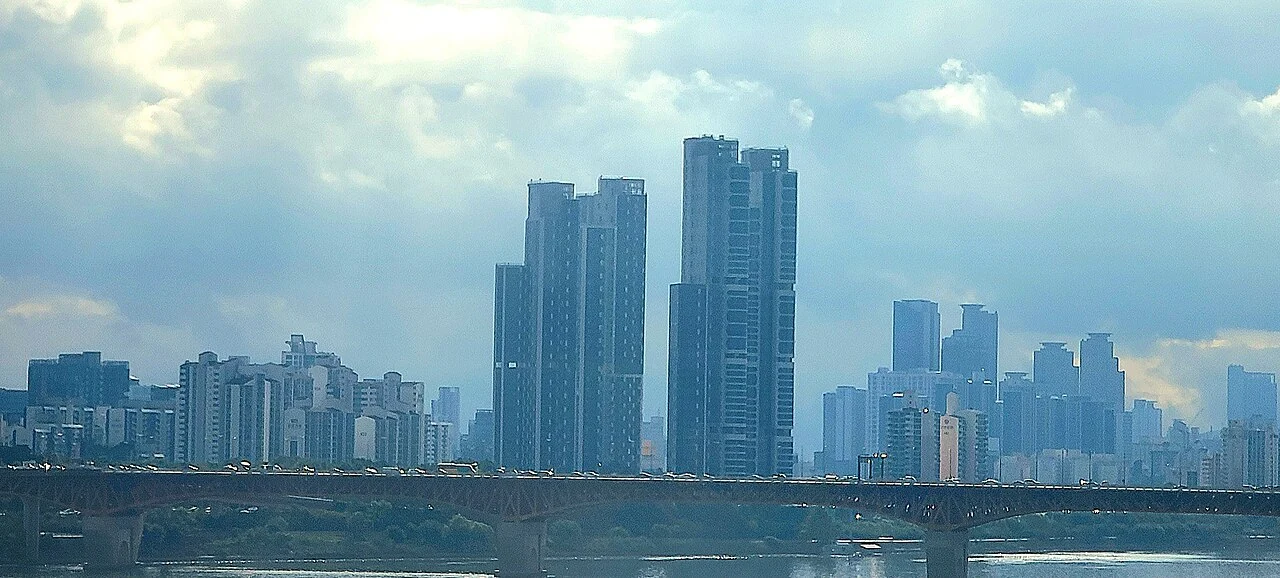
Consider an invented neighbourhood with 60 apartment units and 40 other dwellings. Apartments comprise 60% of its stock. If some apartments are empty or another building houses several households, however, the household share need not be 60%. An apartment occupied by four people and one occupied by a single person each contribute one dwelling but four and one to a population count. This neighbourhood is not a model reproducing Korea’s actual national statistics. It illustrates how spaces, households and people separate within the same physical scene.
Vacancy in a census also does not necessarily mean year-long abandonment. The census reference date is November 1, so accommodation unoccupied between residents can appear vacant on that day. The census vacancy count includes unsold dwellings and public-rental housing. The separate empty-house survey compared in the appendix instead covers homes unoccupied for at least a year and excludes unsold dwellings and public-rental housing. A reference-day vacancy count is not automatically the number of permanently abandoned homes or homes someone can obtain immediately.
A home’s existence does not mean access to it. Location, cost and actual use affect whether a household can move there. A stock table tells us which kinds of space exist. Which space a person searching today can enter is another question. Between stock and residence lie moves, vacancies, multiple households and the different numbers of people in each home.
Mapo in 1962: learning to accept a development
Calling Mapo simply Korea’s first apartment building can erase those who occupied earlier apartment buildings. Haengchon, Jongam and Gaemyeong apartments already existed in the late 1950s. Mapo’s innovation was a development placing several blocks on one planned site. The completed complex contained 642 homes in ten six-storey blocks: six were Y-shaped and four linear. Living rooms and balconies appeared within a common plan. The National Archives’ account of Mapo describes its construction.
The original plan was not built unchanged. Electricity and funding shortages prevented the proposed ten storeys, lifts and central heating. The height fell to six storeys, individual coal-briquette heating replaced central heating, and lifts were omitted. Imagining present-day facilities from the start removes the work of climbing stairs and handling fuel from these homes. A new floor plan and the electricity and construction money supporting its promised life had to be arranged together. The Seoul Museum of History’s early-apartment material documents these differences.
People did not immediately compete to move in. The National Archives records the housing corporation’s anxiety about low initial occupancy. Seoul’s archival account says occupancy remained below half even about a month after the first phase was completed. A living room and balcony did not instantly make leaving a familiar home attractive. Between a completed building and an accepted way of living lay time and hesitation. Reading today’s large share backwards would make apartments look inevitable from the beginning.
Finishing a shell or buying a plan before completion
Postwar Seoul supplied housing in more than one form. Seoul’s archives describe the 1953 reconstruction houses as nine pyeong, with two rooms, a wooden-floored space and a kitchen, giving priority to owners whose homes had been lost in the war. In the 1960s, Sewoon and Nagwon complexes combined commerce and residence within one building. Homes that later appear together in a category had responded to different land conditions and housing needs. The Seoul housing-supply archive follows these approaches.
Citizen apartments for lower-income residents and demonstration apartments aimed at middle-income households differed in financing too. In the citizen-apartment programme, the city built the structure and residents were to finish interiors. The collapse of Wau Citizen Apartments following poor construction in April 1970 showed that rapid supply could not by itself guarantee safety. How many homes had been added and whether people could live safely in them were questions that needed to stay together.
Yeouido’s 1971 demonstration apartments included lifts and central heating. Sales brochures depicted sofas, dining tables and standing-height kitchen sinks; a separate bathroom and dressing room were planned for the couple’s bedroom. Yet presale deposits and instalments financed construction, so prospective residents paid before the completed home existed. More convenient equipment and private space came through a process that also placed cost and completion risk on future occupants.
Following Mapo’s unfamiliar living room to Yeouido’s sales floor plan makes apartment growth more than a repetition of tall blocks. Who paid first, who finished the interior, what equipment arrived and which residents the supply targeted all differed. The present stock percentage adds together spaces reached by these different routes.
Equipment that supports a unit together with its neighbours
Compare Mapo’s six-storey stairs with Yeouido’s lifts and the role of shared equipment becomes tangible. More than the room arrangement changed. People and belongings moved between levels differently. Central heating connected households differently from handling briquettes in each home. Placing both developments under the same current housing category does not make their climbing and heating experiences identical.
One household can move its own chair, but several households continue using a common corridor or lift. During a lift repair, for example, each interior can remain unchanged while the route home and the movement of shopping or luggage change. This is an illustrative situation, not a reported breakdown at a named development. A door frames private domestic life; the building reveals people affected by the same equipment at once.
The service supplied to a unit depends on when and where it was built and the state of its facilities. Walking to a bus stop or crossing a development to leave it belongs to residential life too. Apartment convenience does not emerge solely from the size of private rooms. It also depends on shared structures encountered before entering and after leaving a home.
A national share is not a neighbourhood photograph
Put Mapo’s 642 homes beside the national 65.8% and the first difference is scope rather than magnitude. One is the size of a particular development built in a particular period; the other is the national dwelling-type share in 2025. A photograph of Mapo cannot prove the current housing pattern of the whole country. It shows something built somewhere, while the national count adds spaces across many places.
Even when developments and older lanes occupy the same city, each dwelling enters its category in the national table. Seeing tall blocks from far away and knowing how many local people live in them are different observations. Small quarters and vacant units may be outside the camera’s view. Distinguishing its field of vision from the table’s denominator preserves the strong first impression while explaining its limits.
The chosen territory matters too. Seoul alone and the capital region including Incheon and Gyeonggi contain different spaces and households. Korea beyond Seoul follows the distinction through home-to-work movement. Before expanding the experience of seeing many apartments into one nationwide way of life, it helps to place the route actually travelled on a map.
Different households inside an identical plan
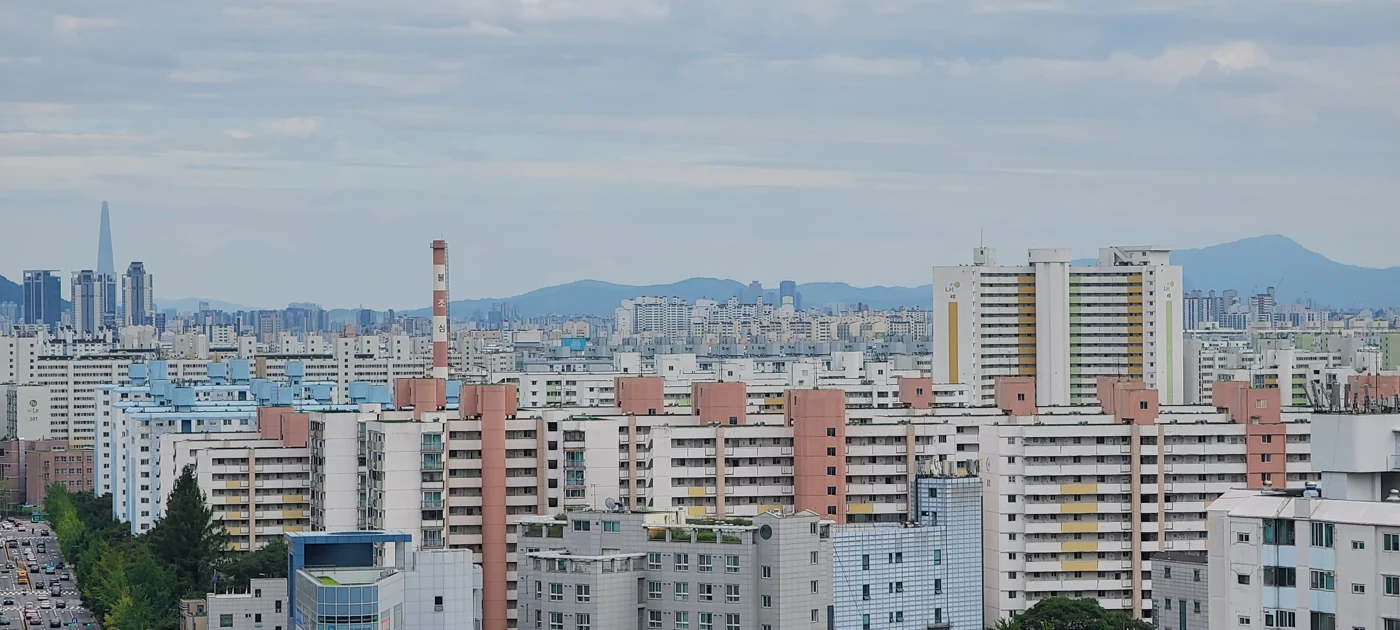
One person or several family members can occupy the same apartment plan. Whether a room becomes a bedroom or workspace, and how many people use the dining table, changes the day inside it. This is another explanatory example, not an interview with identified residents. The stock unit does not describe the number or relationships of the people using it.
Residence in an apartment also does not establish ownership. Households can use the same housing type by owning or renting it. A residence share does not disclose whether the home was a first preference or an accessible choice shaped by work and cost. Describing its form cannot stand in for asking about occupants’ actual choices.
Mapo’s initial hesitation and Yeouido’s presales show that supplied space and accepted life influenced one another without becoming the same thing. Today’s 65.8% cannot be read as everyone simultaneously choosing one taste. Spaces were supplied first; different households moved into and used them, carrying the residential history forward.
Finding different homes behind familiar outlines
Dwellings count remaining spaces, households count domestic arrangements and population counts their people. An apartment view becomes richer when we ask separately how many units exist, how many households use them and how many people live inside. A tall outline cannot provide all three answers.
The 2025 figures here describe November 1 and were published in July 2026. They are not current property prices or live listings. The story of smaller households follows who shares domestic life; apartment history follows the spaces built and the shared equipment people accepted. The two stories meet in a home but start from different questions.
I understand the first impression that Korean apartment buildings look alike. Knowing the homes reached by six flights of stairs and those reached by a lift, households paying before completion and those finishing their interiors, makes that impression harder to use as the ending. Look beyond height to the conditions supporting domestic life and repeated buildings become different homes.
Look beyond repeated outlines to who built the space and the equipment supporting domestic life, and similar buildings become different homes.
Sources & scope
2025 population and housing census: register-based results ↗2026-07-282025 population and housing census: official republication ↗2026-07-28Korea’s first apartment complex ↗Construction of public housing as Seoul expanded ↗Sales brochure for the Yeouido model apartments ↗2021 census definitions: dwellings, dagagu and vacancy ↗2022-07-28Modules independently explains the verified sources. The lead image is AI-generated for illustration; it is not a documentary photograph of an actual place, event or product.
Updates & corrections
Dates record changes to this document, separately from the reference dates of its sources.
- Content update
Rewrote the article with fuller production, history, examples and source explanations.
- Document connections
Organised representative-document links, search descriptions, paragraph links and revision history. No factual correction.
- First published
Initial creation of the Korean and English document.