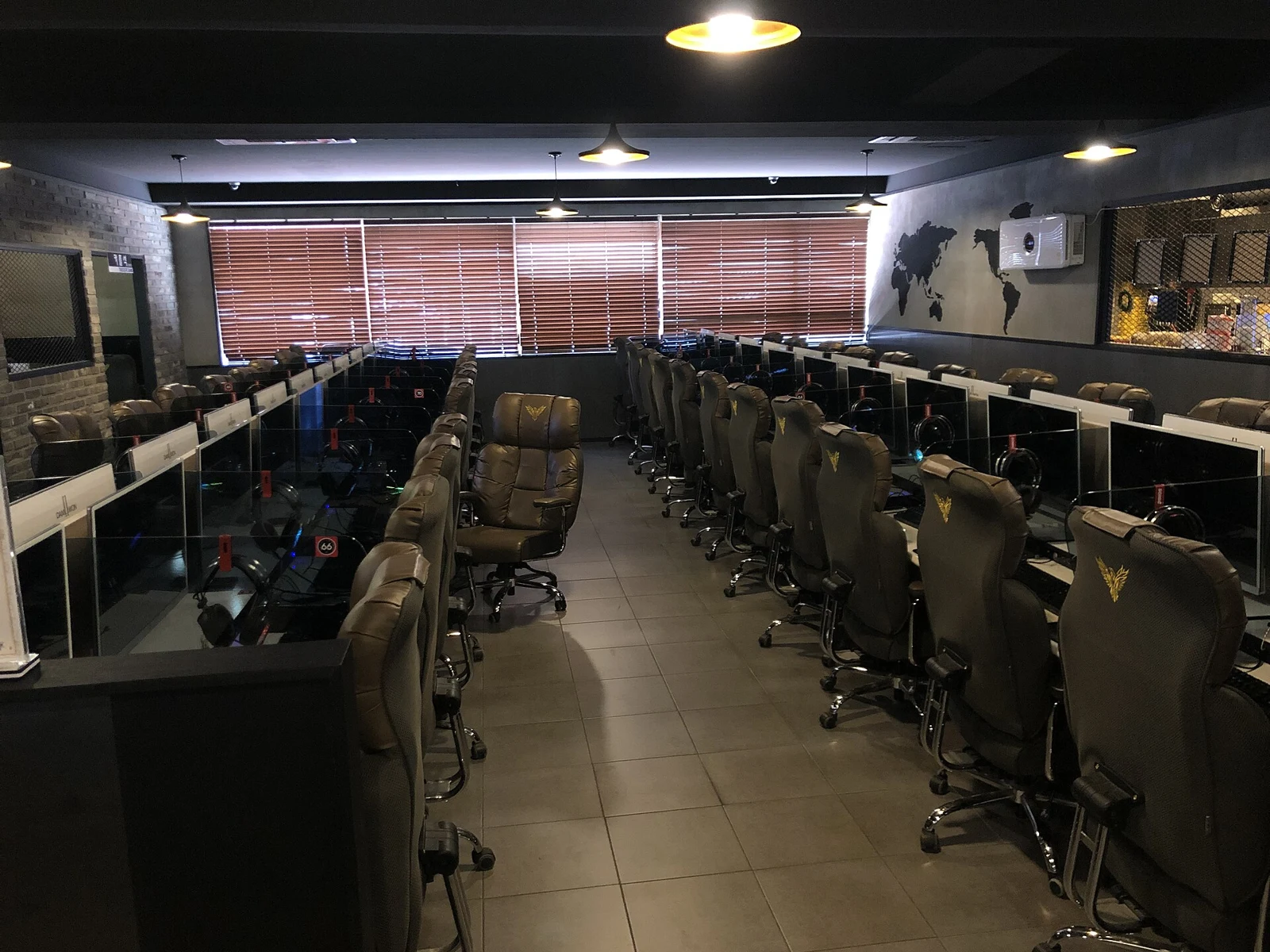
A room that sold a connection
A Korean PC bang and an esports arena both contain people sitting at computers. Their purposes differ: customers play in one, while spectators watch competitors in the other. The distance between them was crossed through changes in internet access, tournaments, broadcasting and professional teams. The story begins with a repeatable game rather than a spectacular stage.
Thrunet introduced cable-modem service in July 1998, according to the International Telecommunication Union; KT records an ADSL launch in 1999. The early broadband record and KT’s history place the gaming boom beside a change in connections. Buying a capable computer and connection differed from purchasing time at an equipped shop. A PC bang—literally a PC room—made playing possible without owning that equipment.
A local network could connect neighboring machines, while an internet service brought distant opponents into reach. The technologies differed, but both offered human competition. Another round could follow immediately; an adjacent player could watch a strategy being tried. Spectatorship was already present inside ordinary play, before a dedicated arena arranged seats for it.
StarCraft: decisions running in parallel
Blizzard dates StarCraft’s release to March 31, 1998. The real-time strategy game put three distinct factions into competition. The developer’s retrospective connects it with professional competition in Korea. A popular title did not turn every café into a training school. It did provide a shared game that people could repeat, compare and discuss.
Start with workers moving between resource deposits and a base. Terran SCVs, Protoss Probes and Zerg Drones gather minerals and gas, as the resource guide explains. That activity supports what happens at the front: an army lost in combat still has to be replaced. Turning from soldiers to workers can reveal the capacity behind the visible force.
Construction makes the factions different. An SCV stays on its building task; a Probe can leave after initiating a warp. A Drone becomes its building, while larvae can become workers or troops. The same word, production, therefore conceals different commitments of labor and future capacity.
Consider a rules-based example, not a reconstructed professional match. A scout finds several Protoss Gateways. Blizzard’s reconnaissance guide identifies that as a possible sign of a Zealot attack. The opponent must choose between retaining defenders and investing in a new resource base. An expansion offers future income but also needs protection; spending on immediate troops can delay that income. Production buildings, the new base and army movement now form one readable decision.
When the broadcast follows troops leaving home, the place they vacated matters too. Where are replacements being produced? Which new base has weak protection? A commentator can connect those views without pretending to know a player’s unspoken thoughts. This is the background that a spectator beside the computer could once ask about directly.
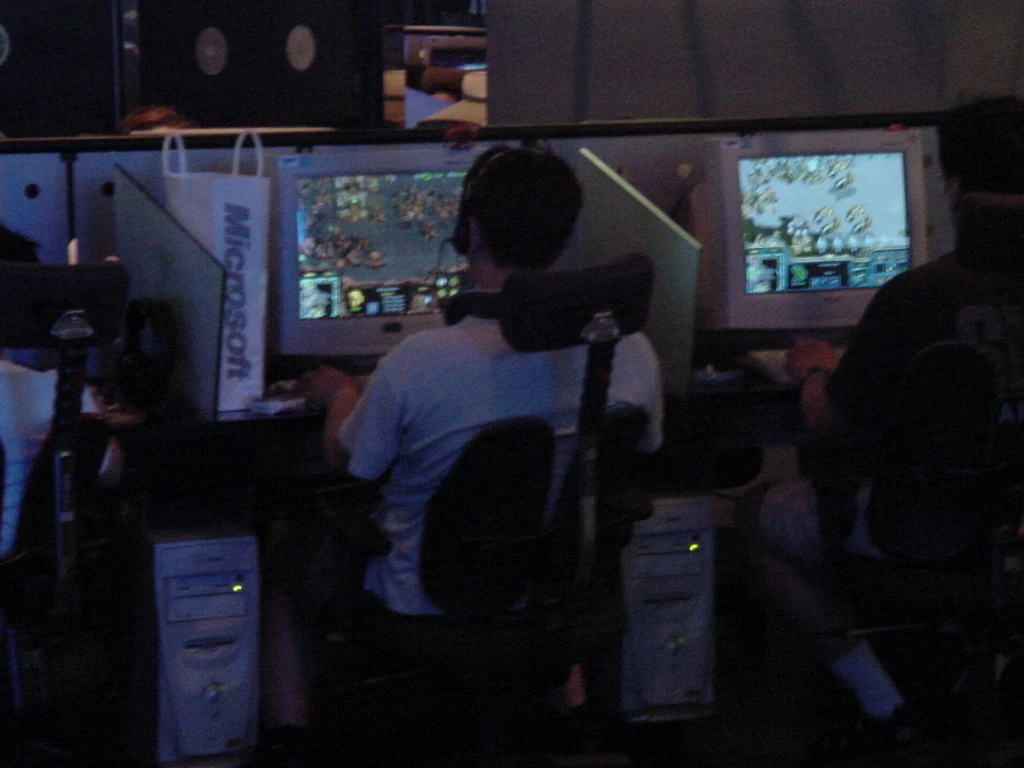
A match becomes a programme
A KOCCA research report records the December 1999 PKO Starleague broadcast on Tooniverse and OnGameNet’s July 2000 launch. The historical report identifies steps toward scheduled viewing. Playing a game and running a durable league were separate achievements, with different requirements.
A one-day tournament can assemble entrants and find a winner. A continuing league must also make the next match matter. Earlier results shape qualification; a rematch invites comparison; a familiar player returns under changed conditions. A brilliant move becomes a clip, while recurring fixtures turn performances into a longer story. The league connects those timescales.
Repeated broadcasts also let audiences associate a name and face with a style of play. Some viewers learned the game while following a favorite competitor, rather than mastering every rule before becoming fans. Broadcasting had to offer that entrance without flattening the competition for knowledgeable spectators.
The organization behind the individual
SK Telecom’s 2019 investor briefing dates SKT T1’s establishment to April 2004. KOCCA’s 2007 game-industry white paper records the May 2005 integration of the OnGameNet Proleague and MBCGame Team League. Team history and the league record show organization growing around individual performances.
An individual competition follows one player’s results. Team competition also asks how separate games contribute to a collective outcome. Excellent play and reliably fielding a roster are different tasks. Coaching, preparation, schedules and sponsorship sit behind the visible match. Their continuity gives spectators a team to await beyond a single encounter.
The route from café customer to professional was never automatic. People also started playing because they admired a competitor. Everyday gaming and professional competition influenced each other without becoming the same life. A person at a monitor could now carry a team identity, season-long expectations and an audience’s memory into a game.
A different game changes the view
Riot records League of Legends’ Korean release in December 2011. Its Korean office history marks another game arriving in a developed competitive culture. In the basic mode, two five-player teams seek to destroy the opposing Nexus, as the official introduction explains.
The map has top, middle and bottom lanes, with jungle between them. Turrets block routes toward the base; drakes and Baron are team-benefit objectives. The game introduction supplies this structure. A screen without a large fight is not necessarily a screen without consequential action.
Imagine an illustrative situation: one team gathers near a dragon while an opponent remains in a lane, advancing there. Following only the dragon loses sight of what changes in that lane; following only the separated player conceals why teammates have gathered. Switching between the main picture and map connects those choices. A tally of kills alone cannot explain every gain.
The selected champions are different tools. Lux is described as mage/support with a long beam attack; Darius as fighter/tank whose attacks build bleeding. These are examples, not a recommended professional lineup. A distant attack and accumulated close pressure require different positioning. The selection screen begins to reveal the distances and encounters a team intends to create, before players enter the map.
Rules can reorganize that attention. In 2025 Riot described Fearless Draft: champions selected earlier in a series become unavailable to both teams in subsequent games. The rule change makes earlier selections alter later possibilities. Viewers can follow how a team manages an entire series, rather than considering each game separately.
The people who assemble the screen
Riot’s account of Worlds 2022 describes observers, replay, graphics and audio specialists, plus regional commentary built around a shared feed. The production account makes that division of work visible.
A competitor looks for information needed to win. A broadcast must decide what viewers need to understand. A fight can finish before its cause becomes clear to an audience. A replay offers another chance to read a short action; organized information makes comparisons possible; commentary supplies context. These different jobs must fit the same live timeline.
A shared match and local-language explanation also serve different functions. Viewers abroad may not know a Korean league’s abbreviation or a long-running rivalry. Global distribution therefore involves more than sending pictures farther away. It requires rebuilding the background that makes the same pictures meaningful.
The audience enters, then returns to play
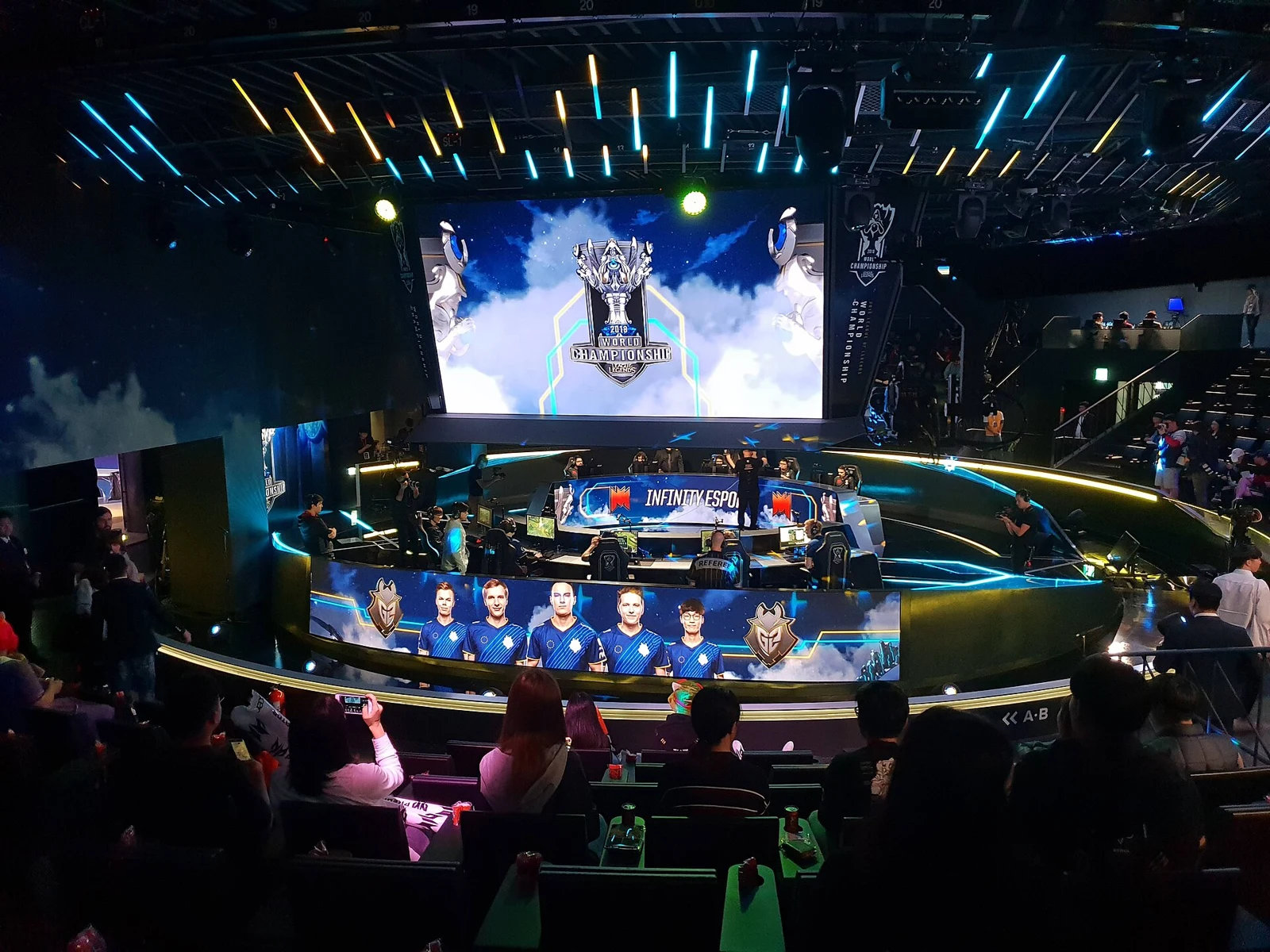
An October 2018 on-site report documented Worlds at LoL Park in Seoul’s Jongno district. The firsthand report and this article’s 2018 arena photograph show competitors and spectators sharing a gaming venue. Riot’s office history records the LCK Arena and LoL Park in 2019; the earlier use and later league role belong to distinct moments.
An arena reveals the people competing, but much of the contest remains inside the game. Spectators alternate between human reactions and the large screen. Proximity alone cannot explain the match: the venue also needs readable pictures, sound and a way to follow its progress.
The Korea Tourism Organization’s 2024 account places playing and watching together at LoL Park and T1 Base Camp. Its venue introduction shows the café form continuing around professional fandom. The computer seat was not simply replaced by an arena seat. Places connecting those activities multiplied.
A reason to wait for the next game
Korean esports grew through several different kinds of work: accessible equipment, repeated competition, intelligible broadcasts, teams and places to gather. The thrill of a match is brief; making another match worth awaiting takes longer. The most revealing achievement is the structure of return: viewers can follow a player’s choices against another opponent and across another season.
That structure still depends on publishers, sponsors and the labor of players. Popularity does not make it permanent. Sustainable working lives and understandable competition matter alongside impressive performance. Other stories about today’s K culture and Korean places offer further ways to see how culture takes shape beyond a screen. The café game and the professional match remain different activities, joined by the pleasure of watching a decision, learning from it and waiting to see what comes next.
Accessible play, repeated competition, broadcasting and teams made the next match worth awaiting. Ordinary gaming and professional competition remain different lives that influence each other.
Sources & scope
How to Play League of Legends ↗Esports principles and sociocultural value ↗2010-11Korea Game White Paper 2007: esports trends ↗2007SKT–Comcast esports joint venture briefing ↗2019-10-14Fifteen Years in the Koprulu Sector ↗2013Fearless Draft in 2025 ↗2025-03-16Global broadcast production for Worlds 2022 ↗2022-11-01Riot’s Seoul office ↗A broadband future ↗2001KT business history ↗An on-site report from LoL Park ↗2018-10-02Esports venues to visit in Korea ↗2024-04-29Terran Basics ↗StarCraft Resources ↗StarCraft Reconnaissance ↗Probe ↗Drone ↗Larva ↗Lux ↗Darius ↗Interior of a PC bang in South Korea, photographed on 8 March 2020.
MatthieuRicard · CC0 · Resized and converted to WebP