
A door makes room for a song
Noraebang literally means a singing room. Translating the name does not yet explain the experience. A microphone and screen can be found in karaoke elsewhere; the interesting question is how these devices are placed in a room, who uses them and for how long. Singing to unfamiliar people on a public stage and singing behind a closed door with companions can make the same song feel different.
Inside, the listener changes position. Instead of hearing a familiar recording supply every line, the person with the microphone must continue the next one. Lyrics on a screen and an accompaniment support that change. The room is less a stage for admiring accomplished singers than a set of conditions under which singing becomes possible. Those conditions help explain why a brief coin-booth visit and a longer group session share a name.
Choosing a unit of time
A visitor first establishes the room and the unit of use. Time-based sessions and coin-room song allowances organize waiting differently. An hour encourages decisions about how songs fit into a stretch of time; a few songs make the next choice more immediate. Prices and payment systems vary, but renting a duration and counting performances are meaningfully different experiences.
For a group, the room becomes shared time. The singer, the person choosing the next track and the person joining a chorus can exchange roles. Alone, the same closed door allows someone to repeat an unfamiliar passage without waiting for others. Solitary singing is not necessarily loneliness, and a group is not automatically a comfortable relationship.
A room is more welcoming when it also permits listening. Forcing a microphone on someone can replace privacy with pressure. Closing the door reduces outside attention without removing expectations inside it. The machine cannot decide how much performance one person should demand from another.
Turning a memory into a queue
Selecting a song translates memory into information a device can find: part of a title, an artist's name or a remembered line. A result becomes a number or an entry, then a place in a queue. An interface stands between recalling a song and making it happen in this room.
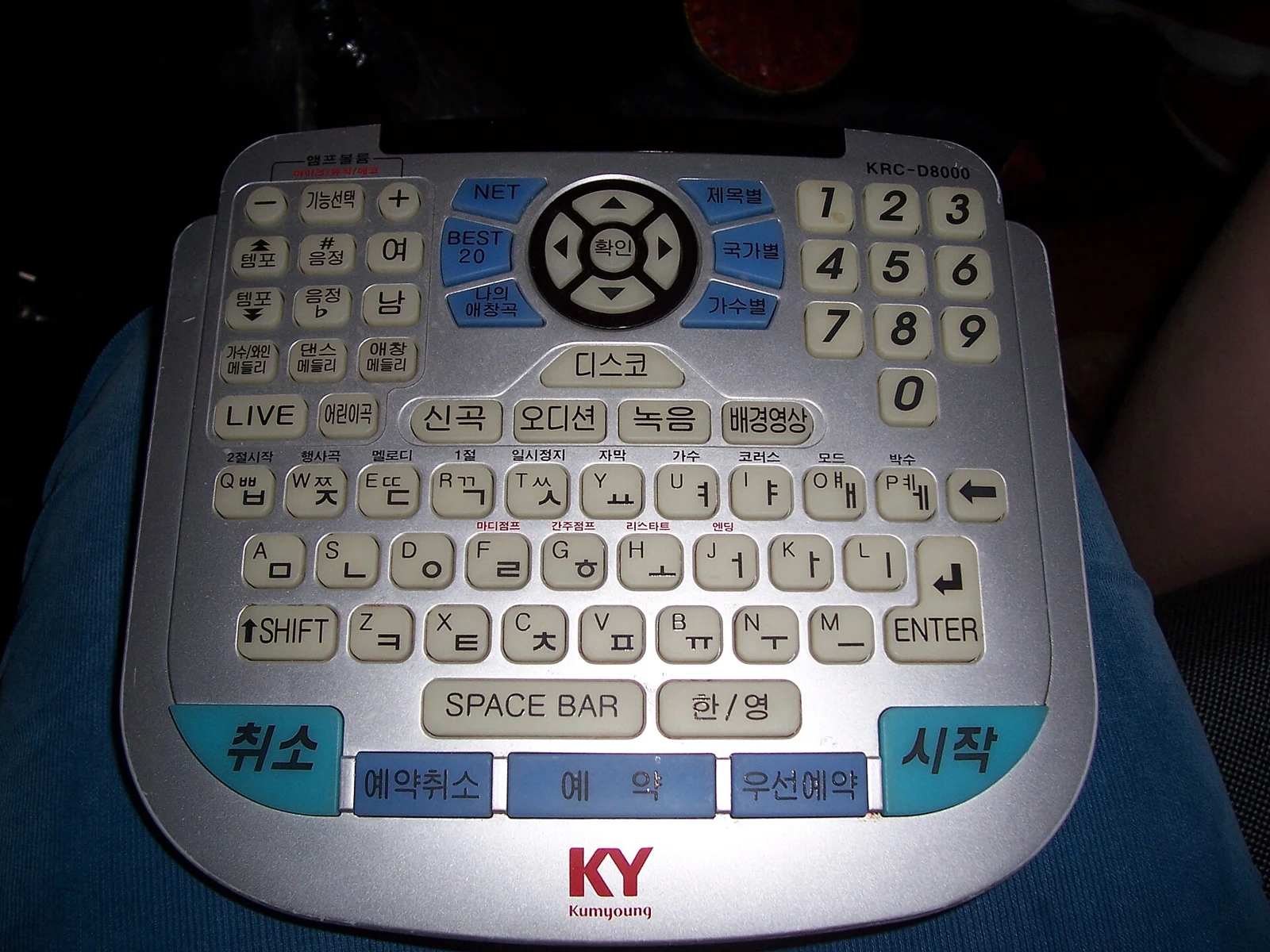
The remote photographed in a Korean-style karaoke room in Epping, Australia, on 3 October 2008 has number, search, reservation, start and cancel controls. It is not a Korean-location photograph. It records a more specific connection: Korean-language equipment being used abroad. Musical taste travels with practical objects that let someone find and start a track.
Reservation separates the song playing now from the next selection. Another person can prepare while the current singer continues. Yet a long queue entered by one person can delay everyone else's turn. A helpful function can also become a small dispute. Buttons provide an order; people still have to negotiate whose order it is.
Between the original key and a voice
Pitch and tempo controls adapt a familiar song to someone's singing conditions. Lowering the key need not mean not knowing the music; it may mean fitting it to the voice available today. A changed tempo alters how breath and movement meet the accompaniment. Pleasure need not depend on reproducing the original exactly.
The microphone and backing track also need a balance. More volume is not automatically a better arrangement for the others in the room. A voice can disappear behind the accompaniment, while an amplified microphone can become uncomfortable nearby. Sound adjustment is a relationship between sounds and listeners, rather than a competition for maximum loudness.
Saying simply that Koreans enjoy singing erases these enabling devices. The screen supplies a cue, the accompaniment supports continuity and the controls offer adjustment. Displaying talent and having a place to try are overlapping but distinct possibilities. The room brings the latter into ordinary life.
The accompaniment made before the microphone starts
TJ’s 2025 production account follows adjustable accompaniment through mixing/mastering, chorus, lyric/video alignment, checks and loading. A track that starts in seconds has already required sound and text to meet.
Consider someone lowering the key because the chorus is too high. Its pitch changes, but the singer still needs to recognize the beat on which to enter. Slowing the tempo is equally awkward if the screen has already moved to the next line before the current phrase finishes. Key controls place the melody within reach; moving lyrics locate the singer within the song. If those signals pull apart, the person holding the microphone spends the verse chasing the machine.
Mixing deals with the balance and placement of sounds. A short instrumental cue at the first entrance does a different job from a backing chorus behind the refrain. Even when another vocal part is audible, the participant needs somewhere to put their own voice. Running screen and accompaniment together tests whether a searchable title actually works as a singable piece. This is a musical arrangement for someone to enter, rather than simply a recording delivered to a room.
The missing song and the song people return to
TJ’s 2026 interview describes rights checks and yesterday’s performance logs feeding the following day’s top200. That ranking measures a different action from streaming.
Imagine three friends sharing a room. One looks for a new song heard daily on a phone; another reserves an older number they can finish confidently. The track actually started in the room need not match how long either person listened at home. Vocal range, remembered words and the desire to sing in front of these particular companions all enter the choice.
A missing title cannot immediately be performed, while a song already in the catalogue can return on another visit. New releases and repeated use occupy the same screen. The interest of a karaoke ranking lies in that shift: from music people receive to a song someone chooses to bring out in their own voice. It records the room’s use of music, rather than giving another copy of a listening chart.
A machine has a changing repertoire
TJ Media's company chronology records a home computer accompaniment product in 1989 and an internet accompaniment model in 2002. This is a company's product history, not a universal invention timeline. What matters here is a device's expanding relationship with the supply of songs.
A new entry may look like one more line on a list. For the user, it can determine whether a remembered or recently heard song is available. Data has to be prepared and delivered before it becomes a choice in a room. The age of the hardware and the date of its repertoire are separate questions.
The business therefore involves more than installing speakers. Equipment care, catalogue maintenance and the room's condition overlap. A singer may not notice that work until a song cannot be found or the sound fails to behave as expected. The ease of the experience depends on people maintaining it behind the performance.

A short visit and a remembered scene
The coin-room format allows a session without first organizing a large gathering. A small allowance of songs fits a different opening in the day from a long group booking. This does not establish that every coin room is used alone or offers identical terms. It is the divisible unit of use that creates a different possibility.
A fictional scene can provide another entrance. A 2023 Korea Tourism Organization feature identifies Hongdae's Su Noraebang as a Hospital Playlist filming location. Viewers can recognize a setting before using it themselves. An everyday facility acquires a second association through a story.
Visiting does not reproduce the characters' experience. Companions, selections and the resulting atmosphere belong to the visitor. Screen popularity can open the door; actual use still determines what happens beyond it. A familiar background becomes a place for a different memory.
When a voice leaves the room
TJ Media's support information includes ways to access recorded content on a smartphone. The feature is equipment-specific, but it illustrates how a session's result may travel beyond the closed door. The later listener might be the singer, a companion or another person entirely.
Recording offers practice and a keepsake. Saving and publishing, however, are different decisions for the people involved. The privacy that made singing comfortable should not disappear merely because transfer is convenient. A friend's relaxed performance is not automatically an invitation to distribute it.
Scores raise a related question. A number can start a game without measuring every aspect of musical enjoyment. Accurate singing and a good shared experience are not identical outcomes. If the number becomes the only goal, a hesitant newcomer's opportunity to try grows smaller. The best final picture need not be a highest-score screen.
The song after the door opens
The room's interest does not depend on claiming Korean invention of karaoke. It lies in the particular joining of equipment, private space and units of use. The Japanese karaoke-shop photograph from 2005, the Seoul noraebang sign from 2011 and the Australian remote show connections that do not stop neatly at one border. Korea's noraebang has its language and practices within that wider relationship.
Among Korean everyday places, it lends people a setting for a voice. Within the many entrances into today's Korean culture, a heard song becomes something someone can sing. We find more lasting value in a room where a first-time singer wants another turn than one remembered only for its best performer. When a song ends and another comes to mind, the small room has already made a story.
A noraebang supplies a room and a working arrangement of search, backing tracks, lyrics and turns. The music is prepared and maintained so a listener can become a singer.
Sources & scope
TJ Media history ↗Korean room culture in screen stories ↗2023-10-17TJ Media support FAQ ↗Making TJ karaoke accompaniment ↗2025-03-26Selecting new TJ karaoke songs ↗2026-09-11Noraebang neon signs in Daehangno, Seoul, photographed on 2 September 2011. Paul Stafford / TravelMag.com.
Paul Stafford / TravelMag.com · CC BY2.0 · Converted to WebP without cropping · www.travelmag.com