A flower that changes without moving
A painted flower has a chosen colour. A flower on Korean mother-of-pearl lacquerware can shift from pink to green to silver as you move past it. The dark background stays still; the shell catches the changing light. The material is the inner pearly layer of a shell, commonly called jagae in Korean. Najeon refers to shell decoration; najeonchilgi brings that decoration together with a lacquered object. Each petal has an actual thickness. The maker must fit that thickness into a finished surface.
Large black cabinets are only one part of the story. Small covered containers, boxes for writing supplies and much larger clothing chests offer different spaces for a design. Shell inlay developed across East Asia, including China and Japan. Korea's history becomes more interesting when we examine its particular objects rather than claim an invention exclusive to one country. Three works at the Metropolitan Museum of Art make useful comparisons: a tiny Goryeo box, an early Joseon stationery box and a seventeenth-century clothing box.
Before the shell comes the structure
A box begins with its body and lid. Woodworking establishes the fit; the prepared ground determines how the decoration will sit. An uneven base cannot be corrected simply by adding beautiful pieces of shell. Beneath the visible pattern are several different jobs, and defects in one stage can travel into the next.
Worn lacquer on the National Museum of Korea’s thirteenth- to fourteenth-century sutra box exposes woven cloth. The ground of a box does not end with one material. Cloth laid over a wooden body, then covered with lacquer and decoration, separates the visible face from the layers supporting the form. Making the place that will receive the flower pattern comes before ornament.
Natural lacquer is another material with its own working conditions. The Met describes processed tree sap, applied in successive thin coats and cured in a suitably humid environment. It can provoke skin reactions while being handled. A glossy black surface therefore includes trained material handling and time between coats, not just a final flourish with a brush. Preparation is part of the appearance even though it disappears beneath it.
Cut a petal, assemble a line
Shell begins curved; a box surface is flat. The pearly layer must be prepared as a thin sheet before a motif is cut. Colour, grain, thickness and cracks affect which area can become a usable petal. Repeated shapes have to come from a material that is not uniformly manufactured. A broken point means preparing another piece, while gaps between pieces alter the pattern's rhythm.
Two important Korean techniques are jureumjil, also written juleumjil in craft descriptions, and kkeuneumjil. The first cuts a shaped piece with scissors, a knife or a fret saw: a petal or leaf is made as a form. The second uses narrow, threadlike strips of shell, cut into lengths and joined along a design. One works with a shaped sheet; the other builds a line from small sections. Older museum descriptions use a variant Korean spelling for the first technique.
This is not a strict division between curves and straight lines. Short strips can build complex outlines, and a larger cut piece may receive incised detail. Metal wire can provide another way to connect flowers. Following a stem through a design reveals that the apparently continuous picture is assembled from materials with different tasks. It is drawing through construction.
Cover the pattern to reveal it again
After attachment, shell and its surrounding ground need to become one finished surface. Building lacquer layers and working back the material over the inlay allows initially hidden shell to appear again. This differs from applying a single coat with a brush. Adding layers and exposing the necessary parts have to work together to place a luminous motif beside its dark ground.
Excessive abrasion could damage a thin piece or its fine detail. Uneven preparation also affects how light crosses the surface. Polishing cannot magically cure every earlier problem. The tactile finish and the visible motif are results of the same layered construction. There is a satisfying reversal here: to display the shell, the maker temporarily hides it.
Goryeo detail on a ten-centimetre box
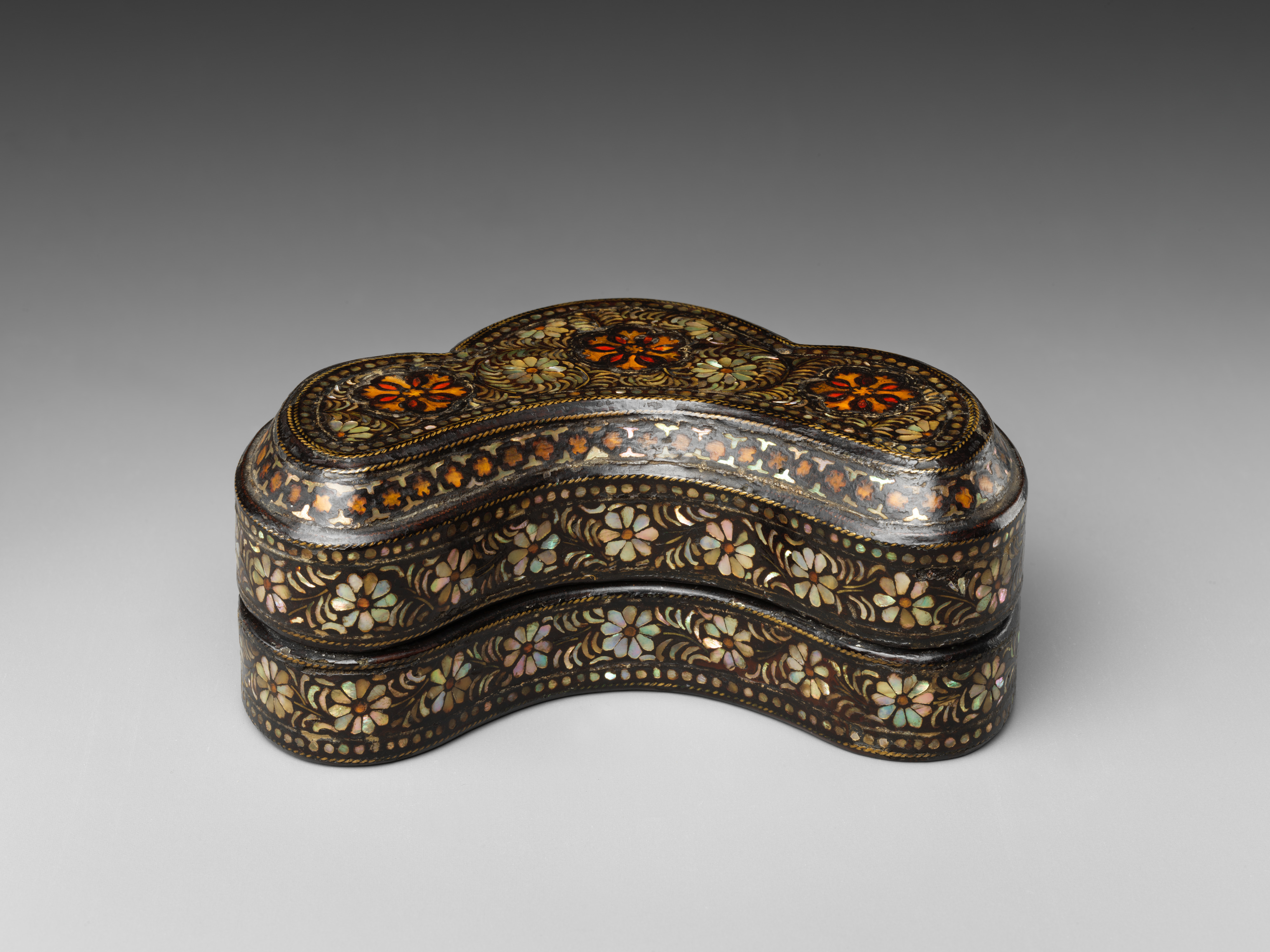
The Met's trefoil covered box with chrysanthemums dates to about the twelfth century, in the Goryeo period. It is only 10.2 centimetres long and 4.1 centimetres high. Once its actual scale is understood, the repeated flowers and narrow borders look different: they occupy a palm-sized object, not a large cabinet. The three-lobed outline gives the decoration another task, carrying a pattern around a curved perimeter and between lid and body.
The museum records mother-of-pearl, tortoiseshell over pigment and brass wire. These are three different visual devices: iridescent shell, colour seen through tortoiseshell, and fine metal lines. Reading the historical material list is not a recommendation to use tortoiseshell today. It explains why treating every luminous part as mother-of-pearl would erase the maker's distinctions.
The Met proposes that containers of this shape could have belonged to an ensemble with a larger box, and suggests cosmetics or incense as possible contents. Those remain possibilities. They nevertheless let us imagine the object's handling: placing a small container within a group, removing a lid and returning it to its position. Ornament and use were connected at this intimate scale.
A writing box becomes a clothing box
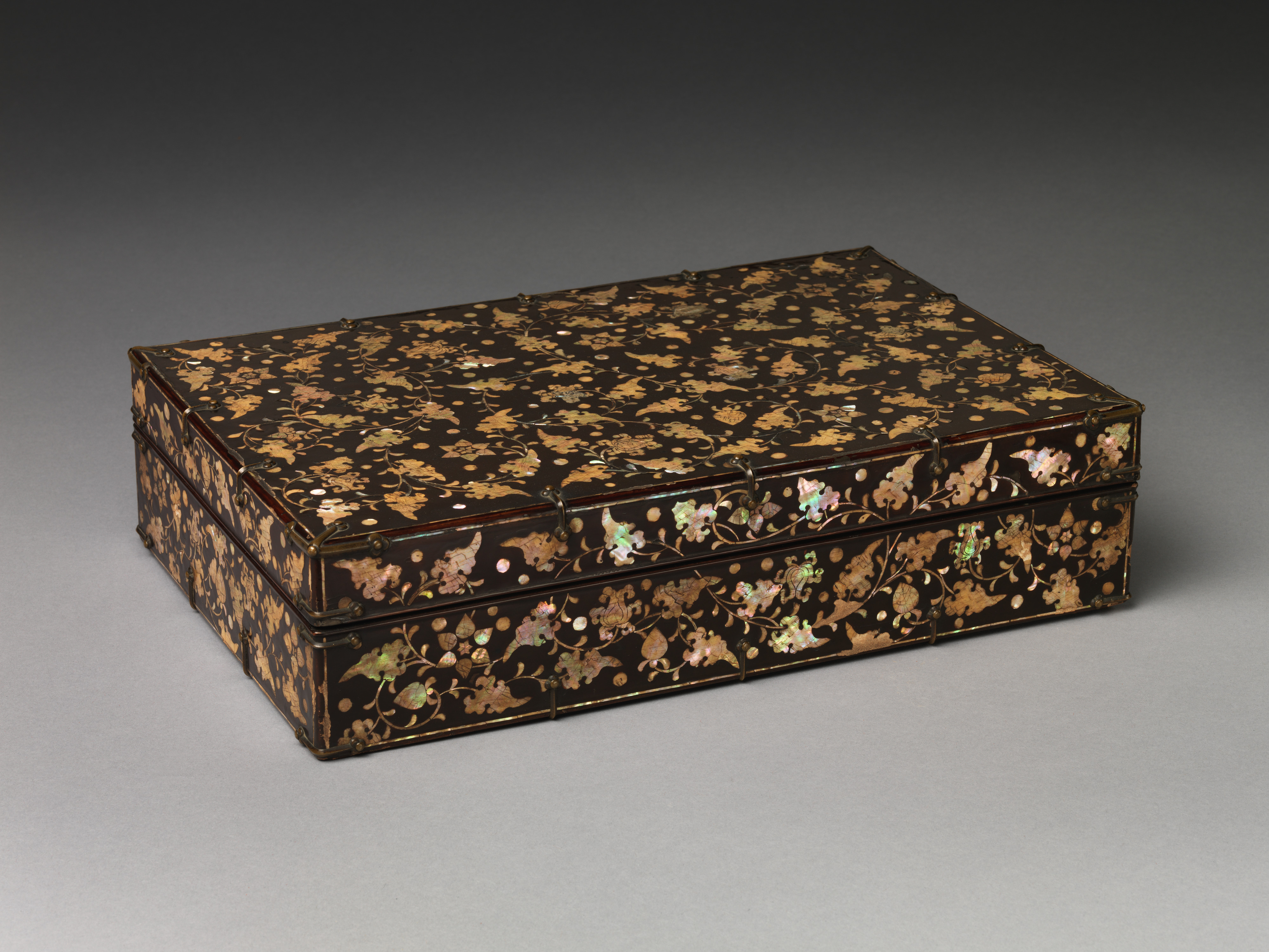
The fifteenth- to sixteenth-century Joseon stationery box measures 36.5 centimetres long and 9.2 centimetres high. According to the Met, it held paper and writing implements. Peony scrolls spread over a low, broad lid and continue onto its sides; brass fittings articulate the box's edges. Compared with the Goryeo container, both the working surface for the design and the position in front of a user have changed.
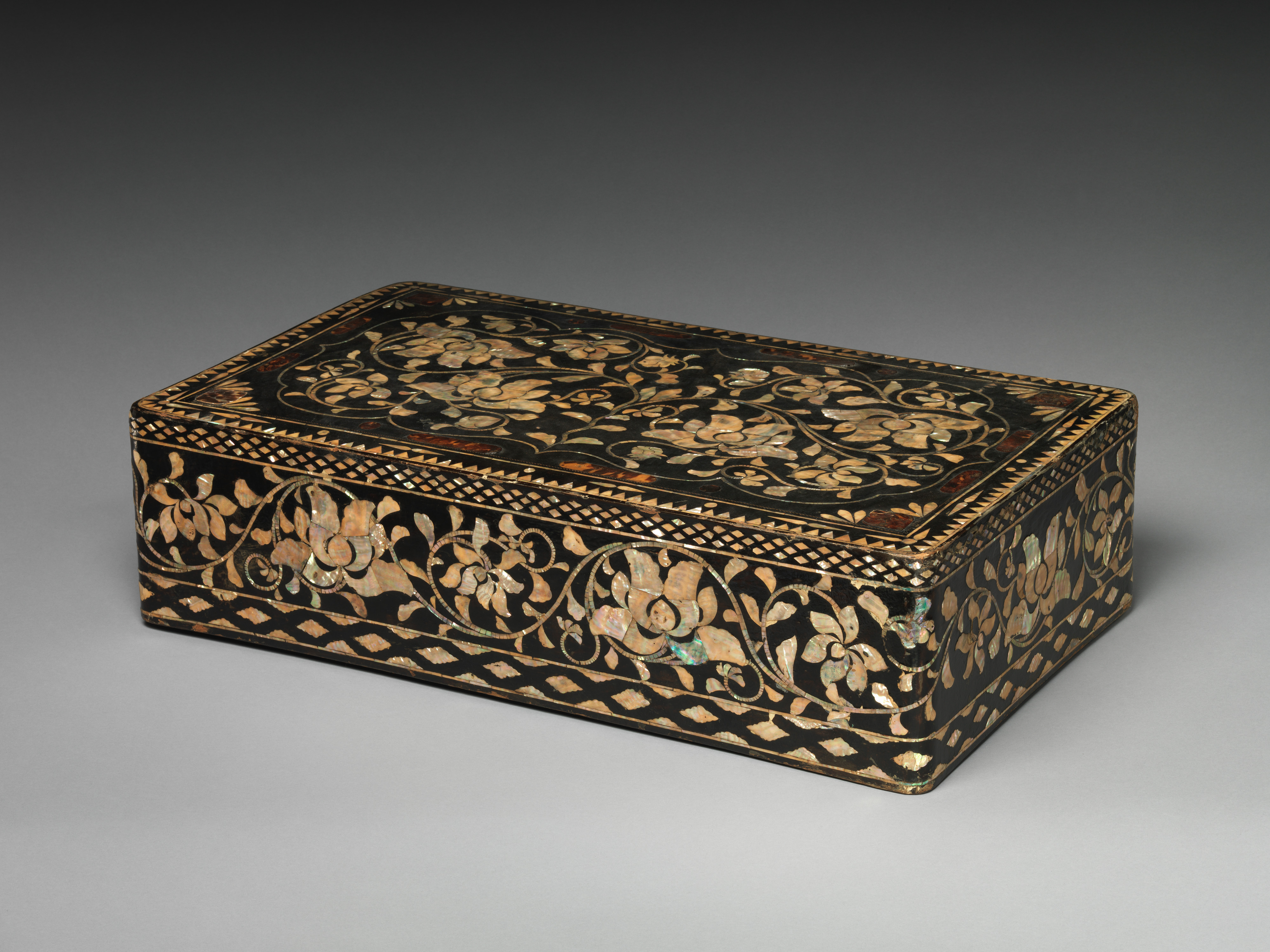
The seventeenth-century clothing box is larger again, at 79.1 centimetres long. Large peonies, substantial leaves and geometric border bands organise the broad faces. The photographs show the contrast clearly: bigger floral forms command attention on the clothing box. Its recorded materials include mother-of-pearl, tortoiseshell and brass wire. A shared peony theme has produced different distributions of flowers, open space and framing.
Calling the first period refined and the later one coarse would flatten this comparison. A small container and a large clothing chest are not viewed at the same distance or used in the same way. Dense miniature repetition and a broad arrangement of floral masses are different design solutions. Function and dimensions explain more than a single verdict on an entire dynasty.
A workshop is longer than one signature
The Encyclopedia of Korean Culture describes a traditional division among makers of the wooden body, lacquer specialists and shell-inlay craftspeople. Calling a finished object the work of a single gifted hand can obscure that structure. The separate skills need to connect successfully; mastery of one does not automatically complete the rest.
In Tongyeong, the twelve workshops associated with the naval headquarters after the Imjin War produced craft goods. Access to abalone shells also helped support local inlay production. Raw materials, institutional orders and skilled construction converged in one place. Modern changes in furniture demand, imported shell and substitute coatings altered the trade and blurred some older divisions of labour.
Recognition of the craft as an intangible heritage in 1966 became part of its transmission, alongside makers such as Kim Bong-ryong. What needs to survive includes more than drawings of motifs: preparing fragile shell, joining a line and judging the surface require practice with real materials. Continuity depends on working time and opportunities for the next maker to learn those decisions.
A 1997 box also contains tofu
The material list for Kim Seol’s 1997 Box with Many Angles includes lacquer, hemp, quail eggshell, tofu and abalone shell. Combining reflective shell with opaque eggshell already gives the materials different jobs. An account limited to wood and mother-of-pearl would miss that expansion of the craft’s material vocabulary.
This is more than an old technique with a fashionable ornament added. Knowledge of layers and material surfaces is redirected into a new relationship between form and texture. Earlier boxes organised patterns around the storage of paper or clothes; this work lets experiments with facets and materials shape the box itself. A transmitted technique can produce a changed object.
Hanbok and the culture of wearing it connects clothing to construction, while Korean homes expands the scale to spaces where storage objects belonged. Najeonchilgi is compelling because its beauty has a concrete route: prepare fragile shell, build a hidden ground, cover and work the layers back, then bring the light into view. Continuing that work makes the craft an active practice of choosing and making, rather than a frozen emblem of the past.
The beauty continues through the hidden ground and the real work of preparing and finishing materials.
Sources & scope
Materials and processes of East Asian lacquer ↗2004-10-01Peony-scroll sutra box and its construction ↗Korean inlay makers, techniques and transmission ↗2026-08-12Goryeo chrysanthemum trefoil box ↗Joseon peony-scroll stationery box ↗Joseon peony-scroll clothing box ↗Kim Seol’s Box with Many Angles ↗Trefoil covered box with chrysanthemums. Goryeo, about the twelfth century. Metropolitan Museum of Art.
The Metropolitan Museum of Art · CC0 / Public Domain · Original image used without modification