What the name covers
Hanbok names a Korean traditional clothing lineage rather than one unchanging pattern. A familiar women's ensemble combines a jeogori jacket with a chima skirt, while a familiar men's ensemble uses trousers, or baji. Those basic descriptions do not include every outer garment, ceremonial layer or seasonal variation.
Joined body panels and sleeves enclose the torso, while gathered skirt cloth creates volume below. A short jacket reveals more of the skirt’s upper edge; a long one covers that boundary. Silk and ramie, padded and unlined construction, collars and closures produce different garments. Changes in hanbok therefore take place inside the seams and layers as well as along the outer silhouette.
The work of separate upper and lower garments
The jacket covers the upper body; the skirt or trousers covers the lower body. Separate pieces permit different materials and colors and allow each part to be fitted independently. Jacket length and the position at which skirt volume begins affect the balance of the whole outfit.
A skirt's width is best understood by considering both the cloth laid flat and the folds it makes when worn. Trousers accommodate the movement of two legs and face different construction questions. Exact patterns vary by period and type. The basic vocabulary explains a component's role before the material and proportions of a particular garment are examined.
How separate pieces become a jacket
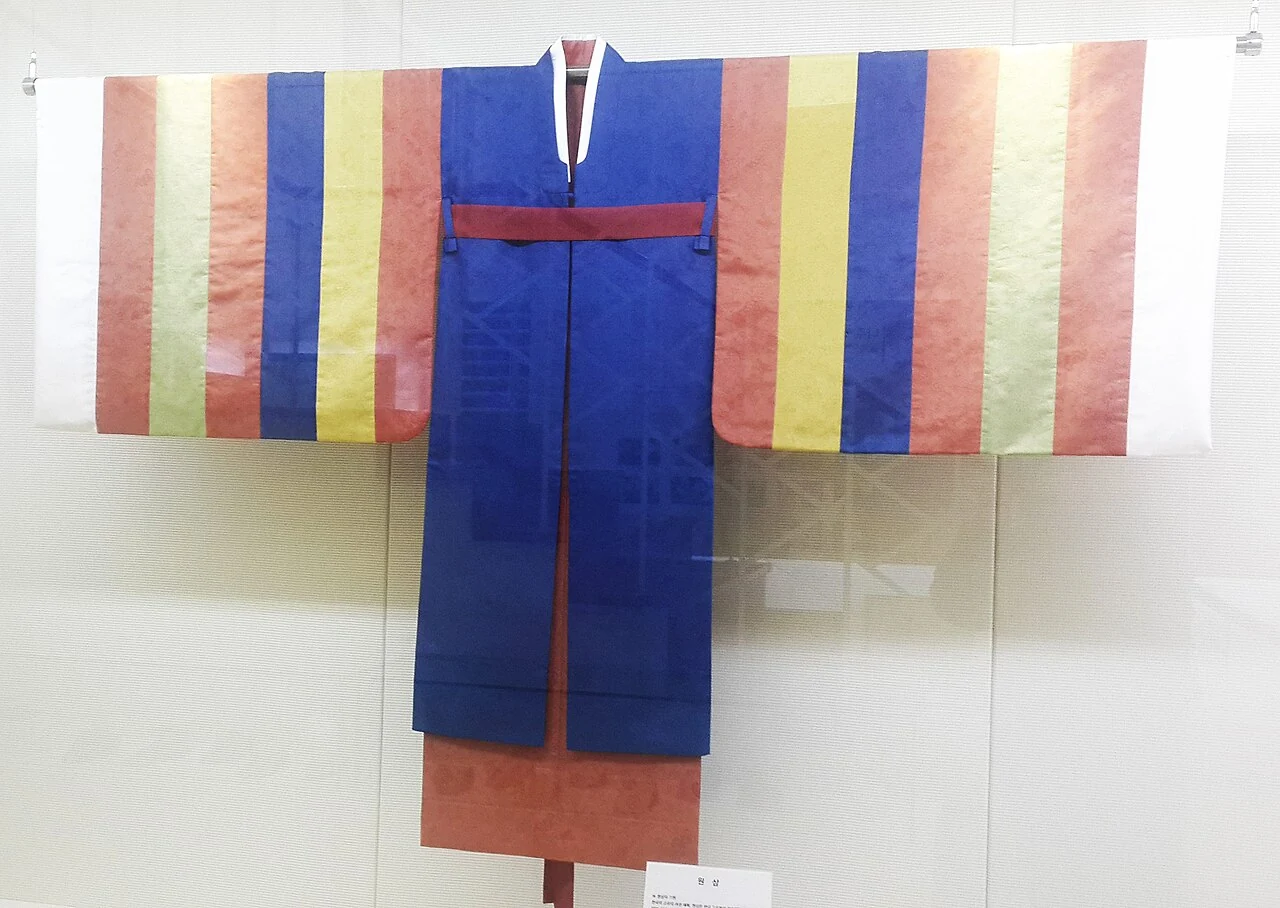
A jeogori is assembled from parts with different jobs: gil body panels, sleeves, seop front extensions and a git collar. The Traditional Culture Portal describes a women's jacket built by joining two body panels at the back, adding sleeves and unequal front extensions. A mu underarm gusset can add room where the arm meets the body. The collar must work with the inner neckline, called godae. Even an apparently simple jacket therefore contains junctions between the torso, arms, neck and overlapping front.
Cutting requires more than transferring finished measurements to cloth. A seam allowance leaves material for joining two pieces, while the direction of the weave affects how a panel stretches or twists when suspended. Joining the back panels establishes one line; attaching sleeves and matching the side and underarm connections creates others. The collar's course affects both the neck opening and the chest overlap. This explains construction relationships rather than claiming to reconstruct the exact sewing order of every surviving garment.
In the arrangement called uim, the wearer's left front overlaps the right. The width of that overlap affects space across the chest. Moving a fastening ribbon is consequently different from changing its color. Narrowing sleeves or shortening the body changes movement and relationships with clothing underneath. Contemporary adaptations become easier to understand when viewed as decisions in cutting and assembly, not simply collections of recognizable outlines.
Fastening and overlap
Goreum are ribbons used to close the jacket. Their visible color and length can make them look purely decorative, but they also participate in holding the garment together. The collar, overlapping front and any internal closure belong to the same structural question: how does the cloth stay around a moving body?
Daegu National Museum describes a floral jacket from the 1940s that uses a brooch instead of goreum. It is a documented exception to the familiar arrangement. A common component should therefore be distinguished from a universal requirement.
Outer layers should also be identified separately. Adding a ceremonial garment alters weight, movement and silhouette. Everyday separates, outer clothing and clothing for a specific ceremony serve different uses; they are not interchangeable names for the same outfit.
Season, material and occasion
Daegu National Museum’s 1940s winter jacket combines patterned silk outside with a lining. The lustrous outer cloth and interior material perform different jobs. A lining sits between body and shell rather than adding another visible pattern. The brooch-fastened jacket discussed earlier also uses lining associated with Western-style women’s clothes. Changes in clothing occurred inside the garment as well as in its recognizable outline.
Daegu's exhibition describes hwarot as bridal clothing and dangui as ceremonial clothing worn over a jeogori. These are categories with particular functions, rather than mandatory additions to every hanbok ensemble. Their names should be read alongside occasion and wearer.
What happens inside an unlined or lined garment
Gangdong district's account of needlework artisan Gu Hye-ja names silk, cotton, ramie and hemp alongside needles, thread, scissors, rulers, thimbles and pressing tools. Cutting, joining and setting a folded edge require different tools. Needle and thread size must suit the fabric: an oversized needle leaves conspicuous holes in fine cloth, while excessive thread tension gathers the surface around a seam. Matching thread color alone does not make a seam unobtrusive; stitch spacing and tension matter too.
An unlined garment has no second layer concealing its allowances. In open or translucent ramie, folded allowances form darker lines. Narrow folds and finishing the cut edge address both appearance and durability. A lined garment introduces another relationship: outer fabric and lining are handled separately, then connected. A lining that pulls against the outside prevents the jacket from hanging freely; excessive lining can bunch inside. Cotton-padded winter clothes add the task of spreading and securing insulation between layers.
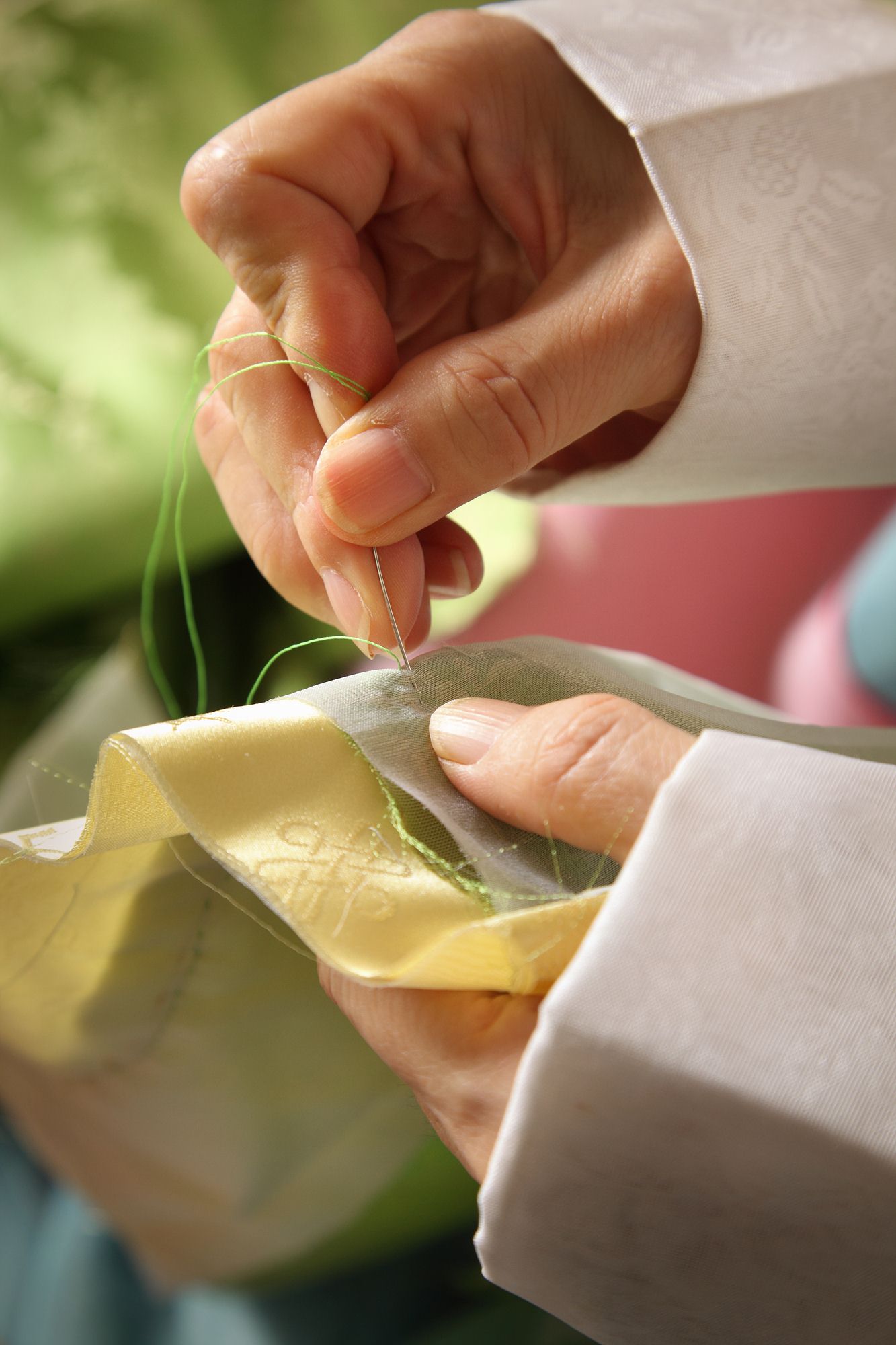
A running stitch advances through the cloth; backstitch returns toward the previous stitch to make a firmer line. Overcasting controls an edge that might fray. A concealed joining stitch, gonggeureugi, travels between folded edges so that less thread shows on the surface. The practical distinction is where a seam takes force, where a visible line is wanted and where delicate cloth needs finishing. The hands in the photograph show that clothing depends on work performed at the scale of individual stitches.
Historical form and wearing knowledge
Gu Hye-ja learned garment making from her mother-in-law Jeong Jeong-wan, the previous recognized needlework master; she was recognized on 9 July 2007. This transmission concerns more than a finished outfit. Fold width, thread tension and matching collars to sleeves are judgments carried through work. The hanbok lifestyle designation connects making and wearing. Preserving a garment and enabling another person to make one are related tasks.
The Smithsonian record for a chima notes that Mary Kim had the hanbok made in Itaewon, Seoul, in 1975 and wore it at the opening gala of the Asian Art Museum of San Francisco in 2003. One ensemble connects the city of its making with another city of wearing. Keeping a garment also keeps open the possibility of its next occasion.
Comparing historical jackets rather than one silhouette
The Seok Juseon Memorial Museum at Dankook University presents garments from different periods. A sixteenth-century ceremonial jacket excavated from the grave of a woman of the Eunjin Song clan has a broad body, straight sleeves and a squared mokpan collar; its length covers the waist. An eighteenth-century jacket associated with a woman of the Gyeongju Yi clan is shorter and narrower. The owner's life dates in an exhibition are not an exact manufacturing date for a garment. The objects nevertheless let us compare the parts in which proportions changed.
A long body covers the skirt's upper edge; shortening it reveals more of the skirt waistband and moves the visible boundary between upper and lower garments. Narrowing a sleeve is a separate cutting decision. Saying that jackets became shorter therefore does not explain every change in collar, sleeve or width. Materials and wearers also differ between finds, so one excavated example is not a census of everyday clothes.
The subsequent story includes lengthening as well. The Traditional Culture Portal describes reforms associated with girls' schools and waist-length jackets of the 1930s and 1940s. Daegu's brooch-fastened jacket shows a change beyond length. This history is not a straight progression toward a single ideal. Today's clothes can combine the proportions of one period, another collar and a new fastening. Understanding the parts and their assembly makes that combination more legible than asking it to resemble an unspecified past.
Changes continue inside the garment
Adaptation does not stop with a recognizable collar or color. Lengthening a body panel moves its meeting point with a skirt; replacing ribbons with a brooch changes the parts holding the front. Giving an unlined jacket a lining changes the visibility of allowances and how the inside moves against the body. A silhouette meant to register across a stage faces different design questions from a garment worn repeatedly in ordinary movement.
Our editorial view puts these working connections alongside visual resemblance. Broad areas of cloth depend on small junctions. When body panels, extensions, collar, seams and lining work together, a historical form remains wearable rather than only recognizable in a photograph. The story of hanbok and its wearers follows individual garments and people. Stage and everyday clothes also open different entrances to Korean culture today.
An assessment should consider how clothing can be worn alongside what it resembles.
Sources & scope
Hanbok lifestyle heritage designation ↗2022-07-21Hanbok as living heritage ↗2022Korean clothing at Daegu National Museum ↗Mary Kim’s hanbok: chima collection record ↗Needlework artisan: tools and stitches ↗2026-01-19Women’s jeogori: parts and changes ↗Historical women’s jackets from Joseon ↗Hand sewing in chimseon needlework. Photographed 9 June 2009; image supplied by the Cultural Heritage Administration.
Cultural Heritage Administration (문화재청) · KOGL Type 1 · Original JPEG used without modificationUpdates & corrections
Dates record changes to this document, separately from the reference dates of its sources.
- Content update
Rewrote the article with fuller production, history, examples and source explanations.
- Document connections
Organised representative-document links, search descriptions, paragraph links and revision history. No factual correction.
- First published
Initial creation of the Korean and English document.