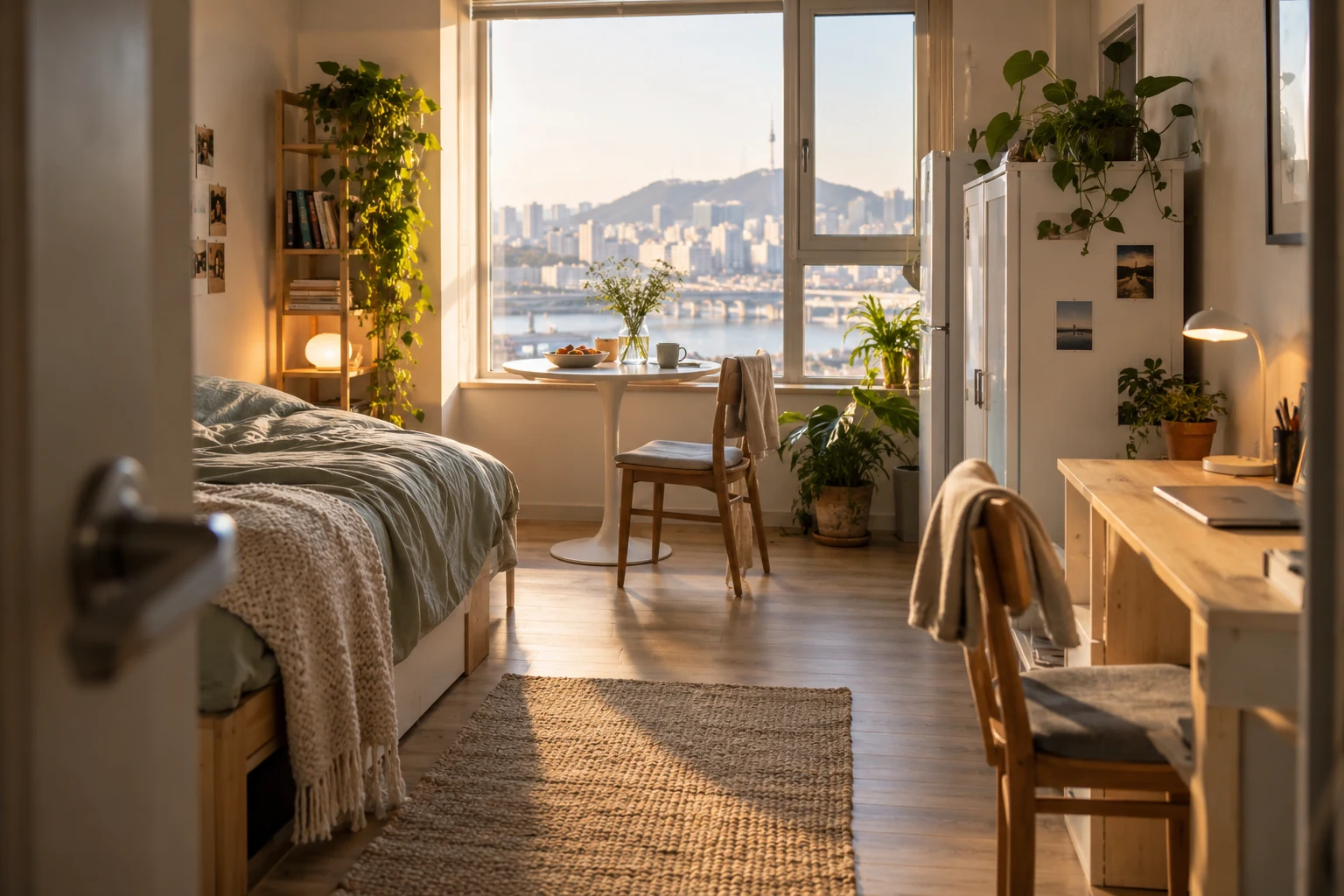
How many homes fit behind one front wall?
In an apartment complex, finding someone’s home usually means finding a building number and then a unit number. One building contains many front doors, each opening into a separate domestic space. A low building in a smaller street can be less legible from outside. It may look like one house, while different households run separate lives on its floors or in subdivided accommodation. Counting roofs, counting dwellings and counting the people who live inside them lead to different answers.
Imagine a small, hypothetical street. In the first building, two parents live with two children. The second building contains accommodation for five households, each running its own domestic life. In the third, someone lives alone in an officetel unit. There are three buildings, but more household units, and another total for residents. Although an officetel can be somebody’s everyday home, it belongs outside the “housing” category in the census classification discussed below. This is an illustration of counting, not a report about an actual surveyed neighbourhood.
Korean housing includes apartment blocks, detached houses, multi-household houses and officetels, among other spaces. A statement that there are “many homes” can therefore describe the number of structures, the amount of separate accommodation or the number of domestic arrangements. Leaving out the households behind one building’s wall makes a neighbourhood appear less inhabited than its everyday life actually is.
A family can live apart; unrelated people can share a household
In Korean statistics, a household describes a unit of shared everyday life rather than a family name. KOSIS, the national statistical portal, connects the definition to activities such as cooking and sleeping together. Parents and an adult child who maintain separate homes remain relatives without necessarily forming one household. A small group of people who are not related can also belong to the ordinary-household category. Someone maintaining an independent domestic life alone forms a one-person household. See the KOSIS indicator definitions.
The classification appendix to the 2021 census places family households, families living with unrelated people, one-person households and groups of up to five unrelated people within ordinary households. Groups of six or more unrelated people and collective arrangements in dormitories, nursing facilities or childcare institutions belong to a different category. Households composed entirely of foreign nationals are separately classified; a household with both Korean and foreign members belongs among ordinary households. These are statistical boundaries, not a ranking of which family is more legitimate. The distinction tells readers which domestic units a particular table includes. See the census appendix.
Resident-registration households add another layer: they are administrative records. Their membership does not always describe the same people who actually organise meals and living arrangements together. If the subject is how changing households use kitchens and dining tables, the relevant evidence concerns domestic life, rather than an interchangeable count of registration entries. An adult child establishing a separate home illustrates why this matters. Shopping, laundry and waste disposal become another household’s recurring tasks even when family relationships remain close.
Living in an officetel does not put it into every housing table
An everyday home and a census dwelling are overlapping concepts, not identical ones. The 2021 appendix describes living accommodation as a structurally separate, independent unit where people reside. Within that wider category, a dwelling meets requirements concerning a permanent or semi-permanent structure, at least one room and a kitchen, an independent entrance, and a customary unit of ownership or sale. Detached houses, apartments and other classified forms of housing fall within this narrower group.
The same appendix places officetels, hotel and inn rooms, dormitories, certain institutional accommodation, shacks and greenhouse accommodation outside the housing category. An officetel is a Korean building type associated with office and residential uses. Its placement here does not mean nobody lives there. It means that the census counts all living accommodation and the narrower housing category separately. A person living alone in an officetel can be a resident and a one-person household while the unit remains outside a particular dwelling table.
This changes what a comparison can show. A table restricted to dwellings may not capture officetel residence adequately when an article compares the everyday spaces of apartment and officetel residents. A table covering accommodation types has a wider scope. A bed, desk and refrigerator describe a domestic setting; a census label determines inclusion in a statistical category. Knowing where a place enters or leaves a table is more useful than treating one of those descriptions as the only real meaning of home.
One multi-household house: one dwelling in one count, five in another
A dagagu house makes the distinction tangible. The term refers to a house accommodating multiple households; it should not be confused with every building that happens to have several residents. In its comparison of census dwelling counts and the housing-supply calculation, the 2021 appendix explains that the census counts a multi-household detached house at building level, while the supply calculation reflects its separately divided accommodation. Its worked example is one building designed to accommodate five households: one dwelling in the census count, but five in the newer supply calculation.
Neither table has invented or erased four homes. They address different units: the dwelling considered through ownership, and the separated accommodation available within it. Whether all five spaces are occupied, whether one is vacant and how many people live in each are additional questions. Capacity to accommodate households and occupation on a particular survey day are different observations.
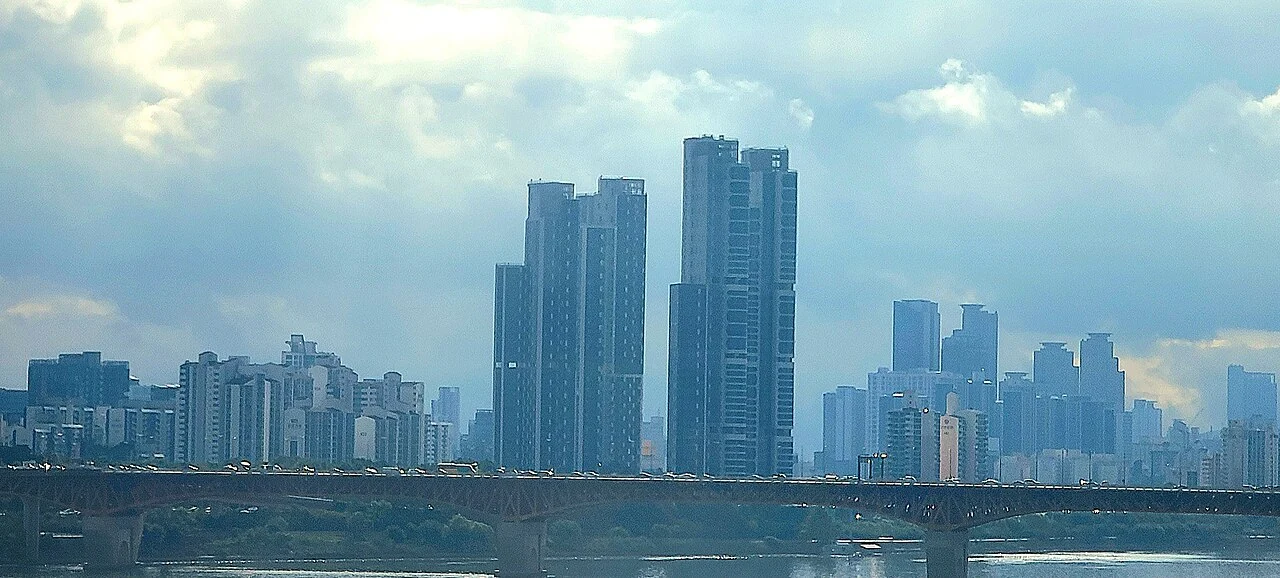
A photograph of an apartment tower illustrates a related problem. One tower is not one apartment. It contains separate dwellings as well as shared circulation through stairs, corridors or lifts. The apartment history article follows both building construction and the provision of homes for this reason. Separating the larger structure from its domestic units reveals how many lives have been brought together at one address.
A share of households is not the same share of people
Consider a second, deliberately small arithmetic example. Two households have one person each, and a third has four people. That gives three households and six residents. One-person households account for two thirds of the households, but people living alone account for one third of the residents. Giving each household one unit of weight produces a different answer from counting each person. These figures illustrate the calculation; they are not Korea’s actual distribution.
Apartment proportions can differ for the same reason. The share of the housing stock made up of apartments counts spaces. The share of households living in apartments counts domestic units. The apartment-resident population share counts people. An apartment with four residents and an apartment with one resident each count as one dwelling, but they contribute four and one respectively to the population. Similar façades can conceal very different household sizes.
This distinction begins the article about smaller households. As households increase and average membership declines, refrigerators, cooking equipment, shopping and laundry previously shared in one domestic arrangement can spread across several homes. It does not follow that every home becomes physically smaller. To describe floor-area changes, evidence needs to connect the people and the spaces they occupy, rather than making household size stand in for room size.
Empty between tenants, or empty for a year?
Census vacancy is a condition attached to a date. The 2021 appendix uses non-occupation on 1 November and includes temporary vacancy related to new construction, sale, letting, moving or unsold homes. Imagine tenants leaving in late October and new occupants arriving in mid-November. The space can be unoccupied on the reference date without being permanently abandoned. This is a classification example, not a finding about an actual property.
The appendix contrasts this with the vacant-house survey, which covers homes uninhabited for at least a year and excludes unsold homes and public rental housing. One measure takes a broad snapshot of occupation; the other identifies a longer-term condition relevant to the improvement of vacant properties. Omitting the survey name turns a briefly empty rental and a home left unused for years into one apparently uniform issue.
An empty home is not automatically suitable accommodation for someone else. Its location can be far from a person’s job or school, repairs may be needed, access may be difficult, and the owner’s terms may be unsuitable. These possibilities explain why a national vacancy total does not translate directly into a solution for housing need. Location, condition and actual availability remain part of the question.
Follow the space into an ordinary day
A person living alone may also use the dining table as a work desk. Several residents may need to fit meals and study into the same room at different times. These are illustrative uses rather than descriptions of surveyed households. They show why an identical floor plan does not produce an identical day. After counting rooms, a useful account asks who uses them and when.
Building form does not settle tenure either. An apartment can be owner-occupied or rented, as can a detached house. Housing type describes a spatial arrangement; tenure concerns the relationship through which somebody uses it. To discuss recurring costs or responsibility for maintenance, an article needs actual expenditure and contract information. A complex name or an exterior photograph cannot supply those details.
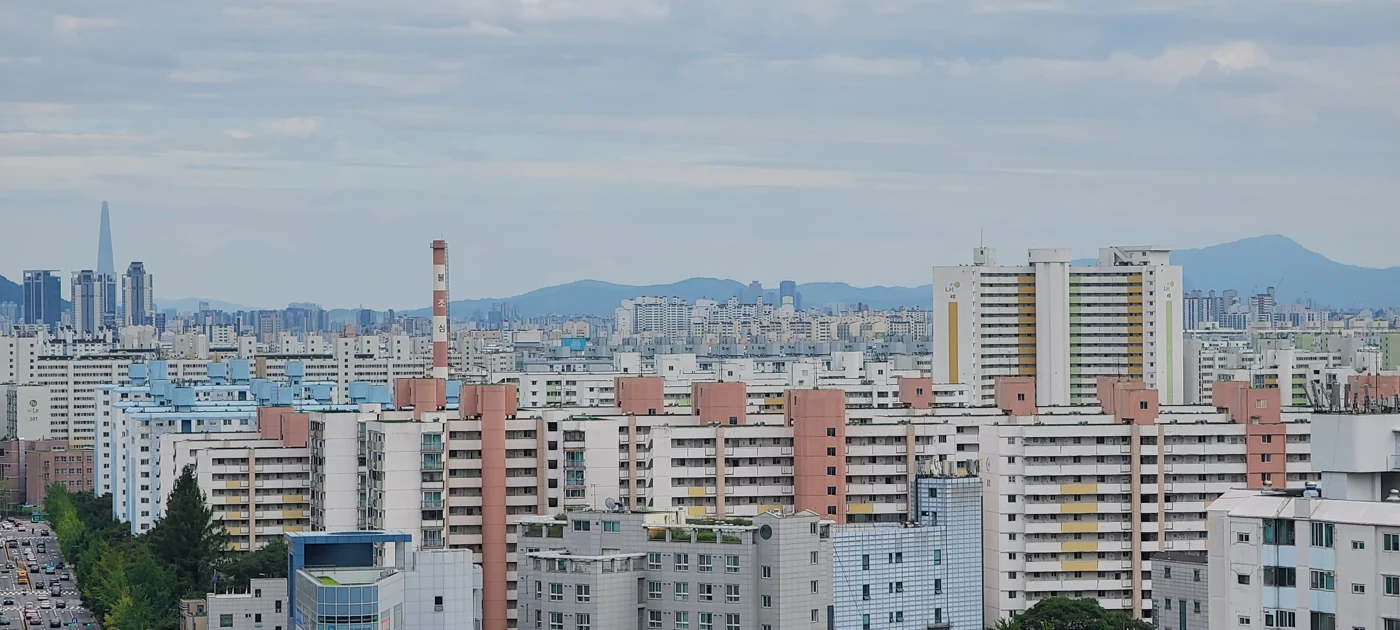
Korea’s residential landscape includes large apartment complexes, low houses in narrow streets, buildings associated with both work and residence, and collective accommodation. Different counting units produce different maps of that landscape. What interests me most is how many separate days take place inside one building, and which parts of the space those lives share. Used carefully, a number becomes an entrance into households that the outside view cannot reveal.
Following the separate days and shared spaces inside a building reveals the households that an exterior view cannot show.
Sources & scope
Population of Korea: indicator definitions ↗2021 Population and Housing Census: definitions and housing-statistics comparison appendix ↗2022-07-28Modules independently explains the verified sources. The lead image is AI-generated for illustration; it is not a documentary photograph of an actual place, event or product.
Updates & corrections
Dates record changes to this document, separately from the reference dates of its sources.
- Content update
Rewrote the article with fuller production, history, examples and source explanations.
- Document connections
Organised representative-document links, search descriptions, paragraph links and revision history. No factual correction.
- First published
Initial creation of the Korean and English document.