A circle that changes as you look
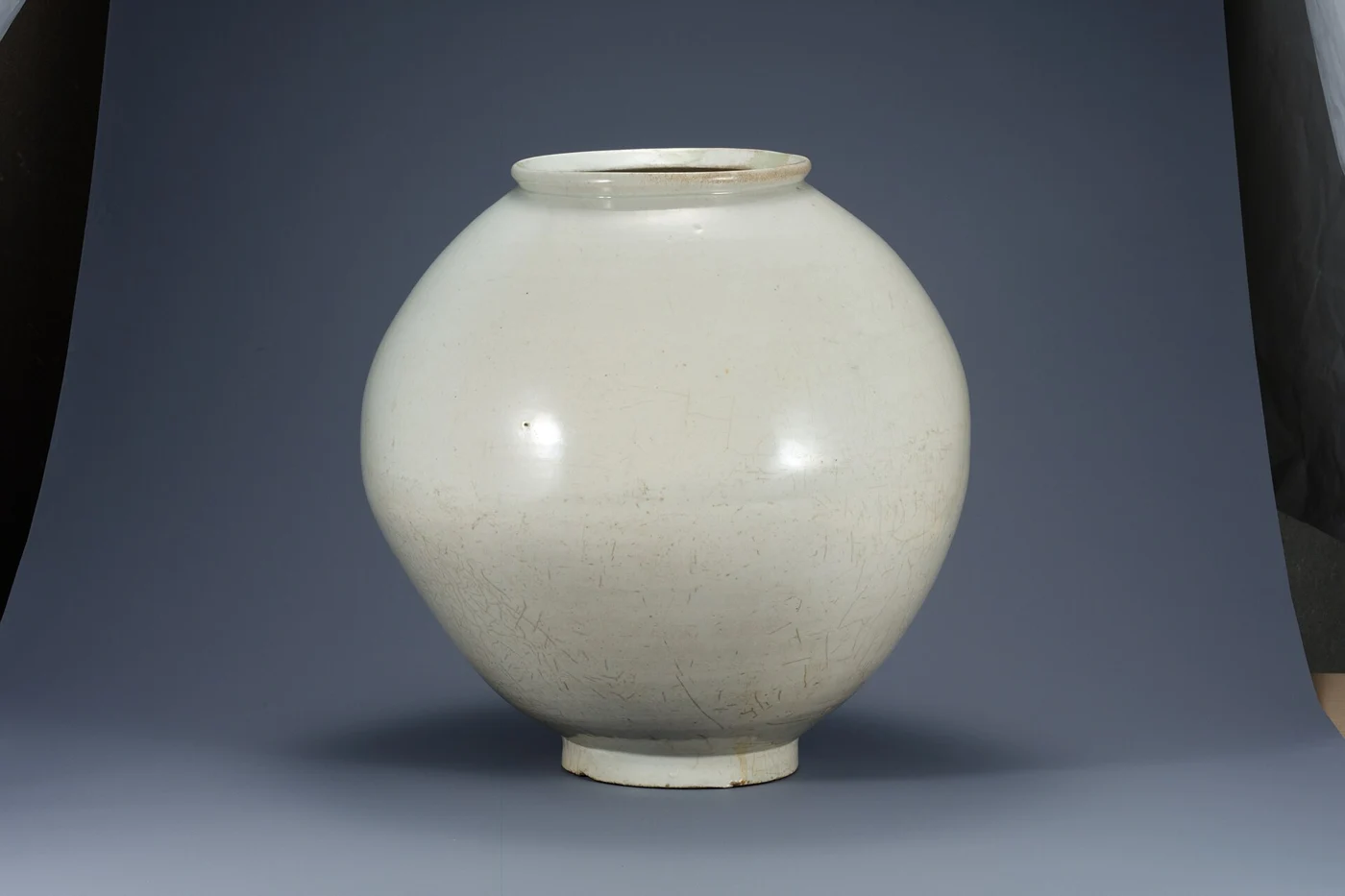
A moon jar seems easy to describe. It is a large white porcelain vessel, with a short neck and a swelling body that narrows towards its foot. Without painted decoration, its outline becomes the main event. Follow that outline from the mouth down both sides, however, and the curves may not mirror one another. One shoulder can look fuller; the other side can descend more gently. Calling this either a mistake or an expression of Korean serenity skips the most interesting question: how did the shape come into being?
The Academy of Korean Studies locates the emergence and popularity of late-Joseon moon jars in the late seventeenth and eighteenth centuries. The National Museum of Korea dates that name to the 1950s. Centuries separate the vessel from its present name. The Met describes its utilitarian daeho past and twentieth-century reappraisal. The time of manufacture and the time of encountering it in a present exhibition are different stages in the life of the object.
Joining two halves into one wall
Large moon jars were formed as upper and lower sections on the wheel, then joined around the widest part of the body. One section contains the bottom and lower curve; the other contains the shoulder and opening. When their broad rims meet, two hollow volumes become one interior. Dividing the height avoids raising the entire tall wall in a single operation. The waist is consequently both a boundary between volumes and a place through which weight must pass.
Matching diameters alone does not finish the work. If one rim spreads farther than the other, the contacting surfaces do not meet evenly. The lower section has to retain its shape under the upper section, while the joined area must become a continuous wall. Diameter, wall condition and alignment belong to the same problem. The smooth finished curve conceals the meeting of pieces originally formed as separate vessels.
Drying and firing follow shaping. Moisture leaves the body, and heat changes the clay and glaze into the finished ceramic. The National Museum of Korea notes cracks and distortion at joins. Supporting a large wall and passing through those changes are linked tasks. A regular circle made on the wheel does not guarantee perfect symmetry in the complete fired volume.
Round is not a measurement
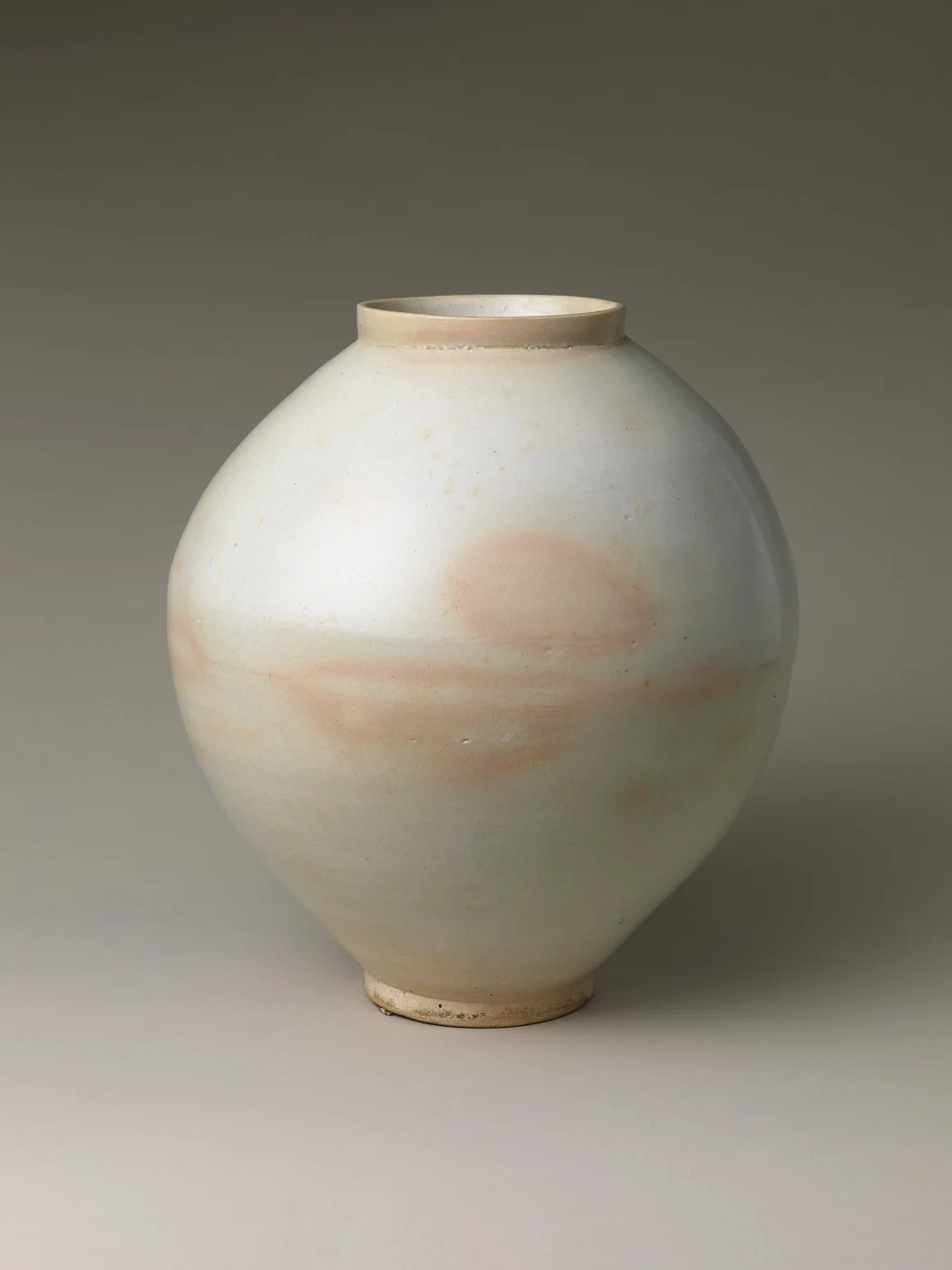
The Met’s eighteenth-century moon jar, object 1979.413.1, measures 38.7 centimetres high and 33 centimetres across its body. Those dimensions alone show why the name should not be mistaken for a geometric specification. One example cannot define the proportions of every jar, but it can unsettle the assumption that a moon jar must be a sphere with an opening added to it.
The rim and foot matter too. Crop them out of a photograph and the body becomes almost abstract. Include them and the image becomes a container again: a thing that must stand up and allow access to its interior. Looking at proportion connects an aesthetic response to these practical requirements. The full body does not float independently of the small structures that hold it and make it usable.
Dividing this object’s height by its body diameter gives approximately 1.17: the total height is about seventeen per cent greater than the maximum width. The height includes rim and foot, so this is a relationship between overall dimensions, not a formula for the body’s section. It makes the difference between an imagined ball and a standing vessel measurable. The body expands and narrows, then meets ends of different widths.
A white surface made by clay and glaze
The whiteness of porcelain brings the ceramic body and the glaze covering it into view together. Without a painted field, light across the body, shadow around the rounded shoulder and darkness inside the opening become especially noticeable. Glaze reflects light, and the location of the reflection moves as the curved surface turns. Unlike a patch of white on flat paper, the jar presents a volume and a surface at once.
The outer surface and the point where the vessel meets the floor do different jobs. Following the glossy body down to the foot returns an apparently floating sphere to a standing container. The Met records a rim diameter of 14 centimetres and a foot diameter of 12.4 centimetres for object 1979.413.1, against a body diameter of 33 centimetres. Two relatively small ends provide access to and support for a much larger body. Making the visible tonal surface and making a volume stand are work on the same object.
A contemporary maker facing the kiln again
Park Young Sook reported that only one jar in ten emerged in a satisfactory shape.
The account reveals the distance between a quiet finished surface and decisions made during production. A standing jar requires not only joining two formed volumes, but time to dry, fire and examine the result. The final shape becomes available only after firing; it is not simply a finished design copied unchanged from the wheel. A maker also decides which produced objects to retain as works. An exhibited jar is a selected result, rather than a display of everything produced.
Knowing that selection changes how I understand asymmetry. Neither a blanket explanation of inadequate skill nor an assumption that every altered shape is beautiful does justice to the work. What matters is joining two volumes, passing through fire and choosing again afterward. Labour that makes a large white interior stand does not diminish because the surface lacks a painted motif.
When one vessel became twenty-five images
Ik-joong Kang’s 25 Wishes comprised twenty-five moon-jar images and appeared in the Met’s 2009–2010 exhibition.
An actual vessel and repeated images meet the viewer differently. Looking at a jar sends the eye along its rounded body; moving sideways reveals another curve. Several images set beside one another invite comparisons of contour and colour within similarly bounded fields, then a movement from one image to the next. Making a vessel and arranging its images are distinct tasks, but both decide how a rounded volume will be presented.
Repetition does not turn an undecorated white jar into an empty image. It brings a familiar form into view again and makes small differences between familiar shapes conspicuous. Placing an old vessel within contemporary work continues beyond copying an outline. The decision to stand a thing in space connects with the decision to place an image within a field. Hanbok as form and practice likewise connects the assembly of clothing with changing settings of wear.
Small ends holding a large body
In the Met photograph, the outline narrows sharply below the widest part of the body. The short neck also leads to an opening much smaller than the shoulder. This 38.7-centimetre-tall vessel creates its volume between a small opening and foot. The point where the foot touches the supporting surface differs from the point where the body expands. Following that transition makes the standing structure visible, not just its circular outline.
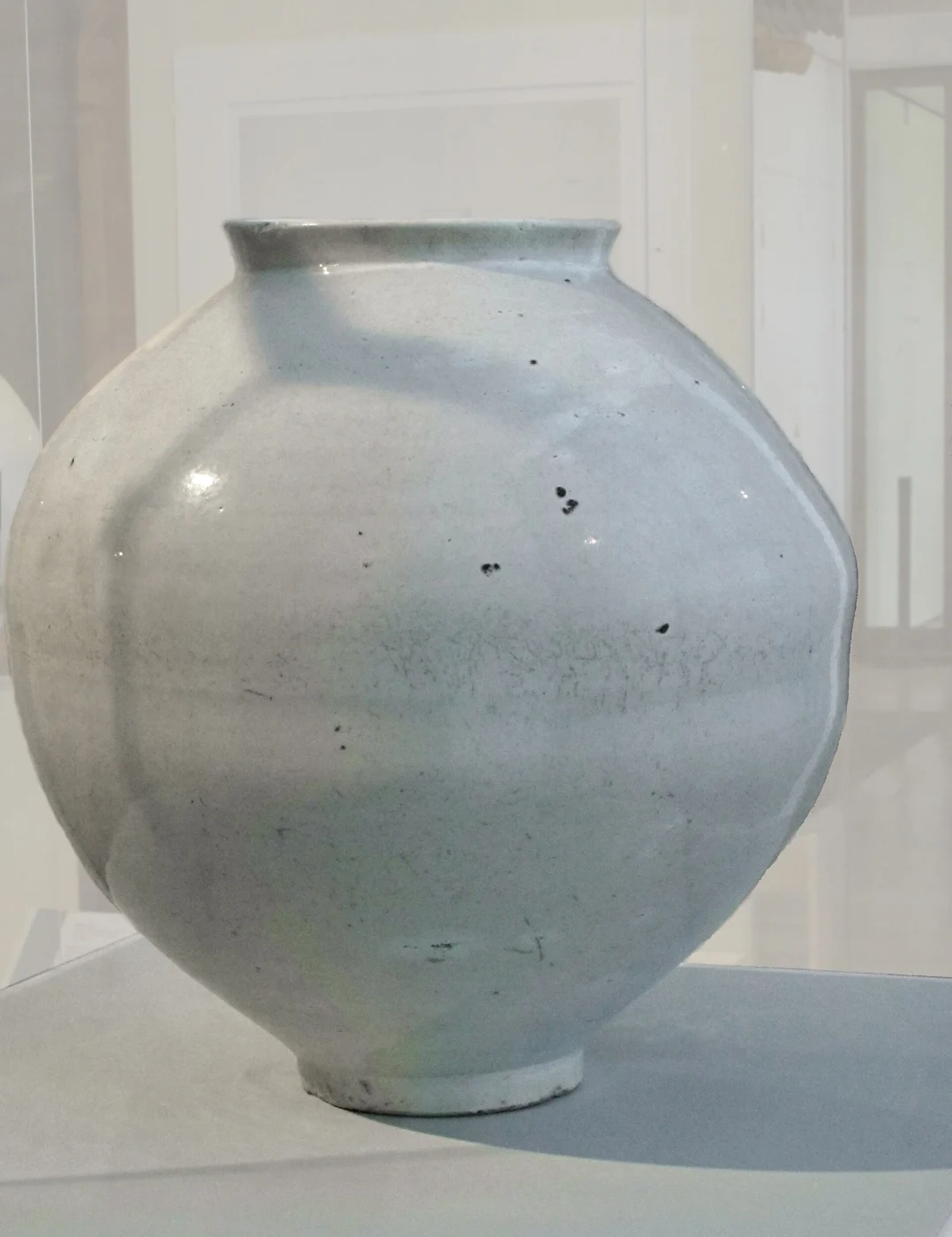
The photograph of another eighteenth-century moon jar displayed at the British Museum shows shoulders and side curves in a different proportion. These are records of different jars, rather than the same object under different lighting. Placed together, they show concrete variation within one name. A photograph retaining the rim, shoulders, waist and foot preserves more of that relationship than an isolated circular image. As the floor and roof enclose space in a Korean home, this rounded body has both a supporting part and an opening.
Decisions behind a quiet curve
The body retains a place where separately formed halves met and a curve that survived firing. Standing a large hollow volume between a small rim and foot involves more than drawing a circle. Two clay volumes meet; drying and firing follow; the maker confronts the result. Today’s viewer encounters the vessel retained from those results and the images subsequently made of it.
I find its attraction in connected choices rather than the single word imperfection: dividing a form to make its size possible, joining it into one body, selecting what emerged from firing, and placing it anew in photographs and exhibitions. The large white body is a static result, but the process that made it and brought it into view was not static. Slightly different sides can consequently be understood as a concrete shape made by hands, material and subsequent ways of seeing, rather than a decorative effect or a simple label of failure.
A moon jar’s curve holds the joining of two halves, drying and firing, and selection of the finished vessel. Objects and exhibition images present those choices in different ways.
Sources & scope
Joseon white porcelain moon jars ↗The Met’s moon jar, object 1979.413.1 ↗Park Young Sook’s moon-jar making experience ↗2014-05-17–2015-02-22The Met exhibition on the moon jar ↗2009-11-18–2010-05-16Joining the two parts of a white porcelain moon jar ↗2023-03-24Late-Joseon moon jars: chronology and assembly ↗2023-11-16White porcelain moon jar. Photograph provided by the National Museum of Korea.
National Museum of Korea · KOGL Type 1 · Resized and converted to WebP