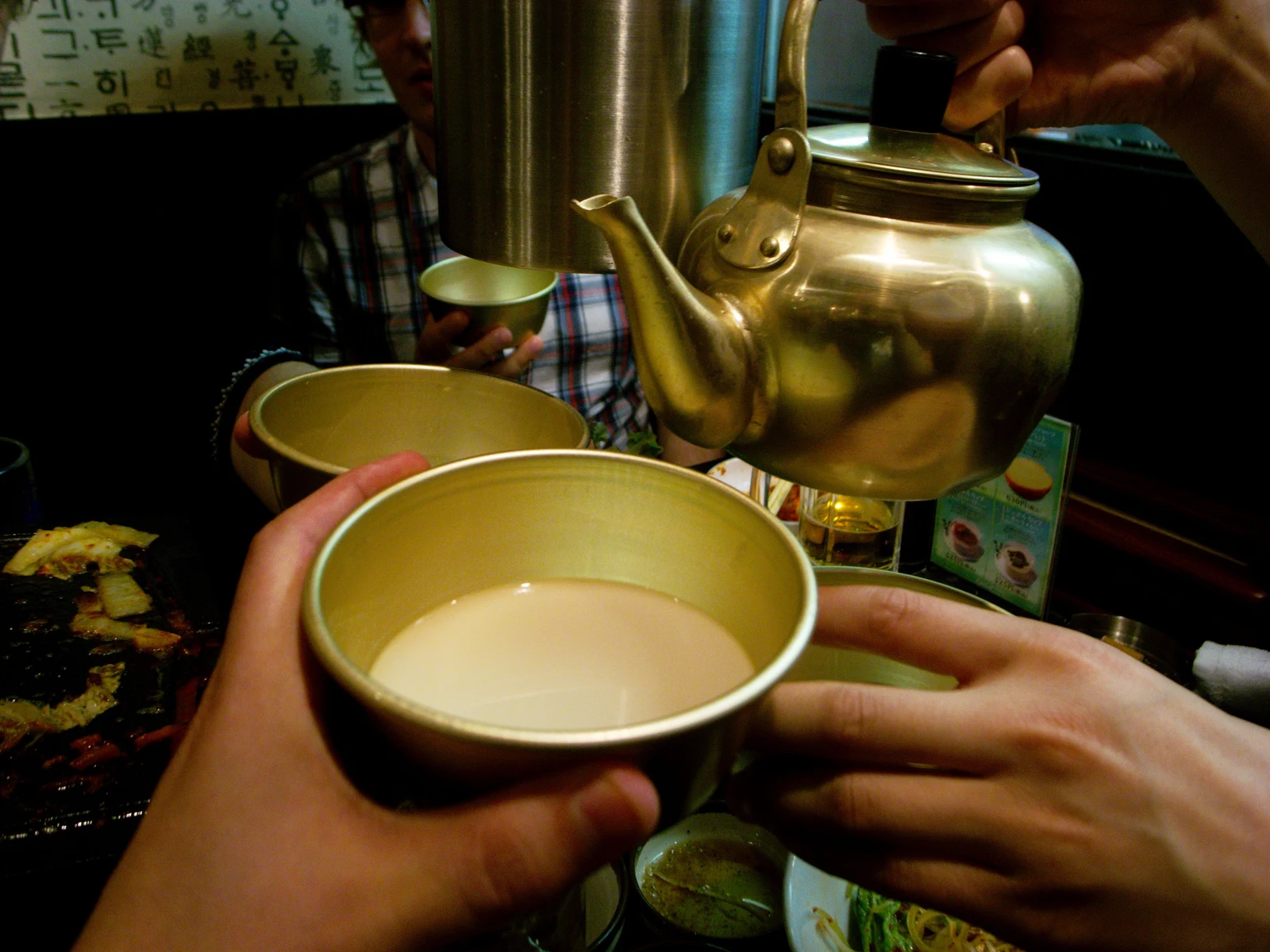
Two transformations in one vessel
Makgeolli poured from a kettle looks almost like rice has given its colour to water. But the change from something chewed to an alcoholic drink involves two different jobs. Rice contains starch. Yeast needs usable sugars rather than treating the starch in a grain as an immediately available meal. Enzymes first break starch down; yeast uses the resulting sugars in alcoholic fermentation. That distinction makes the cloudy glass more understandable than simply calling it rice wine.
Saccharification and fermentation overlap in the mash. Sugar can be released while yeast is already using what has become available. The grain softens and disperses as gas and alcohol develop. A brewer therefore watches the condition of the material, not just a calendar. The amount of sugar being formed and the amount being used are moving quantities within the same vessel.
Cloudiness belongs to a further decision. When coarse material is strained out but fine components remain, the liquid carries suspended particles. A settled lower layer shows that the colour is not a uniform dye. How the drink is mixed and poured changes the distribution of those components, giving the serving of the finished bottle a role in its texture.
Nuruk is a manufactured ingredient
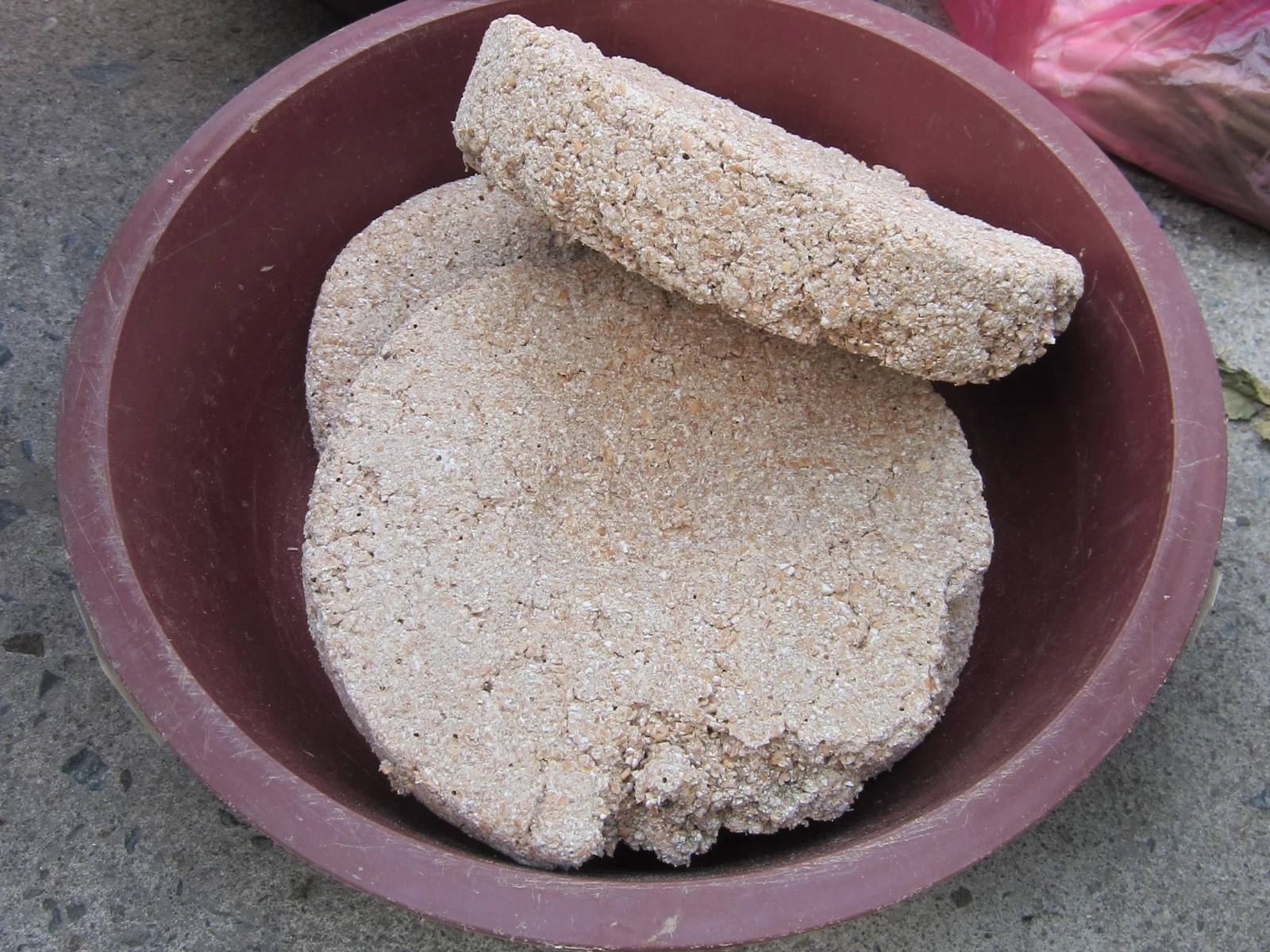
Nuruk is the starter used to initiate the process. The Academy of Korean Studies describes starters made from several grains and formed into different shapes. A round cake in a photograph has rough grain fragments, not the appearance of fresh white rice. Making this material is a separate job from steaming the rice that will become the drink. Breaking the finished starter into the mash brings previously prepared organisms and enzymes to a new substrate.
The roles are different: enzymes associated with moulds help break down starch; yeast ferments the available sugars; other organisms, including lactic acid bacteria, contribute to acidity. Nuruk is therefore more than another name for yeast. An enzyme is also different from the organism that produced it. One acts on a material, while a living yeast population consumes sugars as fermentation continues.
The starter's composition and manufacturing conditions affect what it brings to the mash. Selecting unidentified mouldy grain is not a substitute for a starter produced for brewing. Quality control belongs to the ingredient's own manufacture. Our article on jang follows a comparable hidden preparation behind fermented seasonings. Looking at nuruk as a manufactured material makes the people who prepare it visible alongside the brewer.
Washing, soaking, steaming and cooling
Barry Wong and colleagues, in a makgeolli study available through the Auckland University of Technology repository, washed, soaked and drained their rice before steaming and cooling it. Each operation changes the conditions of the next. Soaking gives water time to penetrate. Draining takes the rice out of standing water. Steaming then prepares grain with a different objective from a soft pot of rice made for immediate eating.
Heating changes the state of starch and makes it more accessible to enzyme action. Cooling matters because the next ingredients encounter the grain's temperature. A deep mound retains heat within; spreading it changes how quickly the centre cools. Adding cold water to hot rice does not automatically make every grain and every part of the vessel identical in temperature.
Once the rice, water and starter meet, the water is more than a dilution destined for the glass. It forms an environment in which materials disperse and dissolved substances move. The preparation of the grain remains present in that environment. A brewery's management of batches and temperatures is the practical work of reproducing these conditions, rather than a pause while an old-fashioned process takes care of itself.
Adding everything once, or feeding a developing mash
Some methods combine the materials in one stage; others begin with a base and add rice later. New starch then enters a liquid in which organisms are already active and fermentation products have begun to accumulate. Dividing the additions requires extra preparation and timing.
Wong and colleagues compared four methods: nuruk alone, added yeast, two-stage and three-stage brewing. In a sensory evaluation involving 62 participants recruited in Auckland, New Zealand, the two-stage sample received the highest preference. This result belongs to those experimental materials and participants. Adding fresh rice to an active base differs from placing everything together at the start: new starch meets a liquid in which organisms and fermentation products are already present. Preparing the base before feeding the next material requires more work, but also gives the maker another point at which to shape the process.
The result is not a rule that more stages always improve a drink. It is a concrete comparison in which changing preparation produced samples that elicited different responses. A label can list the same rice and starter while omitting when they met. Explaining that sequence gives the reader something material to connect to sweetness and acidity, rather than describing an abstract preference for tradition or innovation.
Sweetness in the finished glass also has several possible sources. Residual sugars, added sweetening ingredients, acidity and alcohol all contribute to how a product tastes. Reading the ingredients and the production description together provides more information than assigning every difference to the word nuruk. Preparation and additions continue to matter alongside the starter.
A separate workplace in Busan
A 2022 Korea.net report visited the nuruk-making work at Geumjeongsanseong in Busan. Grain dough was shaped by treading and managed on shelves. That scene sits upstream of the bottled drink: it is a place making starter, not a refrigerator storing a finished product or the vessel holding rice mash.
Shaped dough has a thickness and a surface. Managing the material involves how air, moisture and heat reach it. When it is eventually broken up for use in the mash, the starter maker's work connects to the brewer's at another moment. The high room temperature described in a starter-making report should not be transferred to the fermentation temperature of the drink itself. They are different operations.
The value of this case is its visible labour. A round cake used merely as a symbol of tradition hides the mixing, shaping and tending that produce it. Describing those jobs gives a regional name a material location. Korean food is made at workplaces far from the finished dish or bottle as well as in front of the customer.
Straining and the bottle's own time
Straining separates coarse solids from fermented mash. Fine material can still remain in the liquid and contribute to the cloudy texture. Subsequent adjustment of the drink's concentration belongs to preparing the finished product. The quantity of starting rice and the fermentation period alone do not describe everything in a retail bottle.
Heat treatment changes another part of that product. Living organisms in unpasteurised makgeolli can continue to affect its condition. Pasteurisation is a process used to suppress that activity, but the word does not give every bottle unlimited room-temperature storage. Its label supplies the actual storage conditions and use-by information. Korea.net's 2015 introduction discusses the raw-versus-treated distinction in relation to distribution.
Serving is a final handling step. Sediment can produce a thinner first pour and a thicker last one. Aggressively shaking a carbonated bottle before opening can also make it overflow. Follow the product's handling instructions and mix gently when appropriate. That ordinary movement in the hand is part of the drink's physical journey.
Giving a familiar flavour more names
Calling makgeolli only an old rural drink hides steamed grain, starter manufacture, controlled additions and distribution. Describing only new packaging does the same from another direction. People prepare rice, make nuruk, watch fermentation, finish the product and manage its storage. Their separate work arrives in the same glass.
Our Hanwoo reference separates cattle identity from cuts and grades. With makgeolli, separating raw material, process and finished condition similarly enriches the explanation. My editorial preference is for regional and traditional names accompanied by an actual account of production. An explanation cannot replace aroma, but it gives the time behind the aroma a place in memory.
The cloudy glass is the trace of grain being transformed. Even after brewing, its condition must be handled in a bottle and at the table. Recognising those steps makes an apparently plain white drink worth lingering over: not because it promises mystery, but because an ordinary sip contains work that can be understood.
Starter enzymes release sugars from starch while yeast ferments them; preparing grain, making nuruk, straining and bottle handling shape the finished makgeolli.
Sources & scope
Nuruk materials and forms ↗Nuruk-making work at Geumjeongsanseong ↗2022-08-25Preparing steamed rice for traditional drinks ↗2022-09Original study comparing makgeolli processing routes ↗2022-12-27Live and heat-treated makgeolli in distribution ↗2015-01-12Makgeolli photographed on 27 May 2010, with a kettle and small serving cup.
Jon Åslund from Sweden · CC BY 2.0 · Resized to a maximum long edge of 1600 pixels and converted to WebP