There was a book before the prize
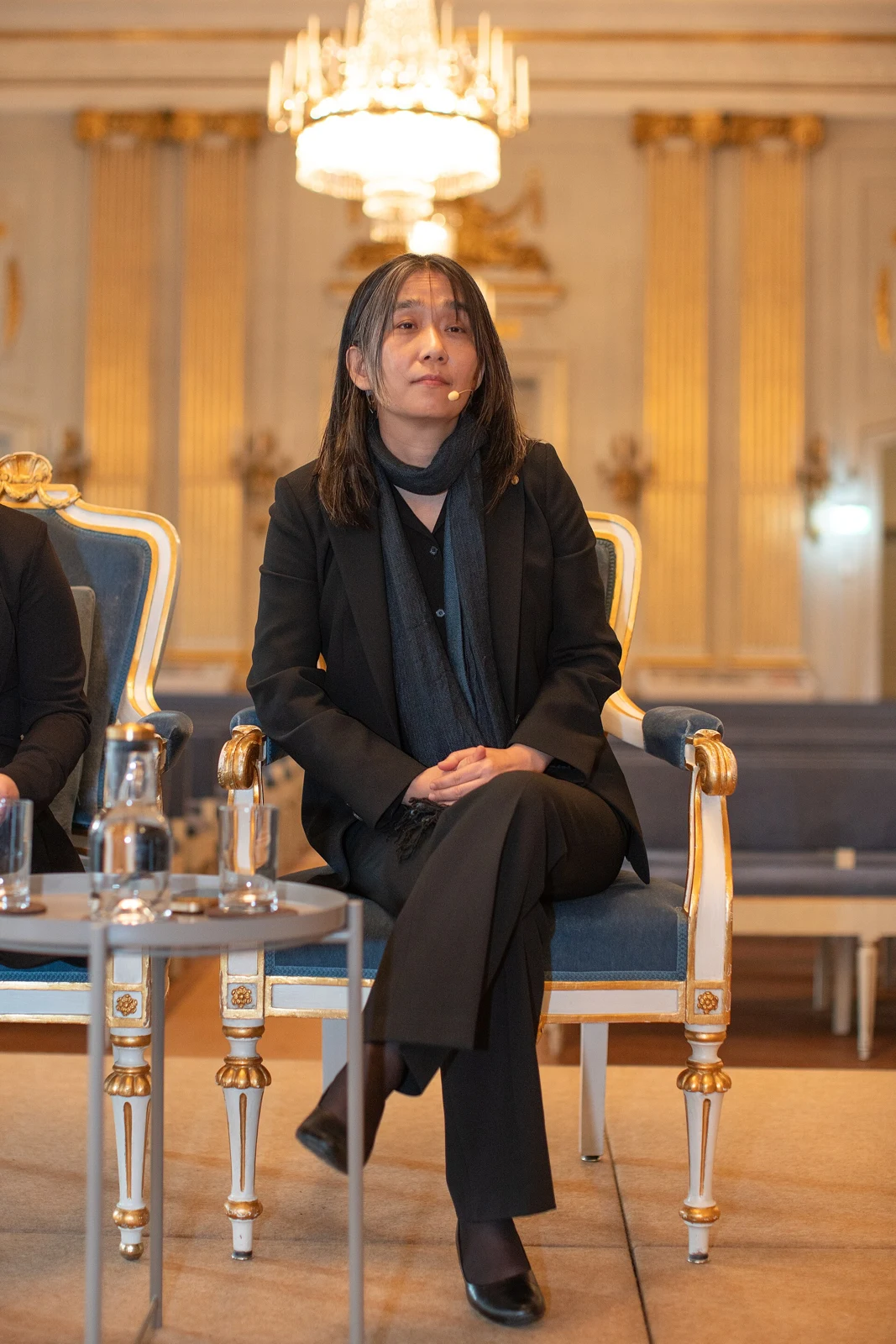
When Han Kang’s name was announced for the Nobel Prize in Literature on October 10, 2024, some readers abroad already knew her through translation. Others began looking for a book that day. The Nobel announcement created a visible moment of attention, but a translated edition had a longer history. Reading, drafting, revision and publishing work had begun before that moment.
Literature travelling abroad is not simply a shipment of books. A Korean-language work needs new sentences, agreements, editing, production and distribution before another reader can encounter it in their own language. Looking beside an author’s name for the translator and publisher begins to reveal that route.
Three examples make it tangible: Han Kang’s The Vegetarian with Deborah Smith; Bora Chung’s Cursed Bunny with Anton Hur; and Hwang Sok-yong’s Mater 2-10 with Sora Kim-Russell and Youngjae Josephine Bae. Rather than treating these works as expressions of a single Korean mood, we can follow their different collaborations.
Why a translator appears beside the title
The Booker record identifies The Vegetarian as Han Kang’s work, translated by Deborah Smith, and the 2016 International Booker winner. The book’s record names both people. A translator credit tells readers who made the sentences in the language they are now reading.
Most readers do not check every sentence against Korean. They follow dialogue and narration through the translated prose itself. Sentence divisions, repetitions and changes of perspective affect the pace of that encounter. Knowing the same plot does not automatically produce the same reading experience. Literary translation must establish meaning while making language work as prose.
Korean honorifics offer an accessible example of the difficulty. Endings and forms of address can carry age, familiarity, distance and authority. Another language may not organize those relationships in the same forms. A replacement word alone may leave something unexpressed; tone and surrounding context matter.
Another book is another encounter
Cursed Bunny, written by Bora Chung and translated by Anton Hur, reached the 2022 International Booker shortlist. Shortlisting differs from winning. Its official record also identifies its short-story form. A reader introduced to Korean writing by one novel can find a very different next book in a collection by another author.
A novel carries a sustained movement through a volume. A collection repeatedly starts afresh as stories change. Translating it involves both the coherence of a book and the rhythms of separate pieces. Readers may remember the category “Korean literature,” but what they actually read is a variety of forms and sentences. Treating one successful work as a formula for every other work obscures that variety.
A book can attract someone through horror, short fiction, a long historical novel or an individual writer’s style. Its Korean background is one possible reason, not a replacement for the others. Literature deserves attention as something readers choose to continue reading, rather than as an accessory to another branch of Korean culture.
Two translators make one volume
The English edition of Hwang Sok-yong’s Mater 2-10 credits Sora Kim-Russell and Youngjae Josephine Bae. It reached the 2024 International Booker shortlist. The book’s record challenges the assumption that one volume necessarily has one translator.
Their interview describes dividing chapters, exchanging drafts and revising together. Consider a separate, hypothetical editing problem: a factory worker in an imagined novel appears under a surname at work and as “father” in a family scene. Matching these references does not mean replacing them with one uniform name. A child and a colleague address the same person from different relationships. An editor could mark the speaker, addressee and time of each scene, then reread neighboring sentences to check whether a revision changes that relationship. Replacing a pronoun with a name may clarify its referent, but it can also reveal information earlier than the story intended. Clarity at sentence level and the timing of narrative disclosure have to be considered together.
Collaborative translation brings several problems into focus. Names and terminology need continuity; a character’s speech must remain intelligible across chapter boundaries; an expression introduced earlier must still work later. Splitting a task and making its results cohere are different kinds of work.
This example also separates a first draft from publishable prose. Reading another person’s draft within the whole can expose connections missed during composition. Decisions made near the beginning continue into later chapters. Translation time includes revisiting what has already been translated, not merely reaching the last page.
What a publisher reads before a complete translation
An overseas publisher cannot necessarily assess every Korean work in its original language. LTI Korea supports sample translations and synopses through its copyright-export programme. The programme description shows a translation stage before the full edition: materials that make publication decisions possible.
A synopsis and a sample serve different purposes. One presents the larger progression; the other offers an encounter with actual prose. Description alone cannot deliver style, while an extract cannot reveal the entire structure. Their combination helps a publisher examine a prospective book. This does not turn the reader’s eventual edition into a summary; it supports the earlier decision to produce that edition.
Rights and translation agreements follow. LTI Korea’s publication-grant guidance requires publishers to contract with rights holders and translators before applying. The publication programme distinguishes interest in a book from responsibility for publishing it. Support can help sustain work; it cannot choose on behalf of future readers or automatically establish literary value.
The manuscript is not yet the book
A translated manuscript still meets editing, proofreading, layout, cover design and the information through which readers find it. A sentence and a printed page are different units. A page break can interrupt dialogue; headings and contents guide movement through the volume. Readers encounter the work in that produced form.
The grant procedure itself separates final proofs from the published volume. Manuscript readiness and publication are different moments. Not every translated Korean book receives this support or follows the same route. One public programme nevertheless reveals that publication involves stages of responsibility beyond transferring a file.
An author’s face at a ceremony is easy to see. A contract’s scope, an editor’s revision time and small differences caught in proofs are less visible. Their outcome returns to the reader as an experience: prose that holds attention, transitions that support the next page, and a book that remains worth reading even when its outline is known.
Reading lasts longer than an announcement
The work of translators did not suddenly appear after a successful title. LTI Korea established its Translation Academy in 2008. Its educational history and course information reveal a continuing place to study literary translation. Training cannot guarantee publication, but it provides a setting in which the craft can develop.
From an editorial perspective, counting prizes alone gives an incomplete account of Korean literature abroad. A prize may open a door. The reason to seek another book remains in the reading itself. Translator credits, exchanged drafts and publishing samples reveal the work behind that door.
Moving from The Vegetarian to Cursed Bunny or Mater 2-10 can mean encountering different writers’ choices rather than assembling one image of Korea. Other ways of reading today’s K culture and stories about Korean places widen the background. What remains after a book closes is less a national scorecard than a sentence or question. Remembering the people who made it readable in another language makes the journey much broader than the moment of an award.
Authors, translators, editors and publishers make the book readers encounter. An award is one visible moment in that longer route; the reason to read another book remains in the reading.
Sources & scope
The Nobel Prize in Literature 2024 ↗2024-10-10The Vegetarian: book record ↗Cursed Bunny: book record ↗Mater 2-10: book record ↗Author and translators discuss Mater 2-10 ↗Translation Academy history ↗Translation Academy courses ↗Publication grants ↗Sample translation and synopsis support ↗Han Kang at a Nobel Week press conference in Stockholm on 6 December 2024.
John Sears · CC BY-SA 4.0 · Resized and converted to WebP; Modified image remains under its original CC BY-SA license