A second screen faces the stage
A concert camera usually follows the singer. Pull back, however, and the audience makes another picture. One handheld light is a point; rows of them form a surface facing the stage. That change of scale is what makes a K-pop light stick worth examining. It is a purchased object, but it can also become part of the performance's visible setting. The listener has a seat and, at the same time, a way of answering that can be seen.
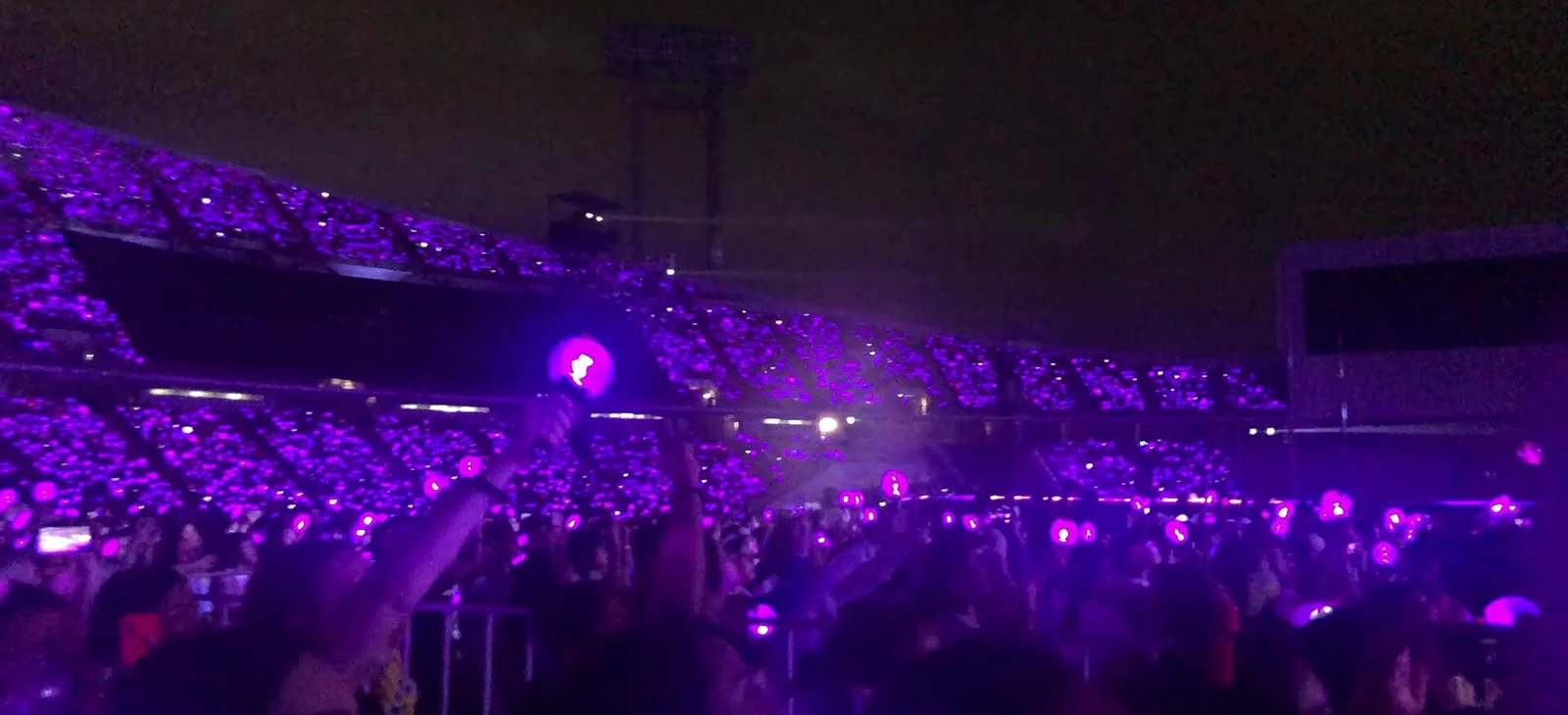
A photograph from BTS's Bangkok concert on 7 April 2019 shows an audience filled with purple lights. The image records the appearance of the crowd, rather than proving how every device was controlled. Still, it makes the exchange tangible: music travels outward, while light and voices return. A souvenir becomes more interesting when we ask what people do with it before, during and after the show.
An identity you can hold
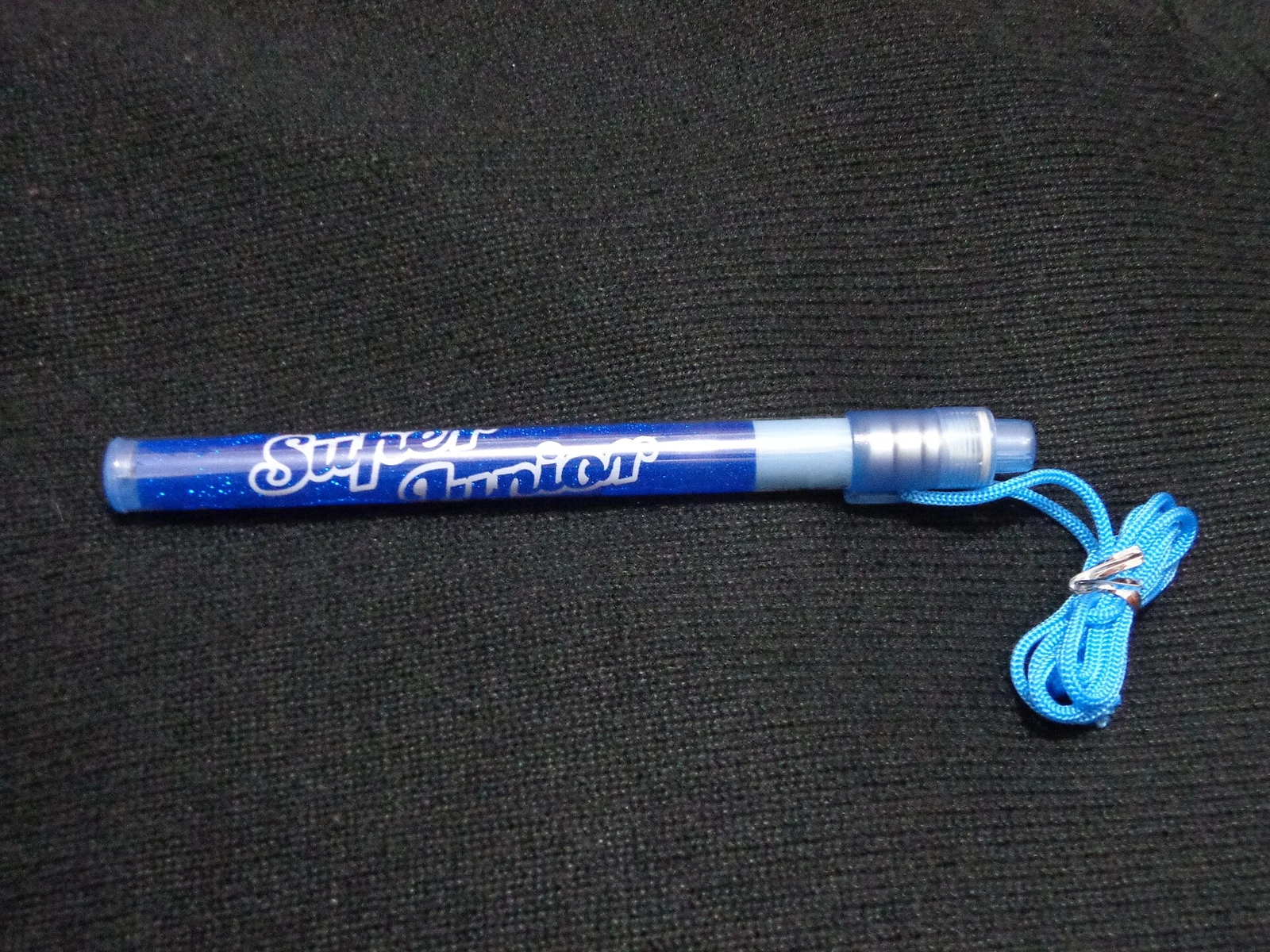
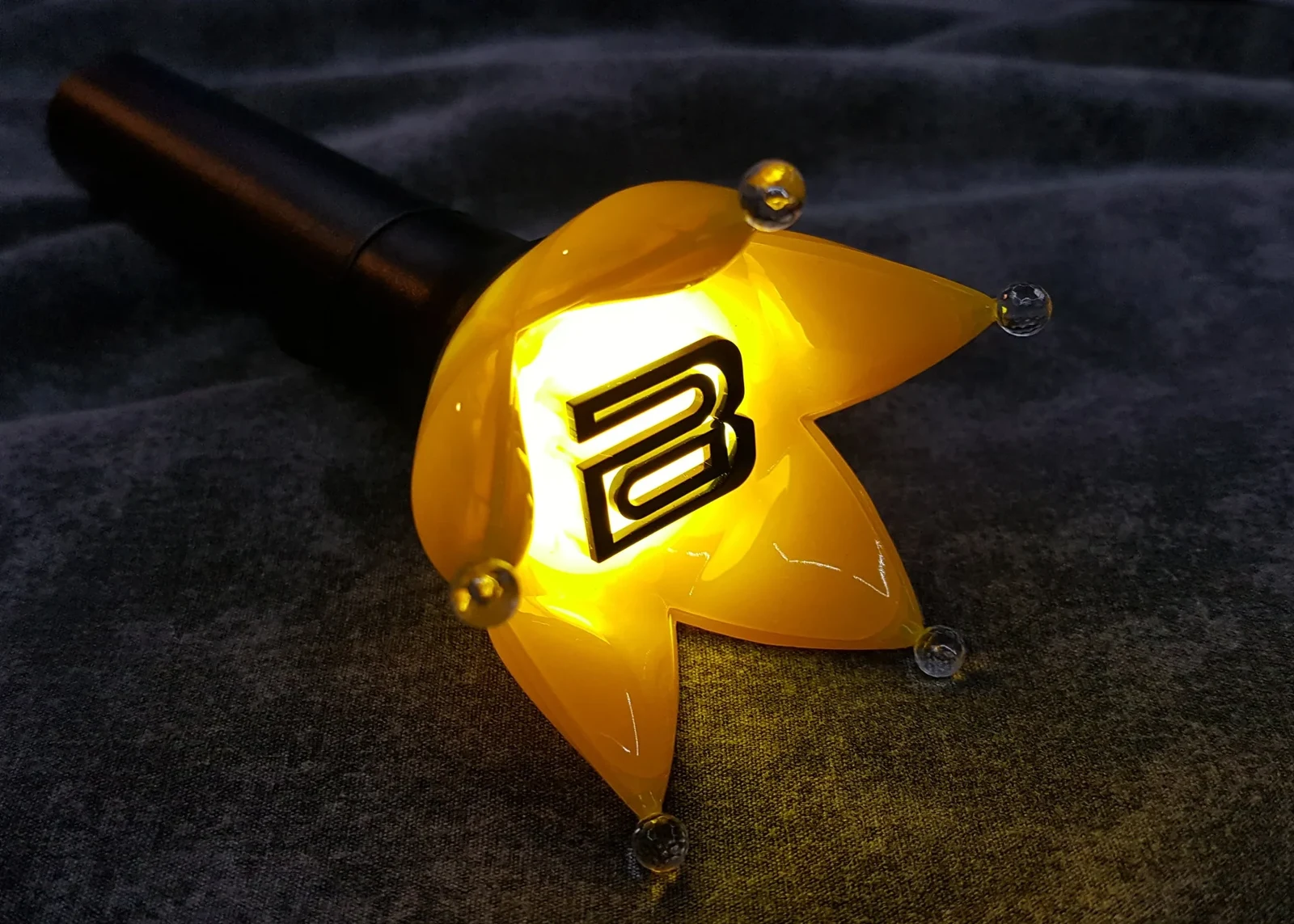
The photographed Super Junior stick from 2015 has a long blue body and lettering; the pictured BIGBANG stick has a yellow crown-shaped head. Those are visible differences between particular objects, not a universal evolutionary sequence. One emphasizes a line, the other a silhouette. Raised at the same angle, they would make different shapes in a distant crowd.
A design must be recognizable from afar and usable up close. The grip, button, wrist strap and battery cover belong to the practical life of the object. A photogenic head and a comfortable handle answer different needs. Holding something through a concert makes balance and weight relevant in a way a product photograph cannot convey. For its owner, the stick becomes equipment to prepare and store, as well as a symbol.
That symbol does not measure commitment. Some fans buy official merchandise; others come to listen without it. Following one group for years and attending several artists' shows are different kinds of musical life. Because a stick is visible, it can misleadingly stand for everything a fan feels. Neither its price nor its version tells us how much someone values a song.
When a light acquires a seat number
Switching on a stick and connecting it to a venue are separate actions. One joins hand and object; the other joins object, seat, app and event operation. The official notice for BTS's June 2026 Busan concerts supplies a specific example: wireless control of Ver.4 required current firmware and seat pairing. These were conditions for that event and version, rather than rules for all K-pop shows.
Seat pairing helps explain the change in role. A production can treat the audience as positions in a space, rather than merely a mass of illuminated objects. The small device has to enter an arrangement larger than itself. The seat number connects an individual light with a picture operating at another scale.
For an attendee, the arrangement starts with ordinary checks. Does the stick turn on? Can the app find it? Have the correct performance and seat been selected? Working as a lamp is not the same as participating in that show's control. Connecting to a phone does not establish compatibility with every venue. Electronic merchandise brings a modest layer of equipment preparation into the anticipation of live music.
From Japan in 2023 to a booth in Bangkok
SEVENTEEN’s notice states that seat-linked use of Ver.3 began with its November 2023 Japan concerts. The firmware notice identifies that change. The same physical object can acquire different conditions of use when its software and event information change. Preparing the device and placing it within a particular performance are separate tasks.
The sequence begins with the ticket’s date and seat, followed by the official app and connection to the stick. Firmware concerns the device’s programme; seat registration concerns the attendee’s location that day. At the venue, the relevant mode still matters. An app need not offer every event in the same state at every moment, so preparation also has a timetable.
For the December 2023 Bangkok FOLLOW concerts, the organizer offered both pairing booths and app-based self-pairing. The Bangkok operations notice shows two routes into one production: prepare independently or obtain on-site help. Installing technology and enabling a varied audience to use it require different work.
Placed beside the 2026 BTS Busan notice, this example explains why support is managed by version and event. The stick is both an artist’s symbol and equipment for a particular show. Its owner also becomes a participant bringing equipment into the venue. Linking a ticketed place with a handheld object creates a small preparation process outside the stage.
The work behind the spectacle
The same Busan notice describes light-stick service booths. Pairing, firmware and repairs sit alongside the language of a concert, revealing work that a finished crowd video rarely shows. Buying the device is only one moment in its life. Someone also has to help make it function in the right place on the right day.
At home, a button test may seem enough. At a venue, an accidentally pressed switch, used batteries or an event-specific setting can matter. A fan need not be a technician. Clear instructions and accessible help are valuable precisely because people have different levels of familiarity with equipment. Behind the luminous picture are decisions, troubleshooting and preparation, not simply enthusiasm.
A new version can offer production possibilities while leaving previous owners with expense and waste. Calling that progress does not settle the question. Support information should let people understand what their existing object can do. In our view, a compelling spectacle is strengthened when participation remains an informed choice, rather than a contest to keep purchasing the newest device.
An audience also has a voice
Light is only one response. Fan chants add short, timed vocal parts to particular points in a song. A song-specific example is BTS's official “No.29” fan-chant guide. The existence of a guide shows that listeners can prepare an answer before entering the venue. Singing every lyric and contributing at selected moments are different musical actions.
The stage arranges time through instruments, voices and movement; the audience can learn when to wait and when to enter. Light is seen across distance, while a chant is heard within a beat. A raised arm and a timed voice participate differently in the same song. The organization of fandom becomes concrete in these small coordinated gestures, as people learn where their contribution enters the song.
A prepared response need not become the only correct way to attend. A newcomer, a listener unfamiliar with the language, or someone who prefers silence also belongs in the audience. What feels effortless to an experienced fan may be a rule another person has to learn. Shared customs are most generous when they offer an entrance without making every difference feel like a failure.
The object after the event
Back at home, the stick is detached from the crowd's arrangement. Its light remains, but the surrounding rows are gone. On a shelf or in a drawer, it waits for another occasion. Taking it out again can bring an earlier concert and a future plan into the same gesture. The object holds something a replay cannot reproduce: the fact of having occupied a particular place beside other people.
Merchandise looks straightforward when measured only as a sale. Follow its use and a longer sequence appears: expectation, preparation, participation and storage. The provider supplies an object and instructions; the owner adds time and memory. The point at which a product becomes a personal keepsake cannot be printed on its price label.
Seeing the small light clearly
The stick's attraction is that it makes the audience visible. Its value should include the conditions of that visibility: useful support, understandable version changes and a welcome for people who do not buy one. If fans help create a scene, production owes them an explanation of the conditions of participation.
Among the many entrances into Korean culture, this is an entrance joining music to space. Read alongside Korean places, a concert venue becomes somewhere whose meaning changes with what people do inside it. The little light survives the show partly because it once shone beside other lights. Its remembered scale is larger than the object held in a hand.
An artist’s symbol becomes event equipment when it joins a seat and a production. Clear support and freedom to participate matter as much as the spectacle.
Sources & scope
BTS Busan light-stick support ↗2026-06-12BTS No.29 fan-chant guide ↗SEVENTEEN Ver.3 firmware update ↗SEVENTEEN Bangkok pairing booths ↗2023-12A frame from Chris Belison’s video of BTS’s Love Yourself concert in Bangkok on 7 April 2019, showing the audience.
Chris Belison · CC BY 3.0 · Still frame extracted from concert video; resized and converted to WebP