A bath that does not end at the exit
The interesting part of a jjimjilbang is often outside its hottest room. After washing, visitors put on comfortable clothes and remain in the building instead of dressing for the street. Someone eats a roasted egg; someone watches television; another moves between warmer rooms and places to rest. Bathing, heat, food and leisure follow one another within a single admission. Calling it simply a sauna can miss the connections between wet bathing areas, clothed rooms, a food counter and a lounge.
Korean signs sometimes overlap the terms bathhouse, sauna and jjimjilbang. The useful distinction is the actual layout. A facility centred on baths and showers creates a different visit from one that also provides clothes, several rooms, food and recreation. The Korea Tourism Organization's 2020 guide describes this combination as a leisure facility. Washing the body and spending time occupy the same building, but do not require the same environment.
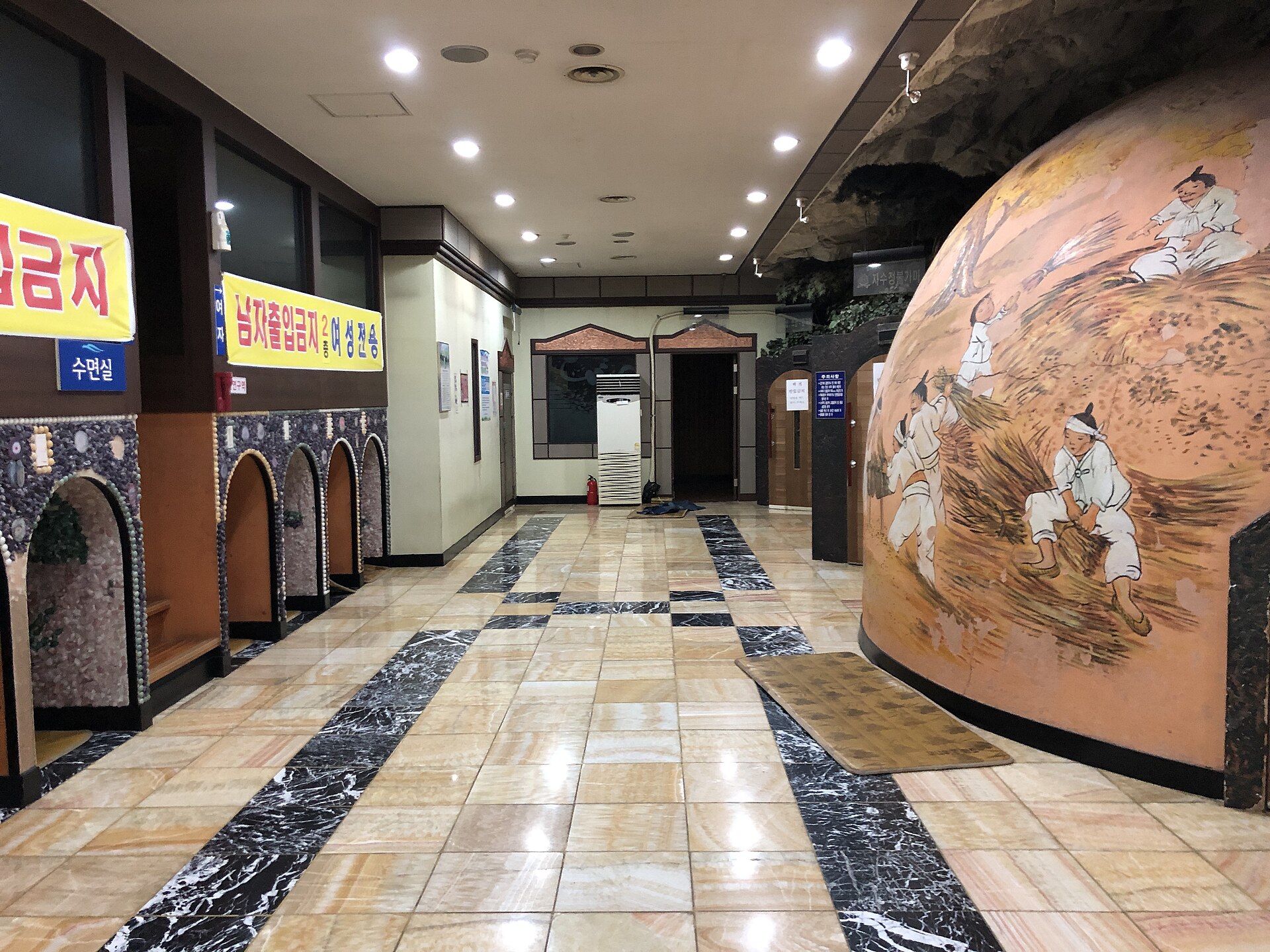
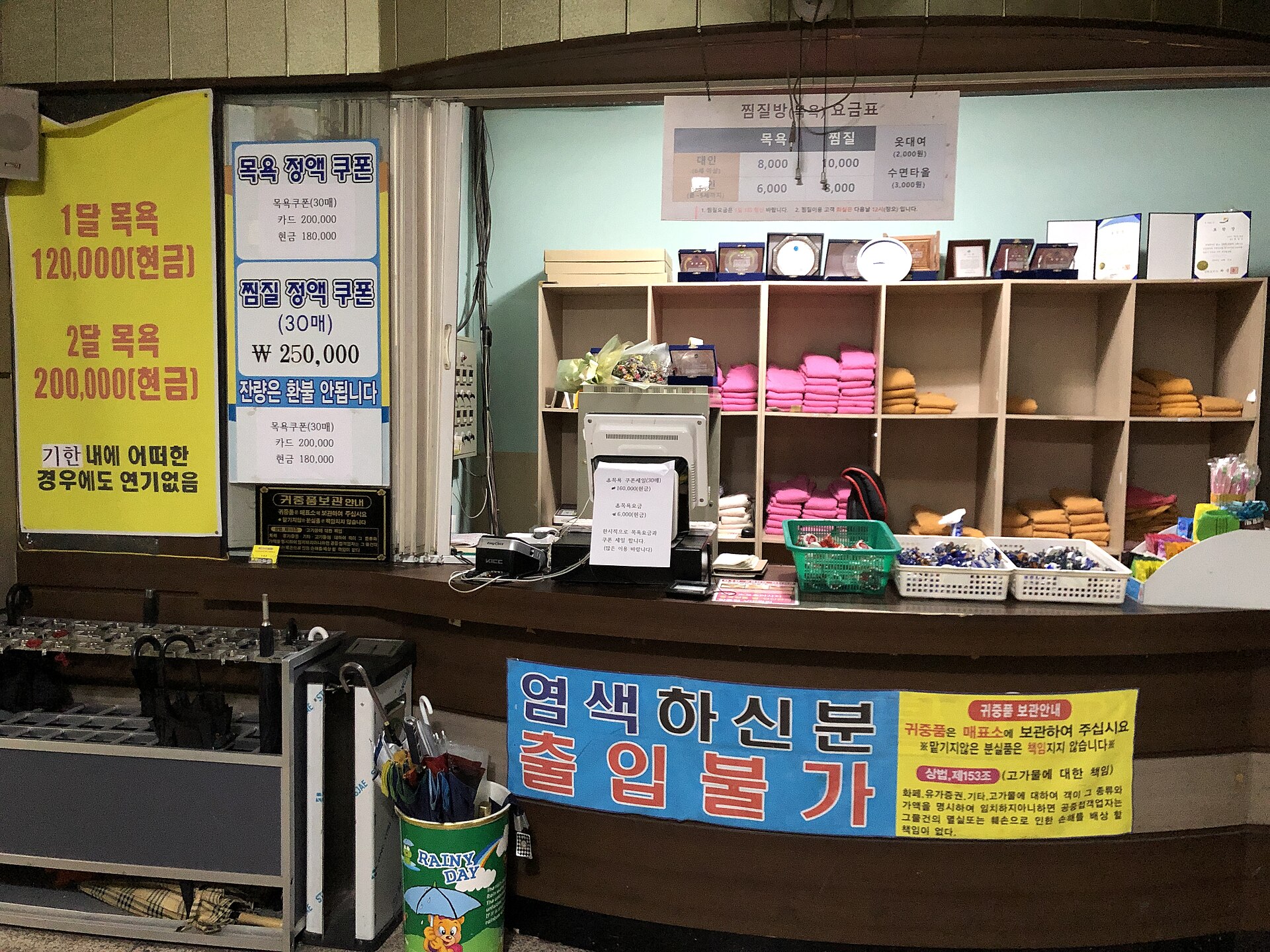
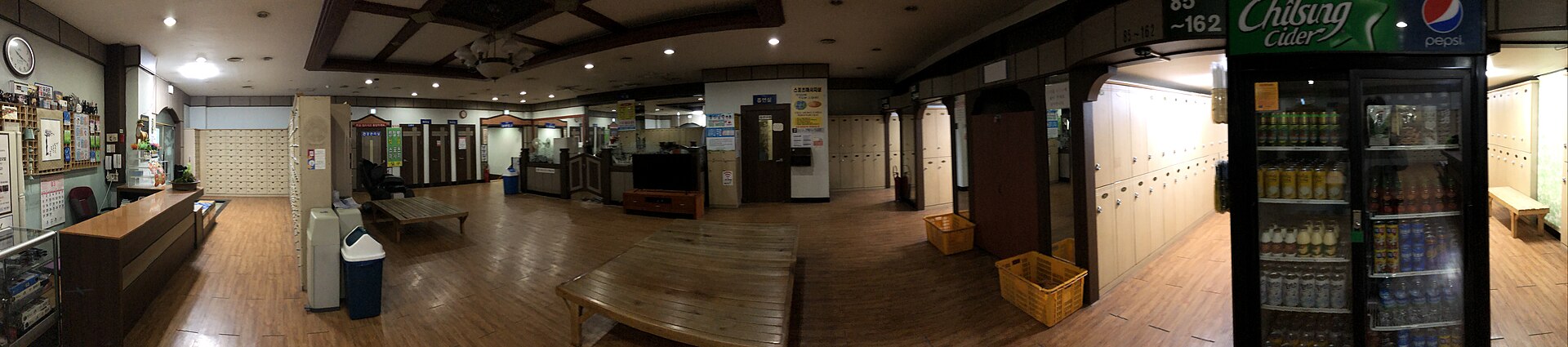
The photographs here, taken on 11 March 2020 at an unnamed facility, show some of those connections: a passage with several entrances, towels and keys at a counter, and a shared area with lockers and a drinks refrigerator. They show operating objects alongside architecture. A place to linger is also a place that must keep track of belongings, garments and movement.
A key organises the visit
Admission is not a direct jump from ticket to hot room. The counter establishes the type of visit, storage and supplied clothing. The KTO guide describes separate changing areas and the issue of a locker key, towel, T-shirt and shorts. Assigning possessions a location lets visitors move through the interior without carrying their outdoor bags.
Chris Sanders’s 2014 account describes a numbered wristband and a clothed rest area after bathing. Once belongings are stored, outside clothes and things needed inside follow different routes. Clothes for the journey home remain in the locker; only what is needed for washing goes toward the wet area. Placing the supplied outfit on a wet floor transfers that moisture back to the body when changing. Storage and washing therefore need distinct places. The KTO's 2020 guide also distinguishes changing and locker areas from the shared, clothed leisure space.
Aquafield's official instructions also connect ticketing to the use of a shoe locker within a prescribed interval. Rental returns and deposits have their own sequence. The photographed counter, with towels, keys and a tariff board, makes the mundane work visible. A relaxed visit begins with organising what is stored, what is issued and which spaces are included.
Wet rooms and clothed rooms
Within the wet zone, washing places lead toward bathing pools. Moving out toward clothed areas involves drying the body and arranging wet belongings so they do not mix with dry clothes. A floor used for rinsing and draining water is used differently from one where dressed people sit or lie down. The changing room is where clothes, towels and possessions are reorganized between those conditions. In the rest area, a visitor can stretch out or select another activity rather than maintain the posture of sitting in a bath. This transition space lets bathing and resting work together within one building.
This explains what may surprise a first-time visitor. Undressing belongs to the bathing area; a typical mixed jjimjil hall is used in the supplied clothes. People arriving together can separate for bathing and meet again in the lounge. Other arrangements exist: Spa Lei, for example, is a women-only facility. A mixed hall is consequently not the universal template of every jjimjilbang.
Clothing and moisture are part of circulation. The setting for a bath differs from the setting for sitting at a food table. After washing, there must be somewhere to dry and dress; outdoor shoes do not belong everywhere inside. Keeping wet spaces and dining spaces distinct supports the ordinary functioning of a place used by many people. The transition itself helps turn a short washing visit into a longer stay.
A kiln, a charcoal room and a light-filled room
Rooms differ in materials and form as well as temperature. Clay, charcoal and salt identify surfaces and atmospheres. A small doorway into a hot chamber, a wider hall and a cooler resting area offer distinct environments. The design is not a competition to endure the strongest heat. Its interest lies in the arrangement of rooms and what happens between them.
At Supsok Hanbang Land, the Seoul Tourism Organization describes charcoal kilns and a hearth room where heated charcoal sits in a brazier. The same material can shape a chamber or deliver warmth from a hearth. Sweet potatoes and rice cakes cooked around the kiln connect heat to food. This is a characteristic of a particular place, rather than a feature to assume at every spa.
Spa Land in Busan's Centum City offers another direction. Its official description explains a Wave Dream Room where light falling on central water produces moving ripples on the ceiling. Other themed spaces combine sound, light and form. Expanding a jjimjilbang can involve sensory design rather than simply hotter rooms. I read those materials and effects as design choices; a room name or promotional promise alone does not demonstrate treatment of disease or removal of toxins.
Eggs and sikhye connect the pauses
Roasted eggs and sikhye are a familiar pairing. An egg can be peeled by hand; sikhye is a sweet rice drink with grains suspended in it. The combination fits a pause near the lounge or food counter. Eating inside, rather than dressing and leaving for a restaurant, allows the stay to continue. The counter is an ancillary service but also a connection between rest and the next activity.
A Seoul tourism article published in 2017 describes eggs and sikhye alongside cup noodles, gimbap and tteokbokki. The 2026 description of Supsok Hanbang Land adds roasted rice cakes and sweet potatoes, a grilled-pork restaurant and a Korean restaurant. Snacks and a complete meal occupy the same sequence. What interests me is how food receives the visitor's next action after bathing.
An official tourism itinerary about MBC's Infinite Challenge broadcasts of November 2015 also includes Supsok Hanbang Land. It records Jeong Jun-ha, Haha and foreign participants eating grilled pork after jjimjil, then using karaoke. This is a concrete example of existing movements being packaged as a television travel story. It does not quantify overseas popularity. A snack becomes the memorable image of a much longer route through the building.
From neighbourhood memory to a leisure complex
The National Folk Museum of Korea's recreated 1970s–1980s Seoul street presents a bathhouse as a neighbourhood meeting place. That is not the same design as a contemporary complex, but it provides a social connection: somewhere to wash could also be somewhere to spend time with others. The leisure function did not begin with a spectacular themed room.
The KTO's 2020 guide lists snack counters and game rooms among the amenities. Choosing food creates time to sit and share with companions; choosing a game brings another kind of attention and conversation after bathing. Someone taking a break may stay in place while another person crosses the shared area, fully clothed, toward the next activity. Aquafield's current categories separate jjimjil spa, sauna, indoor water park, rooftop pool, private rooms and food court. A place for playing in water and a place for eating or resting dry perform different jobs; a single ticket does not automatically include every activity. Adding facilities increases not only the number of rooms but the possible changes of activity during a visit.
An old history of bathing does not make every electronic payment system or water-park combination centuries old. Those are modern business and design decisions. Familiar practices of washing and warmth are placed in new buildings and linked to new forms of ordering and family leisure. Recognising the combination explains more than choosing either old or new as the only authentic version.
Different users, buildings and time limits
The Seoul Tourism Organization describes Spa Lei as women-only, with a special seawater bath supplied from Korea's west coast, an outdoor terrace and cotton robes. Rather than separating only the bathing sections, it defines the users of the whole facility. Clothing and the range of people sharing a stay can therefore differ within the same broad category.
Spa Land connects baths, themed rooms, relaxation, food and coffee inside a Busan department store. Donghae Mureung Health Forest, operated directly by Donghae City at the valley entrance, combines accommodation, themed experiences, consultation and food; its jjimjil spaces use stone, earth and salt. A commercial urban building and a publicly run site beside a valley have different settings and purposes. One brand cannot stand for the entire form.
Admission structures differ too. Aquafield's rules checked on 12 October 2026 distinguish spa and water-park products, included time and extensions. Spa Land also links its basic stay and extension conditions to internal spending. Remembering every jjimjilbang as an inexpensive overnight hotel would miss these arrangements. A visit's length is produced by an actual product and an operating schedule.
The work behind looking comfortable
Sitting in loose clothing on a floor looks simple. To make that scene possible, a facility connects issued and returned garments, storage, washing, food, heat and rest. A hot room without those surrounding connections would not produce the long stay many people associate with a jjimjilbang.
Rather than requiring extraordinary behaviour, the facility gathers ordinary actions within one admission: wash, change, eat, lie down briefly and talk. The egg is memorable partly because it appears after outdoor clothing and shoes have been set aside. Space gives familiar activities another rhythm.
Korean homes explores how living spaces organise movement, while ramyeon follows a simple food into different kinds of meals. For me, the most revealing feature is not the hottest room or most famous address, but the structure that joins activities comfortably. Future jjimjilbangs are worth judging by the ease of actually washing, resting and eating, as well as by their elaborate decoration.
A good jjimjilbang can be read through how comfortably it joins washing, resting and eating.
Sources & scope
Jjimjilbang layout and common visitor arrangements ↗2020-09-25Chris Sanders’s first-person spa visit in 2014 ↗2014-08-06Supsok Hanbang Land’s charcoal kilns and facilities ↗2026-08-08Snacks and meals inside jjimjilbangs ↗2026-06-19The 2015 Infinite Challenge bathing and food itinerary ↗2023-08-31Women-only Spa Lei ↗2026-07-20Centum City Spa Land’s themed rooms and rest areas ↗Aquafield admission, time, storage and rentals ↗Aquafield’s combined facilities ↗Neighbourhood bathhouses in a 1970s–1980s street exhibition ↗2023-04-18Donghae Mureung Health Forest’s public operation ↗Interior passage and room entrances. Photographed 11 March 2020 by Choikwangmo9.
Choikwangmo9 · CC0 · Wikimedia-provided resized image; proportions retained, no cropping