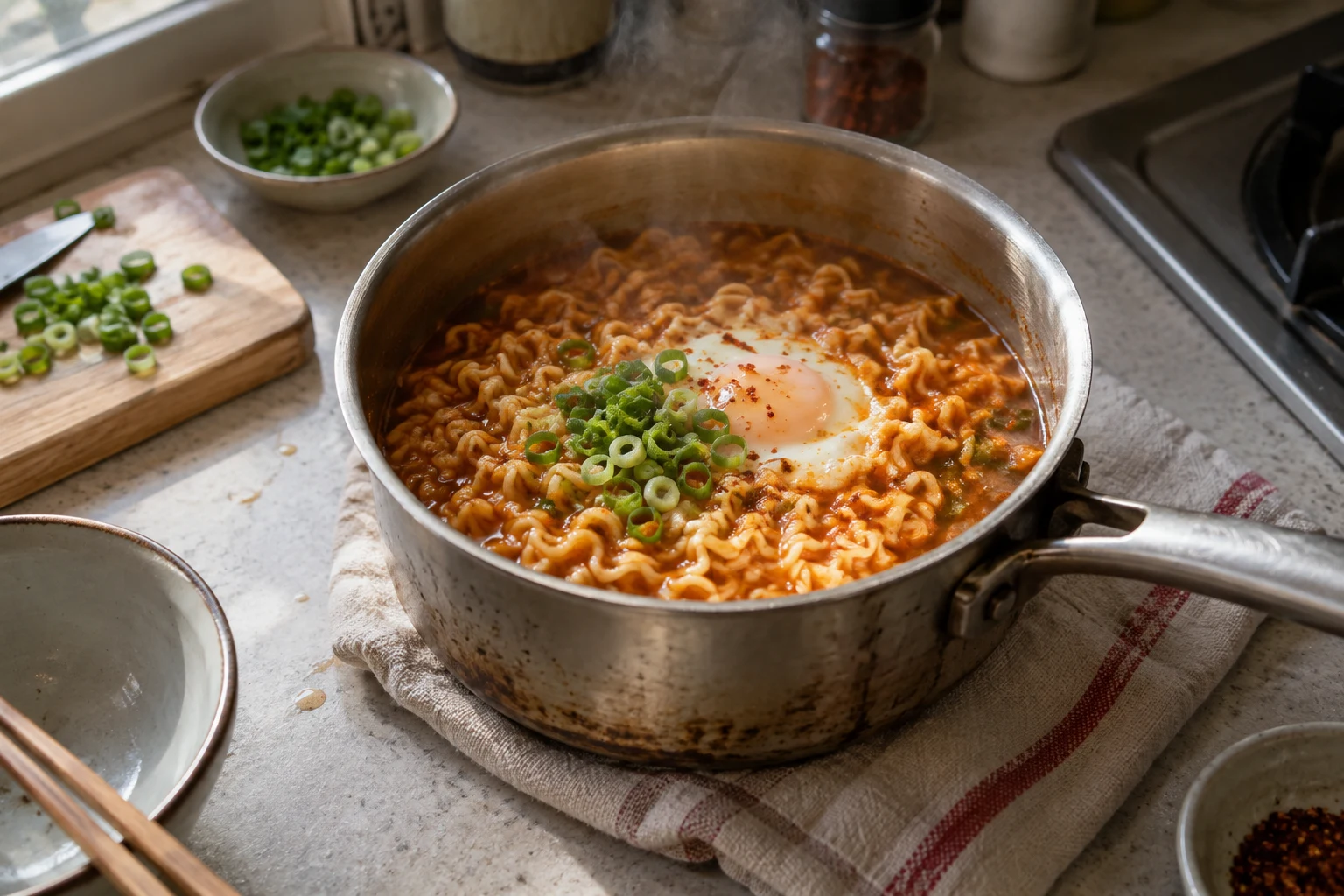
The noodles have already been cooked when you open the packet
A packet of Korean instant noodles opens onto a rigid block and small sachets of seasoning. It is easy to imagine that a factory merely dried raw dough and left the cooking to the saucepan. In fact, the noodles have already passed through heating and dehydration. The water in your kitchen is entering a prepared structure, rather than beginning noodle manufacture from scratch. The few minutes on a stove come after mixing, shaping, heating and drying that happened out of sight.
Ramyeon here means the packaged instant noodles sold in bags or ready-to-use containers. Some go into a saucepan and finish surrounded by broth. Others are drained before seasoning is mixed through the strands. A cup asks the eater to open a lid and supply hot water instead. These are physical arrangements of a meal: they determine which vessel, which source of heat and which final movements the buyer provides.
Dough becomes a sheet, then a wave
Mixing flour with a prepared liquid turns loose particles into dough. Rollers flatten that dough into a sheet before cutters divide it into strands. The thickness of the sheet matters: an uneven starting sheet would leave different amounts of dough in the cut noodles. Making repeatable strands starts before anything looks like a noodle. A broad piece of dough must first acquire a consistent dimension.
Samyang Foods explains in its FAQ that a slower conveyor after cutting creates the familiar curl. When strands arrive faster than the receiving belt carries them away, their length gathers into waves. The shape is a result of equipment movement. Break a dry block and the edges reveal these folded lengths overlapping one another. A straight strand and a curled block offer different ways of fitting a long food into a small packet.
Thickness also determines the distance that water and heat must travel to reach the middle. A fine strand and a thick strand can respond differently to the same final cooking interval. Factory preparation therefore helps a buyer obtain a recognisable result from one packet to the next. The rigid object on a shelf began as individually shaped strands.
Heat first, remove water afterwards
Nongshim's manufacturing account sets out steaming, frying, cooling and packing after noodle formation. Heating and drying follow one another but perform different jobs. Water and heat change starch in the dough. Removing water afterwards prepares a product that can be transported differently from a bowl of soft, freshly cooked noodles. The brittle block represents cooked material reorganised for storage and distribution.
For fried noodles, hot oil supplies heat as water leaves. The small spaces left behind help hot water enter later; the World Instant Noodles Association identifies this porous structure in its explanation of reconstitution. In a saucepan, water enters the block again and the strands soften enough to separate with chopsticks. Dehydration in the factory and restoration in the kitchen work in opposite directions along the same material.
Non-fried products use another drying method, with hot air providing one example. Drying can produce different surfaces and internal structures, which contribute to different textures. A packet of air-dried noodles can therefore offer a different first bite even when its broth resembles a fried product's broth. Both require a final encounter with water and heat, but their earlier preparation is part of what the mouth receives.
A small sachet carries another part of dinner
The packets beside the noodles contain further ingredients. Powder disperses into hot water to season broth; a liquid mixture may dissolve in it or cling to drained strands. Small dried pieces of scallion or mushroom are not wet vegetables simply sealed beside a noodle block. They absorb water as the noodles do, recovering a shape and a texture that joins the meal.
Saltiness is only one part of a broth. Savoury components from stock ingredients, garlic or pepper aromas and a chilli's heat can meet in the liquid. The actual ingredient declaration identifies a particular product's composition. Products sold under a familiar brand in different markets can have different formulations. Their labels connect a recognisable name to the ingredients prepared for that specific packet.
Separate sachets also allocate the buyer's remaining work. A product can supply pieces to boil, powder to add with the noodles and a finishing oil to mix after the heat stops. Adding everything at the start changes the timing of those ingredients' meeting. The short instructions beside the branding specify these final steps in a preparation that began long before purchase.
Leaving broth or draining the pan
Nongshim's instructions for its Korean Shin Ramyun bag product specify 550 millilitres of water and four minutes thirty seconds of further boiling. Noodles, powder and flakes enter together; liquid remains as broth. Some water enters the noodles while some escapes as steam. Pan width, heating time and moisture supplied by extra vegetables can therefore affect the concentration remaining around the noodles. The printed quantity provides a concrete starting point for that product.
Chapagetti belongs to a preparation that drains water before mixing seasoning onto the strands. Water remaining after draining helps move seasoning through the noodles. On very dry strands, powder can gather in patches; abundant water can carry seasoning down to the bottom of a plate. Turning the noodles moves the mixture between strands. Making a spoonful of broth and coating every strand separate into different kitchen tasks.
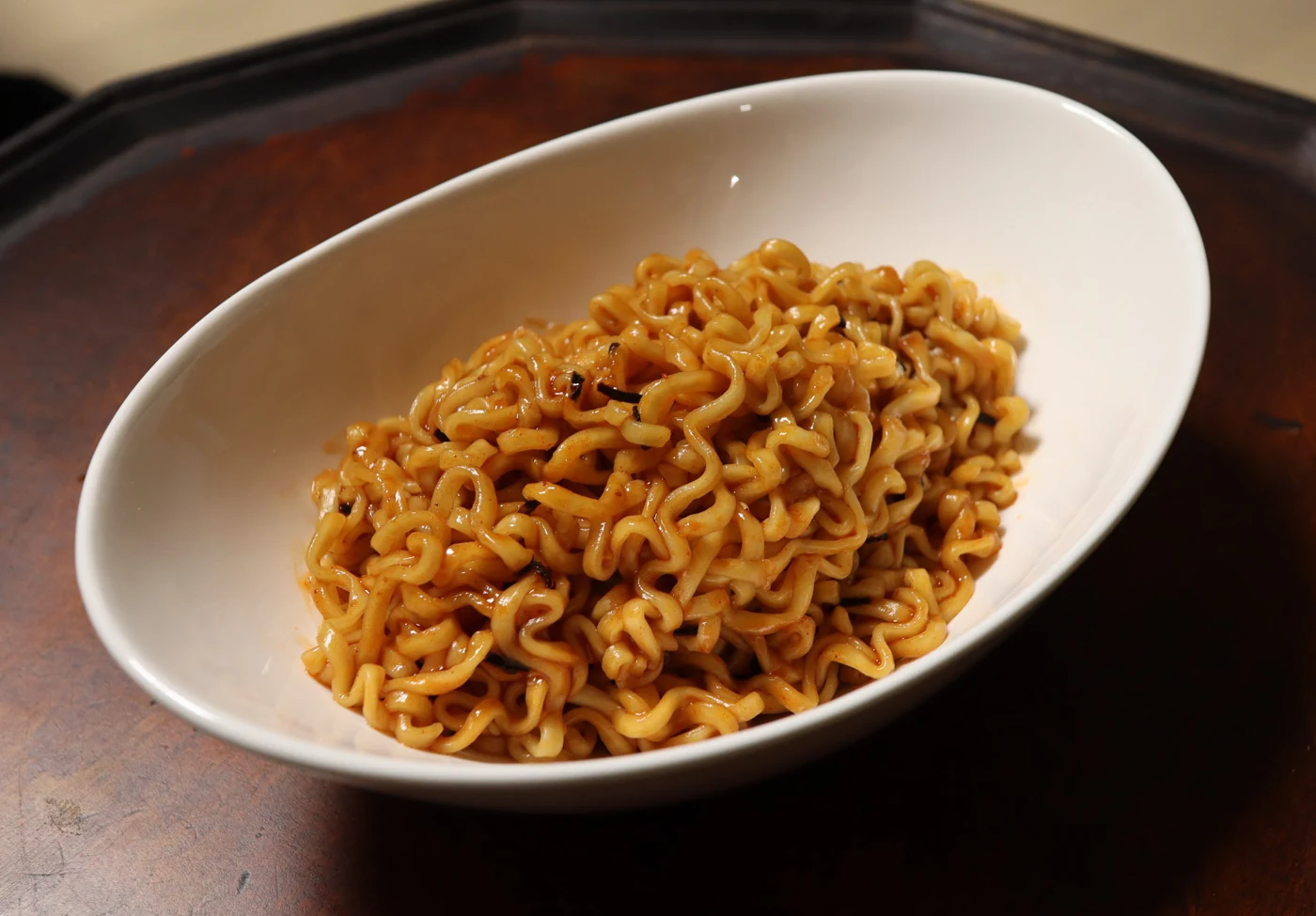
Nongshim's timeline dates Chapagetti to March 1984 and Shin Ramyun to October 1986. These named products demonstrate routes beyond a single image of spicy soup. The documentary Buldak photograph shows sauced strands collected in a bowl without a broad surrounding broth. The visible meal illustrates how much its form changes according to what liquid remains after cooking.
A cup supplies a place for hot water to wait
Cup noodles sit in their eating vessel before sale. Rather than transferring the contents to a saucepan, the buyer opens the lid and adds water. An internal line defines space for the intended liquid. Pouring less or more changes how much water meets the same seasoning. Closing the lid establishes another period in which hot water and noodles remain together.
The official Korean Shin Ramyun large-bowl instructions give an example of waiting approximately three minutes after pouring boiling water to the indicated level. A saucepan keeps supplying heat from below; a cup relies on the initial hot water and its container. A buyer still needs a source of hot water, utensils and somewhere to eat. A convenience store's dispenser and small table provide exactly that remaining arrangement.
Nissin records the launch of Cup Noodles on 18 September 1971; Samyang's timeline records its own cup product in March 1972. A lid and vessel changed how noodles could be finished at the point of eating. A shared saucepan and individual cups permit different distributions of the same basic job: supplying water, heat and a place for the meal.
From a factory's preparation to the last mouthful
Chicken Ramen launched on 25 August 1958, according to Nissin, and Samyang Ramyeon launched in Korea on 15 September 1963. What remains interesting about these dates is the work those products moved ahead of the meal. Shaping, cooking, drying and packing allowed the buyer to take responsibility for water and a short interval of preparation instead of the entire sequence. Convenience redistributed work rather than making it vanish.
When two people share a packet, they fetch bowls, divide strands and ladle broth. An egg or sliced scallion brings another texture and aroma to the prepared seasoning. With mixed noodles, chopsticks lift strands carrying sauce from a plate. These small movements endure after a product's appearance on a screen: the commodity contains both work already performed and room for a person's own dinner.
That capacity deserves attention on its own terms. Instant noodles need not imitate an expensive restaurant dish to be worthwhile. They bring repeatable components home and allow a meal to acquire the ingredients and setting available that evening. The broth level falls as the last strands leave the pan. A rigid block from a packet has become an actual dinner. Continue with the history of manufacturing and overseas tables, or explore the space beside the hot-water dispenser in Korean convenience stores.
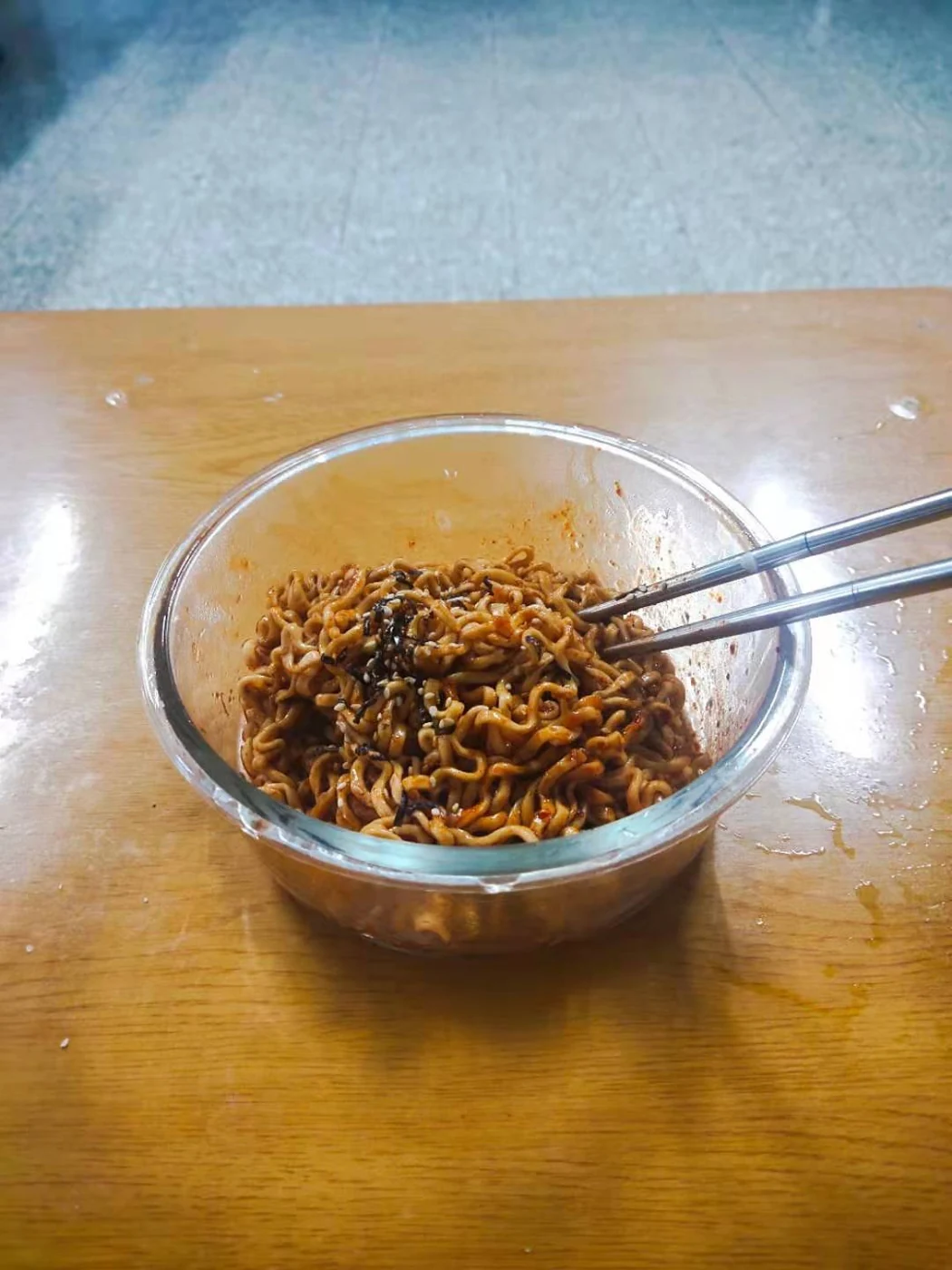
Factory shaping, heating and drying meet the final work in a kitchen. How much water remains also changes the form of dinner.
Sources & scope
Samyang: noodle manufacture and launch questions ↗Nongshim: noodle manufacturing process ↗WINA: rehydration and drying explanations ↗Shin Ramyun bag and large-bowl instructions ↗Nissin: Chicken Ramen and Cup Noodles launch dates ↗Samyang cup-product chronology ↗Nongshim: Chapagetti and Shin Ramyun chronology ↗Modules independently explains the verified sources. The lead image is AI-generated for illustration; it is not a documentary photograph of an actual place, event or product.
Updates & corrections
Dates record changes to this document, separately from the reference dates of its sources.
- Content update
Rewrote the article with fuller production, history, examples and source explanations.
- Document connections
Organised representative-document links, search descriptions, paragraph links and revision history. No factual correction.
- First published
Initial creation of the Korean and English document.