A sheet begins in water and enters the house
Hanji, traditional Korean paper, is often pictured as a yellowish sheet carrying brush-written characters. Yet paper also belonged to the fabric of a room. Attached to a window lattice, it filters light; cut and folded, it becomes a three-dimensional form; applied as a support, it can help another sheet. What paper does depends on fiber, thickness, and surface treatment before it depends on color.
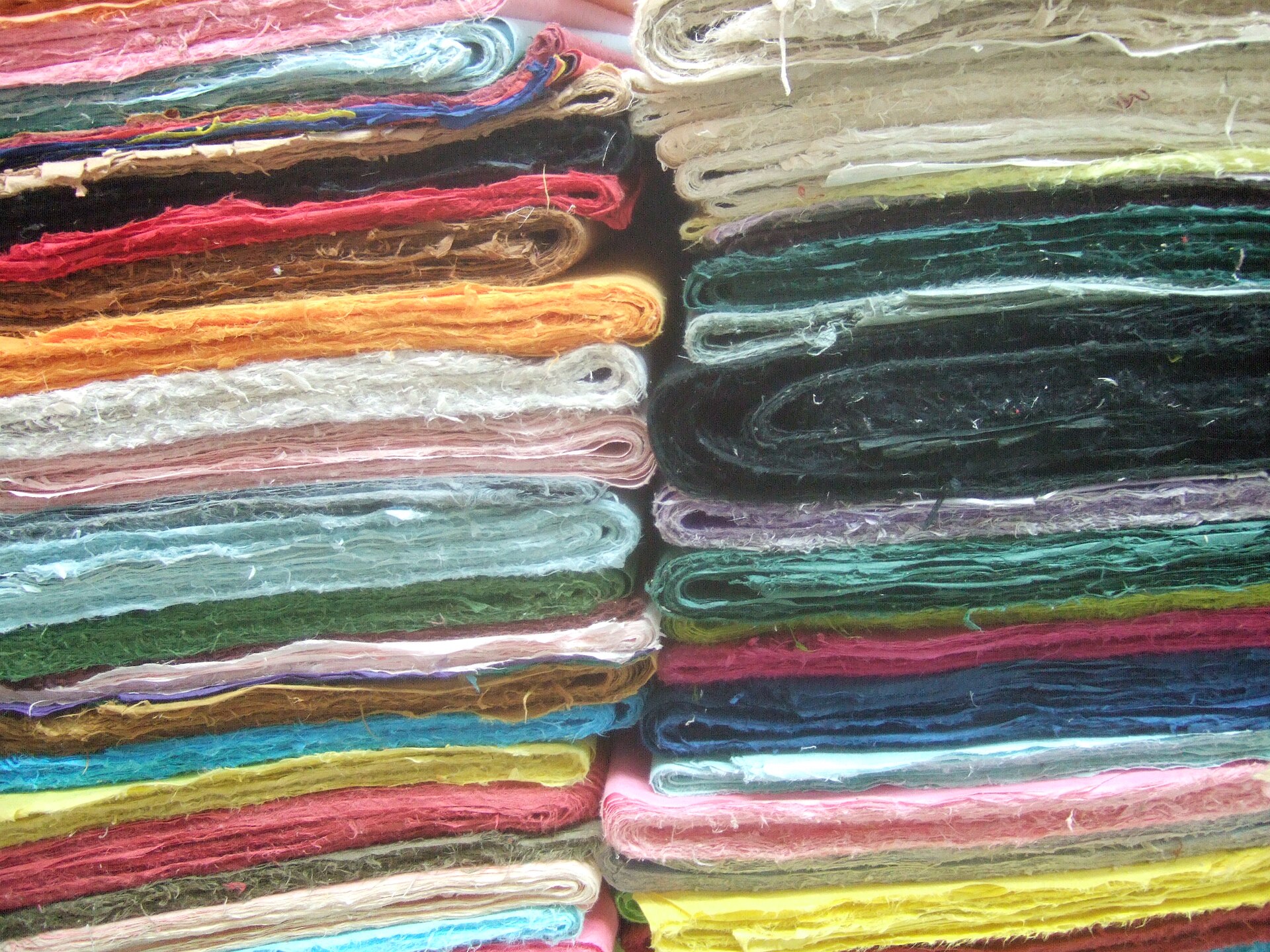
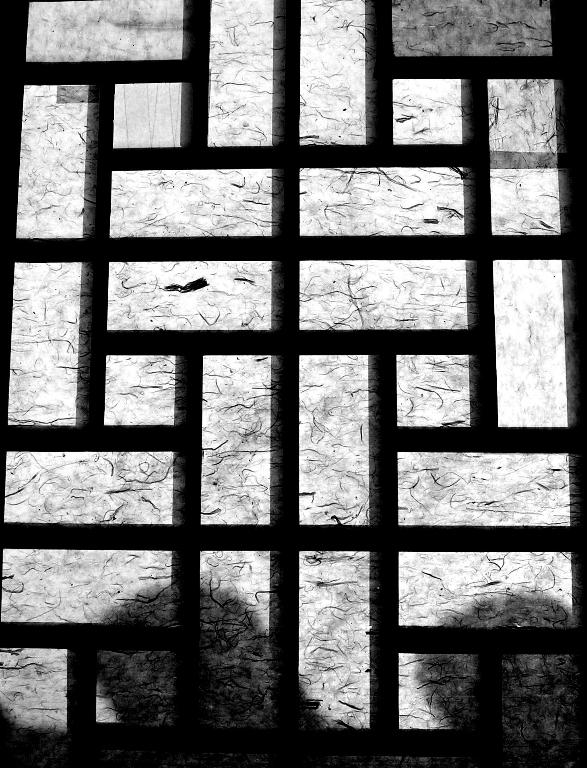
The window photograph here shows paper behind a wooden grid. The Insadong shop photograph presents paper in different colors and sizes. Together, they move us beyond one aged-looking surface or one traditional purpose. To understand those uses, it helps to follow how the sheet is made.
Traditional hanji relies importantly on the inner-bark fibers of dak, paper mulberry. Bark is removed and prepared, fibers are dispersed in water, then brought together as a surface. The material changes through the interaction of water, alkaline cooking, a dispersal agent, a screen, hand movements, pressing, and drying.
Obtaining fiber from bark
Steaming dak, called dakmuji, makes peeling easier. Removing the dark outer bark leaves the lighter inner bark, often described as white bark. Remaining bark particles affect what appears in a sheet; a visible speck need not be decoration. Selection begins well before the paper-forming vat.
Once steam makes bark easier to remove, peeling and selection can follow. Steam comes from heated water, but bark exposed to vapor is in a different condition from bark immersed for cooking. A heat source and a place holding the branches therefore need to work together. This preparation does not replace the later cooking and beating stages.
Peeling alone does not produce paper. Cooking, washing, and beating turn resilient bark into fibers that can be handled in water. The shape of the original branch disappears, but its fibrous material takes on another job.
Cooking, washing, and beating do different work
The prepared inner bark is cooked in an alkaline solution. Plant ash supplies a traditional source of alkali. Cooking removes non-fibrous material and makes separation easier; it is more than briefly soaking the bark in hot water. Its conditions affect what can happen during the following stages.
The cooked material is washed and remaining particles are removed. Washing reduces residues from the previous operation; whitening is another decision. Processes may use water and sunlight or bleaching chemicals. A pale or natural-looking sheet does not reveal its complete manufacturing history. Appearance and production information need to be considered together.
Beating loosens the material into dispersible fibers. Hand methods use a wooden tool against a stone or board; mechanical equipment is also used. Cooking prepares the bark, while beating helps separate its fibrous mass. The repeated impact is invisible in the finished thin sheet, but the state of the material in the vat depends on it.
Dakpul is not the paste used on a window
In the vat, fibers are mixed with water and dakpul. This plant mucilage, associated with hwangchokgyu, helps fibers disperse rather than clump and slows drainage through the screen. It performs a different task from the paste that attaches finished paper to a window. One belongs to sheet formation, the other to the later use of a sheet.
In oebal sheet formation, the maker receives and releases fiber-bearing water using a screen and its support. Front-to-back and lateral movements deposit the fiber. Making paper is therefore not simply lifting a scoop of liquid and waiting for it to dry. The directions of flow and the movement of the screen help arrange a surface.
An upper frame creates space to hold fiber-bearing water; an open arrangement lets water escape as the screen moves. Even at the same fiber concentration, drainage time and direction change the conditions under which fibers remain. Sheet formation brings together screen movement and the passage of water, rather than treating either as a separate action.
Stacking wet sheets, pressing, and drying
A newly formed sheet is still wet. Sheets are couched into a stack, pressed to remove water, separated, and dried on a surface. Some methods combine two wet layers in opposite orientations. Handling a wet fiber mat differs from stacking dry paper because the surface is still being consolidated.
Drying exposes another part of the process. Accounts describe boards and heated metal panels. The surface against which the sheet dries can affect its appearance. A wet arrangement of fibers becomes the dry, handleable sheet we recognize as paper.
Dochim is a finishing treatment applied where appropriate: moisture is managed and sheets are beaten to compact and smooth their surfaces. Not every paper requires the same finish. A rough surface and a smooth one answer different needs. Choosing paper by touch means encountering decisions made after the vat as well as before it.
An old material has a manufacturing history
A 2023 NIFoS study traces equipment changes and the name hanji by 1908. A name’s appearance differs from the history of the material. Old materials accumulate changes in tools and the distribution of work. Hand beating and repeated mechanical beating prepare fiber under different working conditions.
Contemporary workshops do not all follow a single production model either. Jeonju-based Gogam Hanji & Paper describes producing both handmade and machine-made paper with dak fiber as a principal material. An artist's desired texture and a printer's requirement for consistent supply may involve different decisions. How a paper is formed matters together with composition, thickness, and finish.
Calling this change the disappearance of tradition would miss the continuing sequence of preparation and surface formation. Tools and the allocation of time can change within that sequence. The workshop, as much as the finished object, explains the material's present.
Conservation depends on conditions, not a reputation
Song and Munn’s 2004 study compared Korean papers’ strength, brightness, pH and dimensional changes. A repair requires more than strength: its support also has to move compatibly with the object. If attached sheets expand or shrink very differently with moisture, tension can develop between them. This gives a material reason not to treat every paper sharing a name as identical.
A repair paper has to work with the sheet it supports. Strength alone does not settle suitability if the support is too stiff or reacts differently to moisture. Thickness, fiber orientation, surface treatment, attachment, and the condition of the object interact. An advantage has meaning within a particular treatment.
Italy's specialist archive and book conservation institute, ICPAL, lists a hanji validation project among its official activities. I find the process of examining a material for a task more informative than turning international recognition into a slogan. A cultural reputation becomes useful when accompanied by specific production information.
Paper can construct a space
Stony Brook’s 2026 Sacred Paper paired Jongseung Park’s constructions with Heera Shin’s folded work. Layering adds thickness; a fold redirects a plane. Joined surfaces and bent lines allow a flat sheet to stand or support another surface. Petal-like openings and layers that intercept light construct space through a job different from carrying written characters.
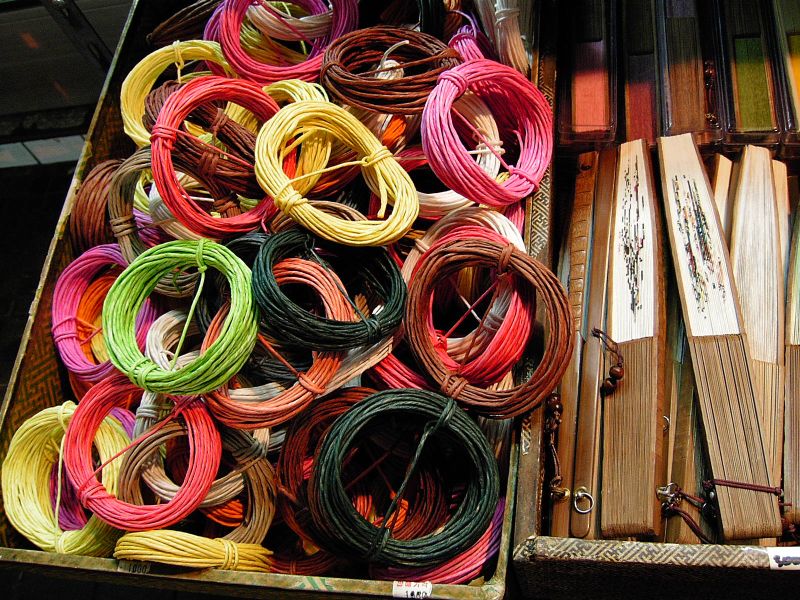
Folding is not the only route into volume. Jiseung cuts and twists paper into cords for weaving; jiho softens paper and mixes it with paste into a moldable mass. The National Folk Museum's account of its 2024 paper exhibition sets these processes alongside one another. Fibers are first made into a sheet, then the sheet can become another working material. A window surface, a layered structure, and a woven vessel use paper differently. Its range grows through construction, not only through decoration.
Continue with Korean homes, where paper meets light and domestic space, or hanbok, where fibers are joined in another way. I would remember hanji as a made material rather than a mysterious sheet that lasts forever. Peeling, cooking, washing, beating, forming, pressing, drying, and finishing leave their decisions inside one surface. Understanding them makes paper less of an empty background and more of a material prepared for use.
A sheet gains its properties through material preparation, movement, drying and finishing. Reading hanji as a made material, with specific production information, makes its uses more understandable.
Sources & scope
Evolution of Hanji-making technology ↗2023-11-25Testing permanence, durability and properties of hanji ↗2004Hanji-making and craftspeople ↗2024-07-11Gogam Hanji production and process ↗ICPAL restoration and hanji validation ↗2024-02-28Sacred Paper: Korean Ritual Arts ↗The 2024 paper exhibition and paper craft ↗2024-07-31Colored paper in Insadong, photographed November 13, 2006, by jared.
jared · CC BY 2.0 · Wikimedia-provided resized image; proportions retained, no cropping