Before the garment reaches the body
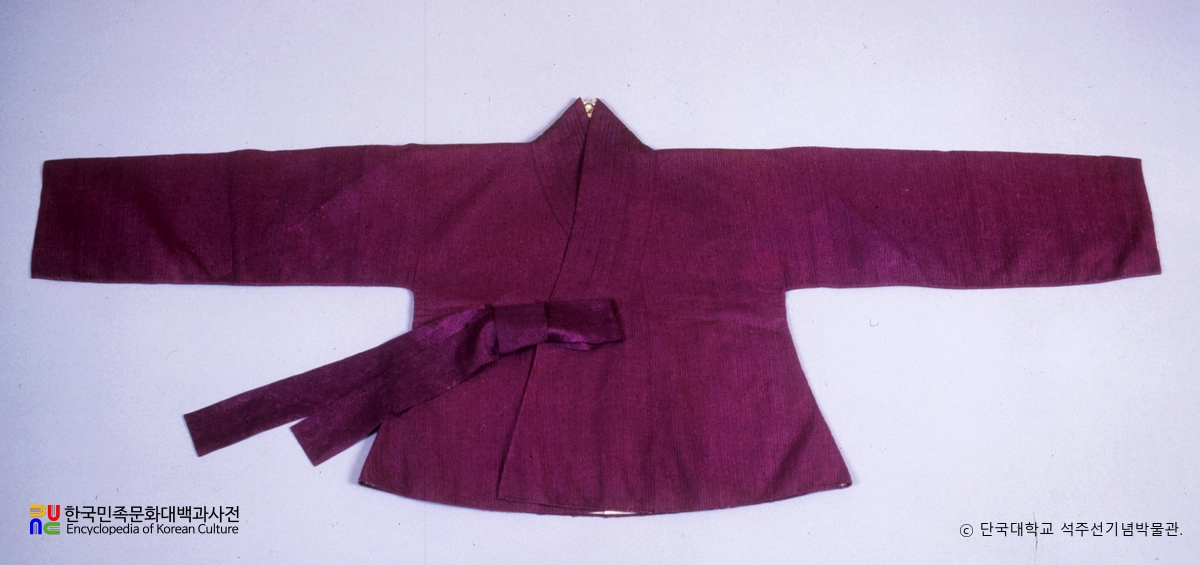
Untie a hanbok jacket and what looked like a single silhouette in a photograph opens into front panels, collar and sleeves. Bring the panels together again and their overlap wraps the torso; goreum, the fastening ribbons, hold that arrangement. The dongjeong strip follows the collar, drawing a distinct line below the face. A skirt or trousers is a separate lower garment. The completed outline comes from assembling these parts on a person, not simply from choosing two attractive colours.
The wearer’s arms pass through the sleeves while the neck sits within the collar opening. Holding the front closed and providing room for an arm to move are different jobs. Tightening a ribbon cannot change the sleeve width or the construction at the underarm. A maker joins the body panels to the sleeves; a wearer then brings the front into place. The component names in our hanbok reference become descriptions of actual actions.
The long and short ribbons do different work. First knot them with the short ribbon above. Fold the longer ribbon underneath into a loop, wrap the short ribbon around it, and draw it out behind the loop to shape the tie. Two strips holding overlapping fronts become a knot and loop through a sequence of movements. Wearing knowledge includes knowing which strip to fold and which to move, not just recognizing the finished outline.
The jacket did not keep the same length
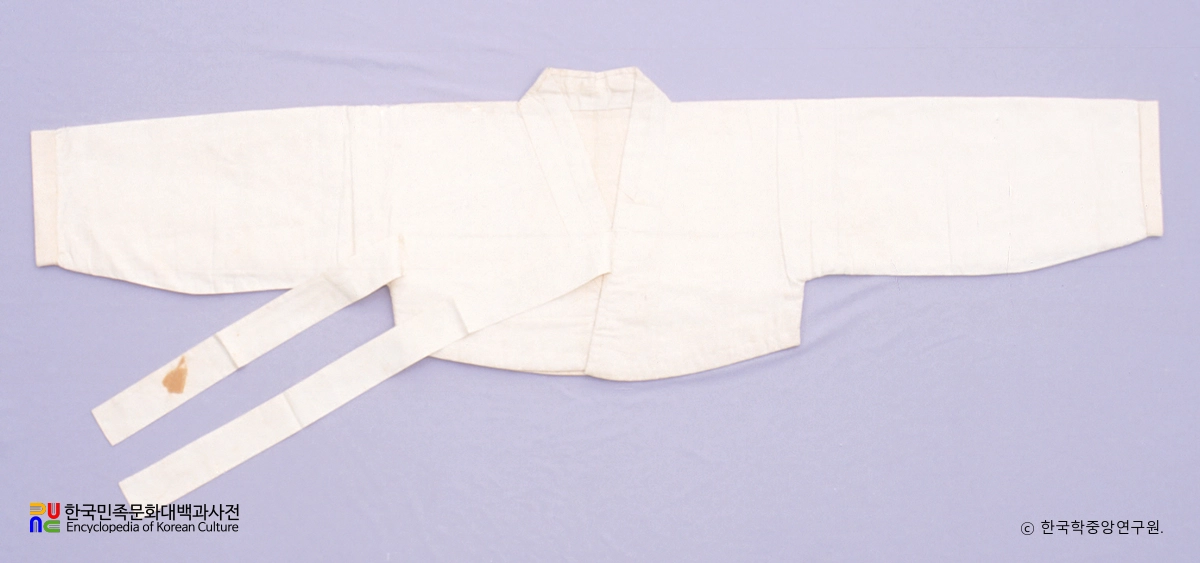
The Encyclopedia of Korean Culture summarizes changes in women’s jeogori lengths as 60–80 centimetres in the seventeenth century, approximately 45 in the eighteenth, 35 in the nineteenth and 22 around the beginning of the twentieth. These are a costume-history account’s outline of change, not mandatory dimensions for every jacket made in each period. They nevertheless make the difference more tangible than a general description of old clothing. An upper garment extending towards the waist covers a different part of the body from one ending near the chest.
Raising its lower edge increases the visible area of the skirt. It moves the meeting of colours and changes the relationship between sleeve and body. Spread a short jacket flat and its extending sleeves emphasize a horizontal line; beneath it, the skirt supplies a broad vertical volume. Shortening was consequently more than using less cloth. It altered the proportions of an ensemble.
The same entry records a tendency towards longer and larger jackets in the 1930s and 1940s. The history did not move continuously towards less length. The silk and brooch-fastened examples discussed below belong to a period of further practical changes. Present designers were not the first people to reconsider where a jacket ended or how its front was held.
Single layers, linings, padding and quilting
Jeogori can be described as hot, gyeop, som or nubi: single-layer, lined, padded or quilted construction. These terms concern layers and joining rather than a colour scheme. A single-layer garment uses one layer of material for its body. A lined garment brings outer and inner cloth together. Padding introduces a filling between them. Quilting sends repeated stitches through layers, leaving lines that can also be visible on the outside.
Our lead photograph shows a nineteenth-century quilted jacket held by Dankook University’s Seok Juseon Memorial Museum. Its extended sleeves, overlapping collar and ribbons appear alongside fine parallel stitched lines. Those lines are not stripes painted onto a surface. Passing a needle through cloth fixes layers together at that point; repeating the passage in rows creates connections across a broad area. The visual pattern and the holding of layers come from the same labour.
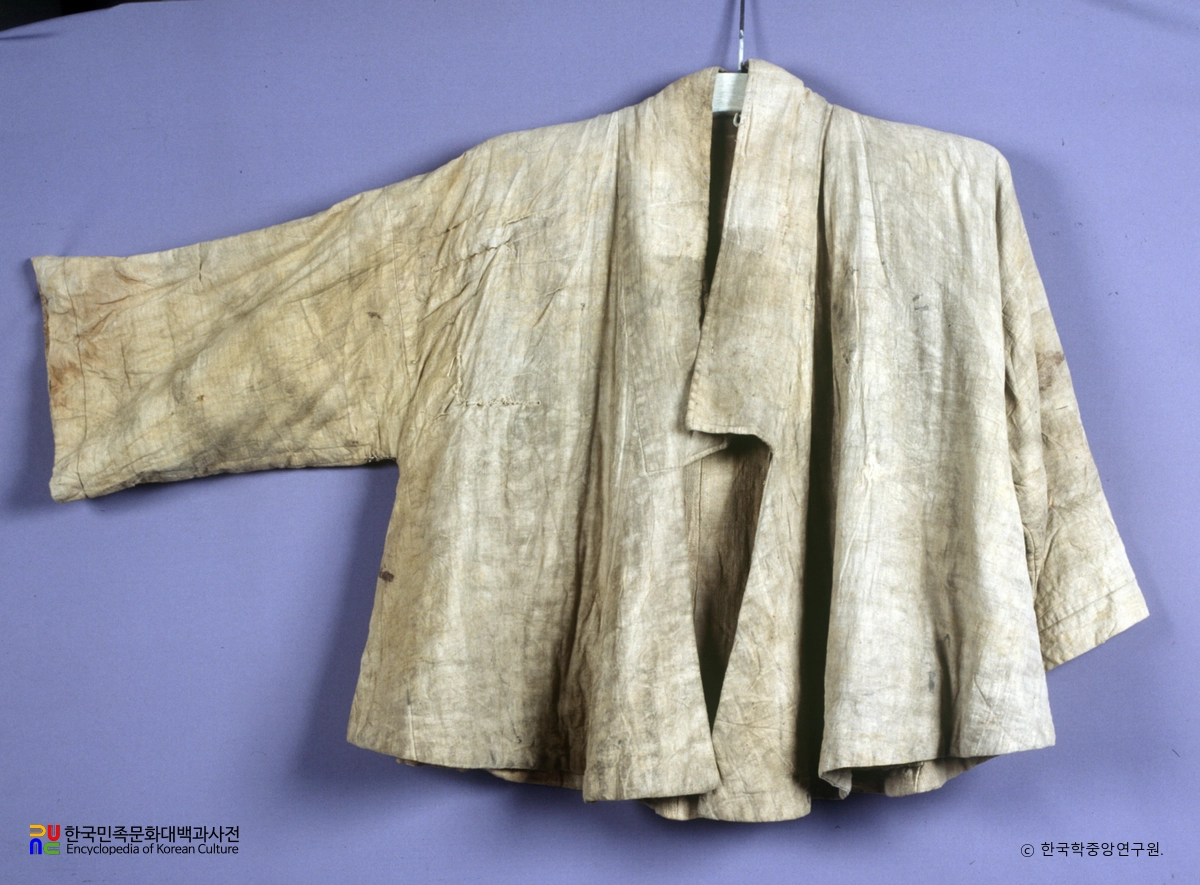
The encyclopedia’s account of the jacket excavated from Kim Deok-ryeong’s tomb identifies padding, coarse cotton outside and hemp cloth inside. Its photograph shows a broad body, spread sleeves and overlapping fronts. The construction uses different textiles for the exterior and the body-facing layer, with another material between them. A garment that appears to have one surface can contain several distinct material jobs.
Lining and a brooch in the 1940s
Daegu National Museum describes a lining in a 1940s silk winter jacket and brooch fastening on another floral jacket.
Lining and padding are different features. A lining places another textile between the outer silk and the body; padding is an additional material question. An exterior photograph cannot show that entire arrangement. During construction, the outer and inner shapes must meet at their edges. Simply stacking layers without accommodating their dimensions can pull one layer tight or gather excess at an edge as the garment moves.
A brooch changes a different part of the job. Rather than tying two ribbons to hold the front, a metal fitting secures the cloth. The hanging ribbon outline is reduced, while the position of closure and the appearance change together. Body and sleeves remain, but a fastening component has changed. Here, adaptation becomes a decision about an actual small part rather than a slogan separating tradition and modernity.
Making in 1975, wearing again in 2003
Smithsonian records Mary Kim’s 1975 Seoul hanbok at San Francisco’s Asian Art Museum opening gala in 2003.
Twenty-eight years separate those dates. This is not the story of a new garment worn immediately after leaving a workshop. Clothes can be stored, moved and brought out for another occasion. The hanbok carries both a making location and a wearing location. Its life continues beyond the moment when cloth became a finished object.
A new encounter with the body accompanies such movement. Sleeves, shoulders and front closure must work for the person wearing it; a separate lower garment completes the proportions. Finding another occasion means more than changing a place-name. The pieces are assembled on a person again. The outfit belongs to a recorded past event and becomes moving clothing at a new one.
Different design decisions in workwear and uniforms
A Policy Briefing report on the 2022 hanbok workwear and school-uniform exhibition at Culture Station Seoul 284 includes designer Hwang Sun-tae’s explanation of transferring collar and dongjeong lines into contemporary garments. A uniform dress used buttons and a zip. A shirt revealed a traditional pattern when its collar was opened. The decisions concerned neckline, fastening and the location of a motif rather than wholesale copying of an old ensemble. Seoul Fashion Road presented Seodamhwa, Guiroe, Ccomaque and Hanbok Studio Hyeon on May 2, 2025.
These parts change the dressing task. A dress connects upper and lower sections in one garment, reducing the need to position two separate pieces. Buttons or a zip close an opening at predetermined points. A pattern inside a collar occupies a different place from decoration immediately visible outside: the garment changes when it is opened. Moving a familiar element into another component changes both the action of wearing and what becomes visible.
What interests me is the specificity of the decisions. Retaining a collar line while changing the closure shows an order of work: identify what to carry forward, then construct the part differently. For clothing repeatedly opened and closed, that sequence extends into use beyond a single exhibition image.
Taking an existing outfit back for alteration
In 2026, the Korea Hanbok Promotion Institute announced professional alterations of stored hanbok for Sangju residents. This was a spring programme.
Starting with an existing outfit rather than purchasing another changes the design problem. One examines which part no longer fits: whether body and sleeves remain usable, whether a closure or length can change, and how outer and inner cloth move together. Not every surface needs remaking, but a changed part must meet the retained structure. Shortening a sleeve, for example, relocates its end and its meeting with adjoining seams.
Alteration is not the opposite of new design. It decides, within the same garment, which earlier cutting choices to keep and which to adjust for a later body. The programme brought professional work into contact with clothing left unworn. Its outcome for every participant is not documented here; its starting object was a garment waiting to return to use.
A garment that can close again
A hanbok holds changing jacket proportions, choices of inner and outer cloth, stitches joining layers and parts that close the front. Nineteenth-century quilting, a 1940s brooch and a contemporary uniform zip solve related material tasks differently. Their continuity is not confined to an unchanged outline. Korea designated hanbok lifestyle as national intangible heritage in July 2022.
I find a more concrete future in the garment being unfolded, put on, fastened, tended and, when needed, altered. Conserving stitches in a museum jacket and adjusting present clothing are different jobs, but both concern a connection between cloth and people. New settings in today’s K culture also rest on material and manual work. Another usable occasion carries clothing forward more convincingly than a declaration that nothing has changed.
Continuity also means making the construction and closure usable for another body, rather than keeping only an unchanged outline.
Sources & scope
Jeogori construction and changing lengths ↗2023-02-07Goreum fastening and knot sequence ↗2023-02-071940s jackets: lining and closure ↗Mary Kim’s Seoul-made hanbok worn in San Francisco ↗Hanbok workwear and school-uniform design ↗2022-02-15Sangju’s 2026 hanbok alteration programme ↗2026-03-23The 2022 hanbok-lifestyle designation ↗2022-07-21Seoul’s 2025 hanbok design event ↗2025-05-13Quilted jacket, nineteenth century. Seok Juseon Memorial Museum, Dankook University; photograph via the Encyclopedia of Korean Culture.
Dankook University Seok Juseon Memorial Museum · KOGL Type 1 · Original WebP used unchanged; original attribution watermark preservedUpdates & corrections
Dates record changes to this document, separately from the reference dates of its sources.
- Content update
Rewrote the article with fuller production, history, examples and source explanations.
- Document connections
Organised representative-document links, search descriptions, paragraph links and revision history. No factual correction.
- First published
Initial creation of the Korean and English document.