Why the collecting net stays at the surface
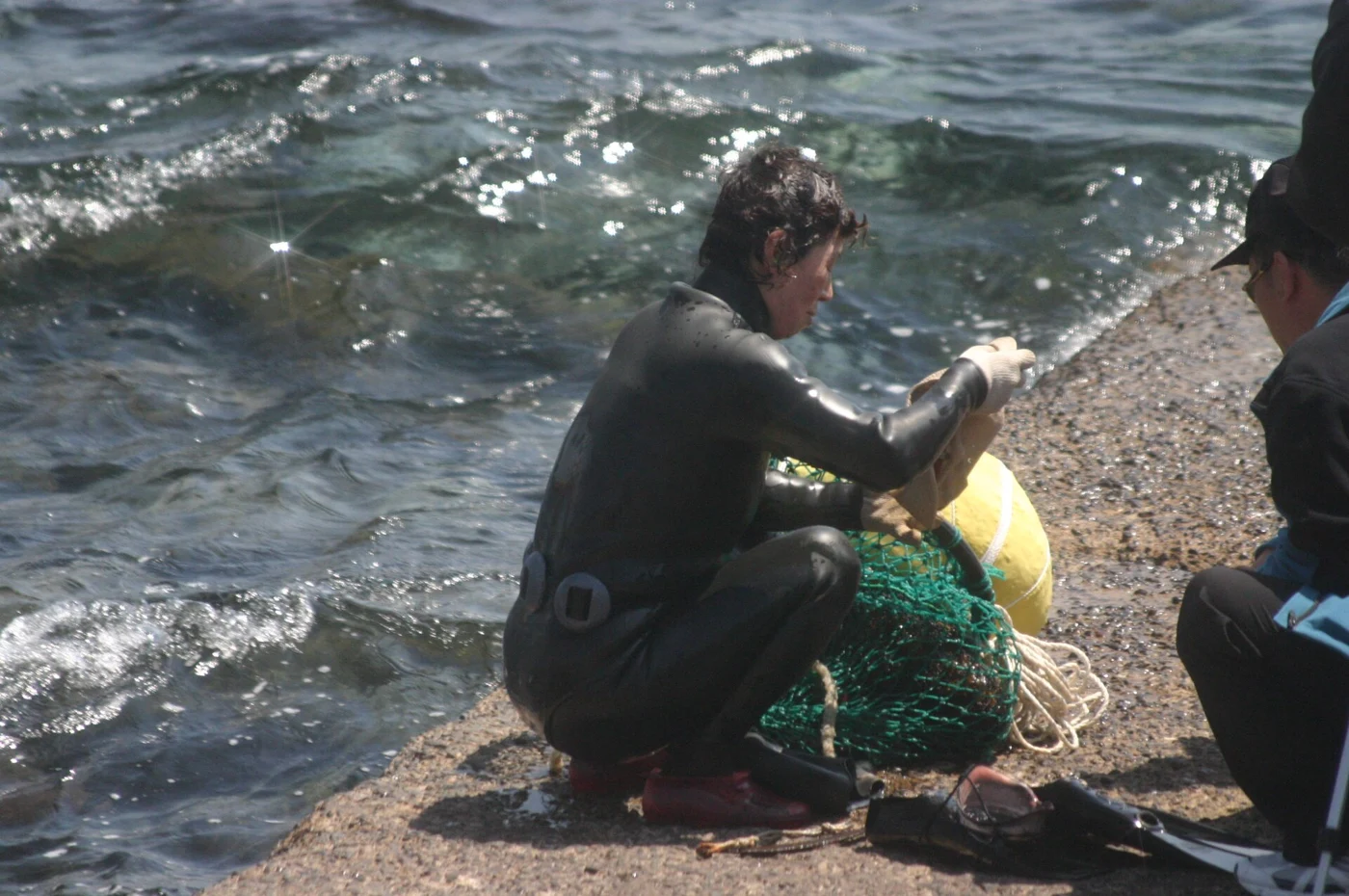
The round object beside a Jeju haenyeo in a photograph is a tewak, a float. The bag-shaped net beneath it is a mangsari. They perform different jobs. A diver holds the float against her chest while swimming and uses it for support at the surface. When she descends to collect marine resources, float and net remain above. The workplace is divided between the person gathering below and the place holding the catch above. Part of the job stays at the surface even when the worker disappears beneath it.
Emptying a net makes the result visible, but the working sequence begins much earlier. Clothing, a mask, movement to the harvesting ground, tools appropriate to the resource, and return to the floating net all belong to muljil, the Korean term for this underwater harvesting work. It is an occupation connecting movement, collection and storage rather than a body’s ability to hold its breath in isolation.
Jeju haenyeo culture entered UNESCO’s Representative List of the Intangible Cultural Heritage of Humanity in 2016. Culture connects the workers with communities, equipment and learning. After Korean places approached a location through its name and boundaries, this sea appears as a place organized around a sequence of work.
Metal for an abalone, a blade for seaweed
The Encyclopedia of Korean Culture identifies bitchang as a long iron implement used to detach abalone, jeongge-homi as a sickle for cutting seaweed, and galgori as an iron picking or raking tool for shellfish. In a display, all might look like implements for bringing food ashore. Their targets and actions differ: detaching something attached to a surface, cutting plant material, and working with a rake are not one interchangeable motion.
Knowing the resource and knowing the tool consequently meet in the worker’s hands. Abalone, miyeok seaweed, tot and agar-producing seaweed may be grouped as marine foods, but their shapes and attachments matter during collection. The names form a small inventory of tasks. Before a harvested object becomes an ingredient in a market, someone matches an implement to what it does.
The float and net connect those tasks to the surface. Detaching a resource and gathering it in storage are separate steps. The body moves between levels while the harvest has a place to remain. Behind the marine ingredients encountered in our gim article are these different kinds of manual work.
Swimming from shore or travelling by boat
The encyclopedia distinguishes gatmuljil, in which workers swim out together from the coast, from baetmuljil, which takes them by boat to the working area. The difference begins before anyone dives. A route from land through coastal water and a route from a boat to a harvesting ground organize preparation differently.
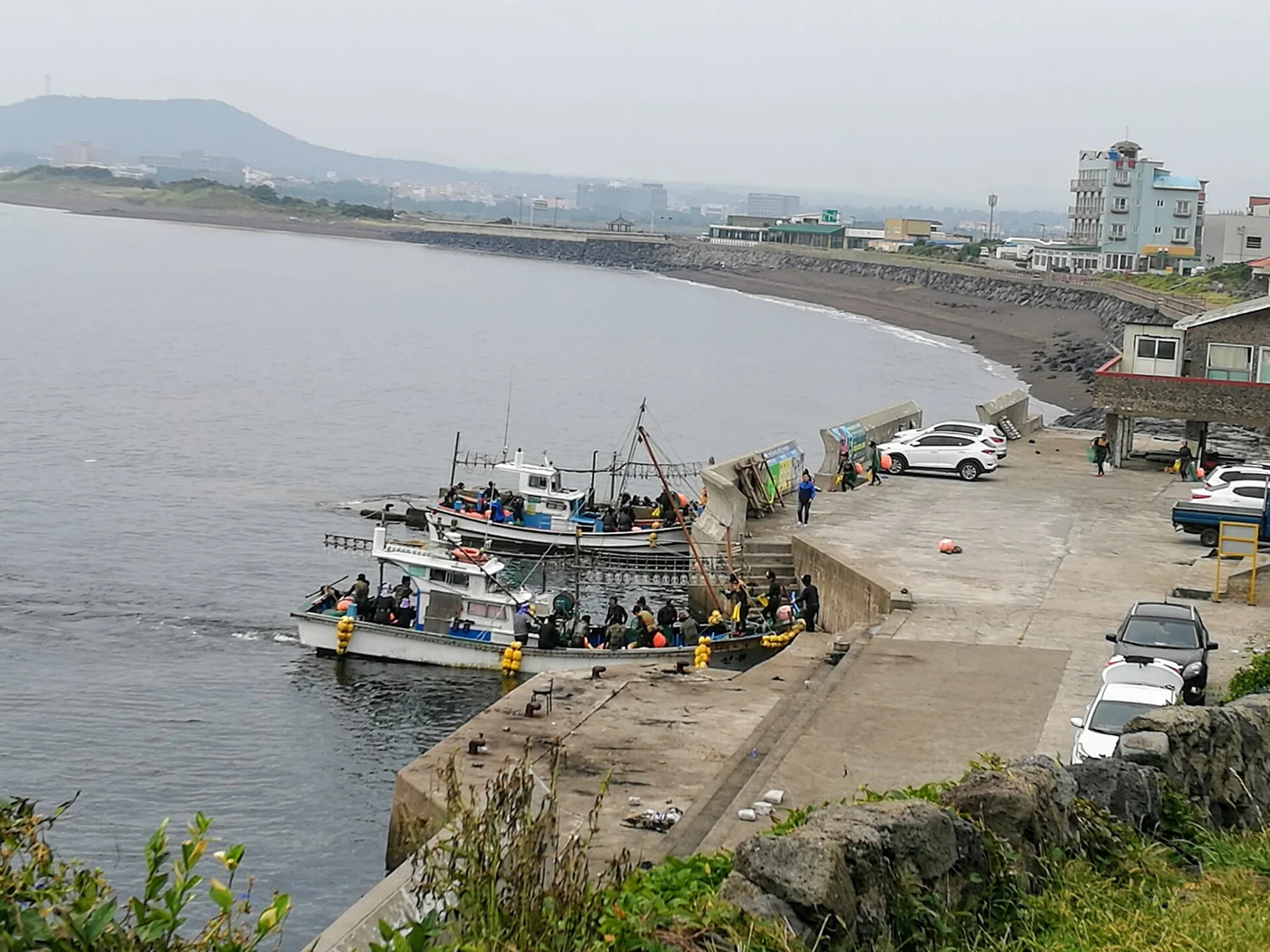
The 2017 photograph of boats near Seongsan Ilchulbong makes departure equipment visible above the water. It does not disclose each person’s contract or that day’s catch; it does show a vessel involved in reaching the sea. Depicting the occupation only as a solitary person floating offshore leaves this journey out. Where a boat is part of the work, transport is a stage within the occupation rather than scenery surrounding it.
The route changes which people and objects must move together. In addition to a tool and a collecting net, there is a connection between departure, working water and return. Occupational knowledge includes moving bodies and equipment into that working area and bringing them back, alongside handling a resource immediately in front of the diver.
Changing clothes and changing ways of seeing
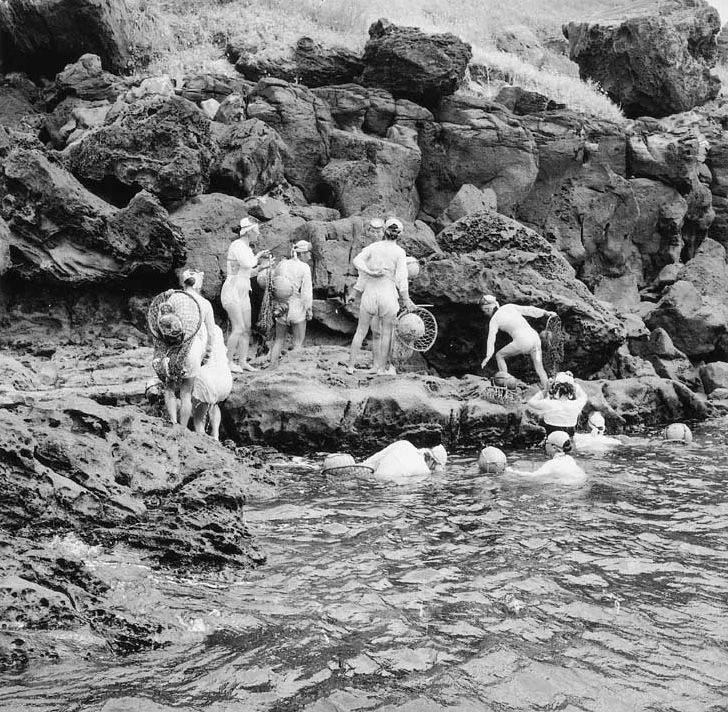
Jeju National Museum identifies divers’ jacket-and-trouser clothing in the Tamna Sunryeokdo of 1702. The record preserves clothing used for work; it need not be treated as the year the occupation began. The 1958 archival photograph in this article also belongs to a different material period from more recent black diving suits.
The equipment used to see underwater changed too. The encyclopedia places the introduction of the wangnun mask in the 1950s, following an earlier binocular-style mask called joksenun. Looking through glass into the sea therefore has a history of objects and shapes. Clothes and masks make an account of changing working equipment more concrete than a picture of custom standing still for centuries.
An item covering the body and an item helping vision solve different problems. Altering one does not make every part of an occupation entirely new, but changes accumulate within its stages. Even when the basic sequence remains collection and return, tools and experience pass through different periods. A present-day diving-suit photograph cannot stand in for every historical worker.
Grounds, access and shared harvesting
The sea lacks the immediately visible fences of land, yet access to working grounds has rights and practices. The encyclopedia describes village fishing associations and haenyeo organizations deciding on entry periods, joint collection and customary access. Entering a ground is an organized activity. The workplace is not simply an area where anyone arrives at any time to take whatever is available.
Joint harvesting can continue after an object reaches an individual net. Organizing collection and income together adds tasks not settled by underwater skill alone: coordinating a date, gathering results and distributing them. People using the same resources need ways to organize time and participation as well as the moment of collection.
Jang Youngmi discusses shared catches, land work and newcomers’ cameras; Kim Hyung-Mi learned from her mother, in UNESCO’s interview.
Those experiences put several kinds of participation beside one another. A learner may not yet collect as much underwater, while work remains above water and another person can share knowledge. A village account is not a rule for every community, but it shows entry occurring during learning, rather than only after complete mastery.
From a coastal fire to a stage rhythm
Bulteok were spaces for changing clothes and warming a chilled body around a fire after leaving the sea. They gave the worker a place to prepare again on land. Defining labour only as immersion leaves out recovery and waiting for another working period. Walls and fire make those less photographed stages tangible.
The encyclopedia’s haenyeo-nori entry describes work songs coordinated with rowing, and beating a float with a bitchang to make a rhythm around the bulteok. An object supporting the body on water could become a sound-making object on land. Equipment gained another role when workers sat together and sang.
In 1967, haenyeo song appeared at the National Folk Arts Competition in Busan in a staged presentation of work and everyday life. Labour songs were arranged as accompaniment, and harvesting movements became the basis for dance. A rowing body’s rhythm and a dance presented to spectators are not identical settings. Performance selects and arranges actions; it is not an unedited window onto a working day. Between labour at sea and its presentation on stage lies another process of making.
Leaving Jeju to work in other waters
The occupation’s history includes work outside the island. The encyclopedia describes late-nineteenth-century journeys to Busan and Ulsan, followed by routes along other coasts and islands and to Japan. Chulga in this context means leaving home to work in another area’s water. Skills known by Jeju’s name also became labour elsewhere.
Working near a familiar village and travelling to a distant coast change more than a place-name. A worker needs accommodation, a time to return, people connecting her with the work and relationships through which the harvest becomes income. The body’s collecting skills operate within those conditions of movement. Time away belongs inside the history of an occupation identified with an island.
This movement differs from the worldwide circulation of an image or heritage designation. A photograph travelling overseas and a worker entering another sea follow different routes. I find the occupation’s international presence more concrete when both are considered: journeys for work changed lives and the geography of marine labour before today’s fame.
Knowledge that makes another working day possible
A net contains the harvest, but its place at the surface, tools for different resources, routes to the grounds and decisions about shared harvesting must connect. Neither one object nor bodily ability alone completes the work. What a diver brings ashore is that day’s catch; what makes another departure possible is a connected working knowledge.
I locate continuity in that connection rather than a record for holding breath longer. Changing equipment, songs arranged for a stage, and people travelling to other waters all involve change. A newcomer learns an occupation among tools, places and colleagues, rather than merely admiring a finished tradition.
A heritage name helps people remember the work. It cannot itself supply a net, a working ground, learning time or colleagues. Making another day possible continues behind the familiar diving image. The float remains above while a person works below; following the sequence that connects them reveals a sea with considerably more content than a view.
A float, net, resource-specific tools, travel and shared harvesting work together to make another working day possible.
Sources & scope
Haenyeo tools, work routes and journeys ↗2023-02-07From haenyeo work songs to performance ↗2024-07-11Clothing in the visual record of 1702 ↗2022-06-20Working accounts of Jang and Kim ↗2023-10-12Jeju haenyeo with float and collecting net. karendotcom127, 2007.
by karendotcom127 · CC BY 2.0 · Resized and converted to WebP