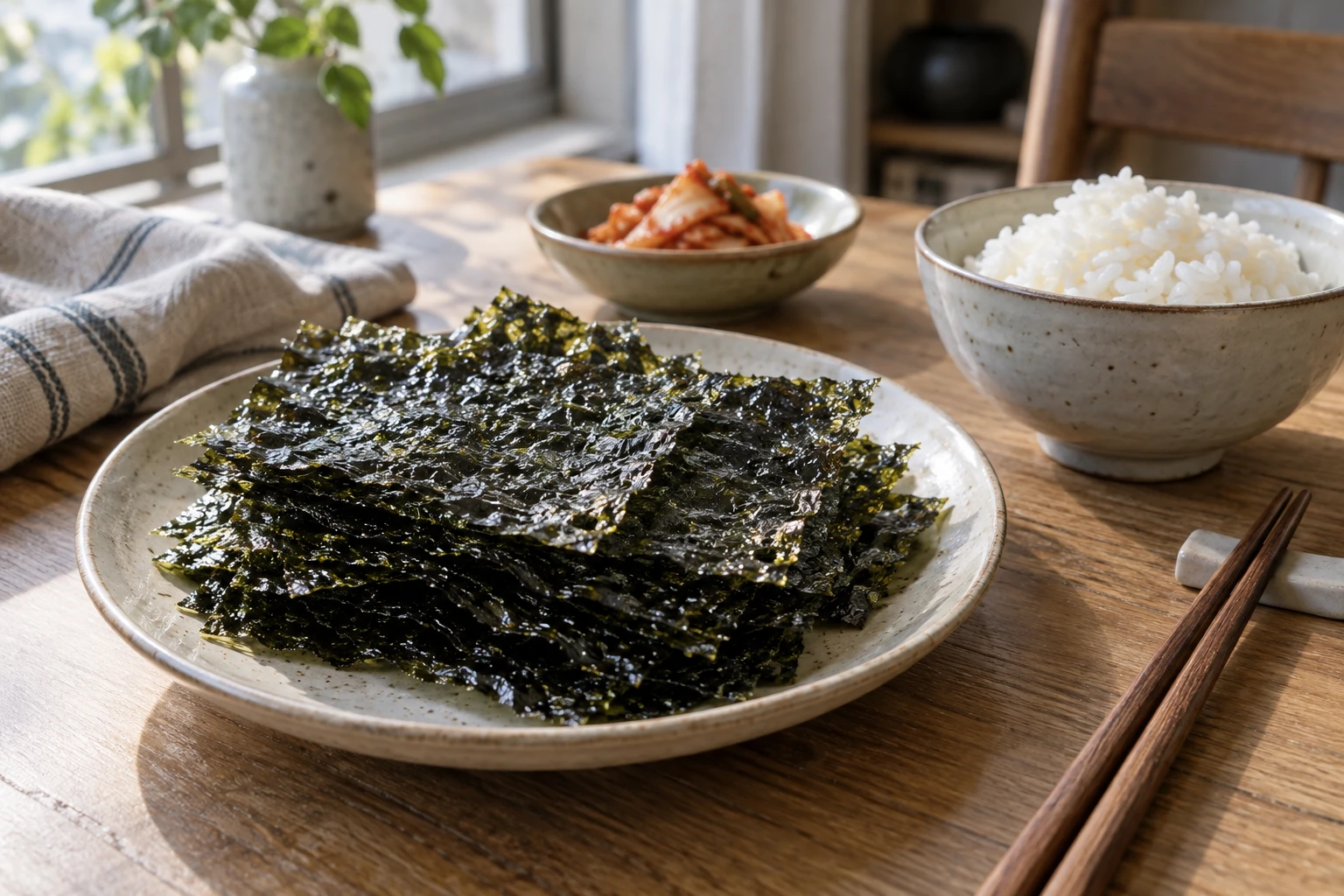
Before seaweed becomes a sheet
A large sheet for gimbap, a small seasoned rectangle beside rice and the flakes clinging to a rice ball look like different foods. The sheet must hold rice and fillings together. The rectangle should break lightly when bitten. Flakes spread flavour across the surface of another ingredient. Those jobs are not already assigned when wet seaweed comes out of the water. Washing, forming and drying produce a sheet; subsequent roasting, seasoning and cutting give it a particular use.
Gim is the Korean name for edible red algae with thin blades. It is different from miyeok, the seaweed often used in Korean soup, and from the thicker kelp called dasima. The familiar outline of a dry sheet is manufactured: soft, wet seaweed is spread out and water is removed. A packet therefore contains the result of work both at a marine farm and on a drying line. Its apparently simple, paper-like shape is one of the achievements of that work.
What the cultivation net does
The net in a gim farm supplies a surface on which the seaweed grows. The Korean National Institute of Fisheries Science describes two arrangements in its cultivation guidance. In a fixed-pole arrangement, supports hold nets in shallow water. The rising and falling tide submerges and exposes them. A floating arrangement uses floats to support nets in deeper water. Where a net remains submerged, farmers manage exposure by turning it over so it meets air and sunlight.
Installing a net is only the beginning. Light and moving water do not reach every part in exactly the same way. Dense growth can shade neighbouring blades, and other organisms can attach to the cultivation surface. Exposure and immersion are practical tools for managing the condition of the net. Behind a neat stack of sheets are repeated tasks of turning a net and returning it to the water.
Harvested gim travels to a processing plant wet. It is not yet a material that can be counted as sheets. Handling that wet crop, cleaning it and preparing it to spread evenly connect cultivation to manufacturing. Growing a crop and making an even sheet demand different kinds of attention, but the kitchen eventually encounters the results of both.
Washing, cutting and forming
A 2025 National Assembly Budget Office report, drawing on material supplied by the Ministry of Oceans and Fisheries, describes washing the crop to remove foreign matter, cutting it, drying it and packing dried sheets. Water initially helps carry the seaweed; removing it is what allows a light sheet to remain.
Seocheon Gim FMB’s own equipment description gives a closer view of forming. It identifies freshwater mixing, forming wet gim and drying as parts of its production arrangement. Dispersing cut material in water helps distribute it before a sheet is made. Forming spreads the wet mixture into a flat unit; water removal and drying turn that unit into something that can be lifted and moved. This is a change in the job that water performs, from a medium for spreading the material to something that must be taken away.
Thickness and weak spots matter later. A fragile patch can tear when rice is spread over it; a thicker area feels different in the mouth. Holding a sheet to the light reveals that it is a food formed from small pieces rather than a uniform black film. Gimbap also places moist rice against it, so the cook must manage the rice layer as well as the strength of the sheet.
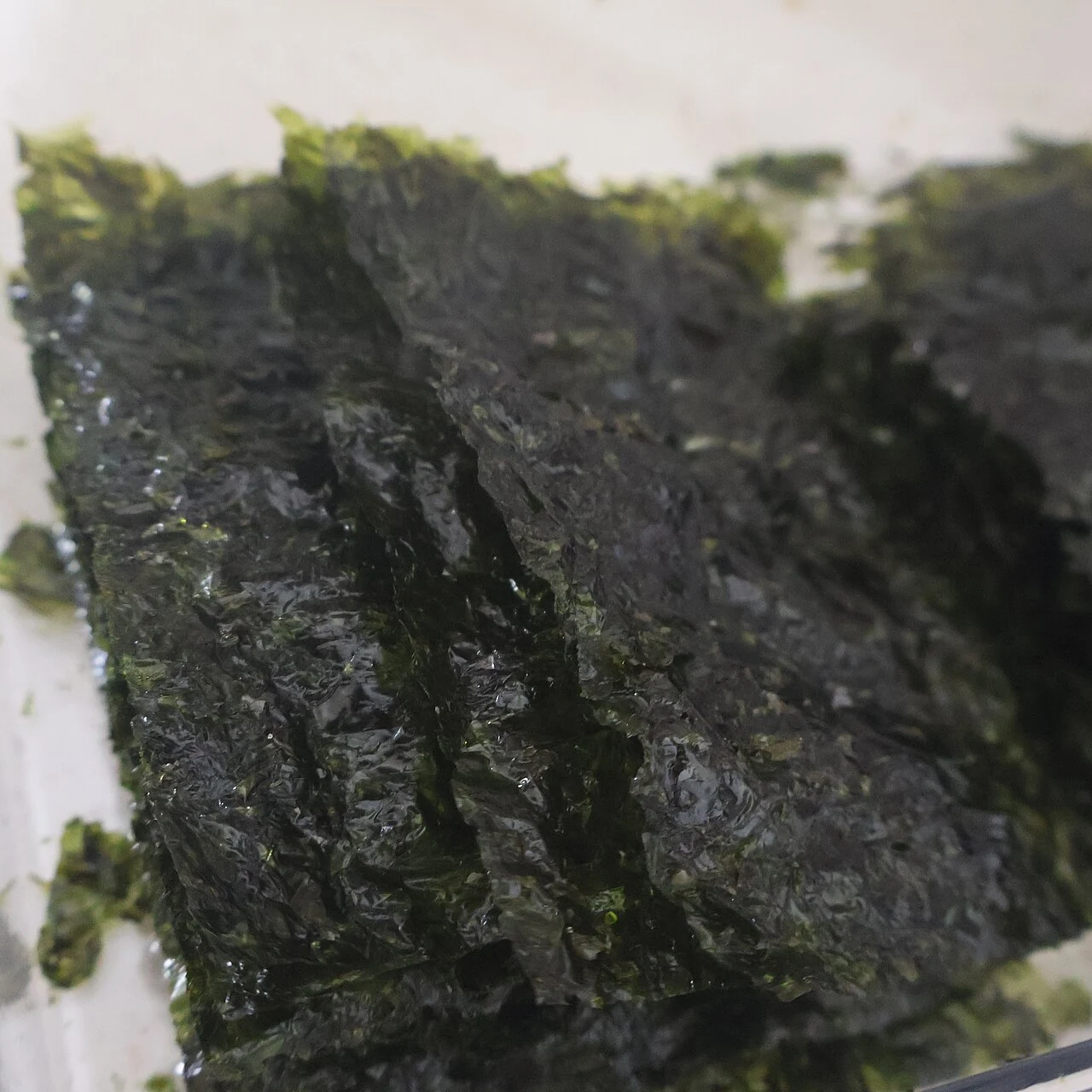
Dried, roasted and seasoned gim
Drying alone does not add oil or salt. Roasting a dried sheet changes its aroma and the way it breaks. Seasoned gim adds ingredients such as oil and salt. The processing example in the budget report includes an initial roast, seasoning with oil and salt, and another roast, followed by cutting, packing and inspection. Drying and roasting appear along the same production chain, but one makes the wet material into a dry sheet while the other heats an already formed sheet.
A seasoned sheet cut with scissors can crumble at its edges. Taken on its own, a piece brings oil aroma and salt directly to the tongue; wrapped around a spoonful of rice, that seasoning spreads through a larger mouthful. Gimbap usually begins with a large sheet on which rice and fillings are arranged. Trying to make the same wrapping from small seasoned rectangles creates extra joins and brittle edges. One form is suited to enclosing a substantial filling, the other to breaking lightly in a bite.
Moisture changes this behaviour. An opened piece that has become limp bends rather than cracking as it did before. Small packets make it possible to expose a fresh portion when needed; remaining dry gim should be sealed according to the product’s storage directions. A completed gimbap roll has already met moist rice, so its eating texture is different from that of an unopened packet of dry sheets.
Flakes and a rice-coated crunch
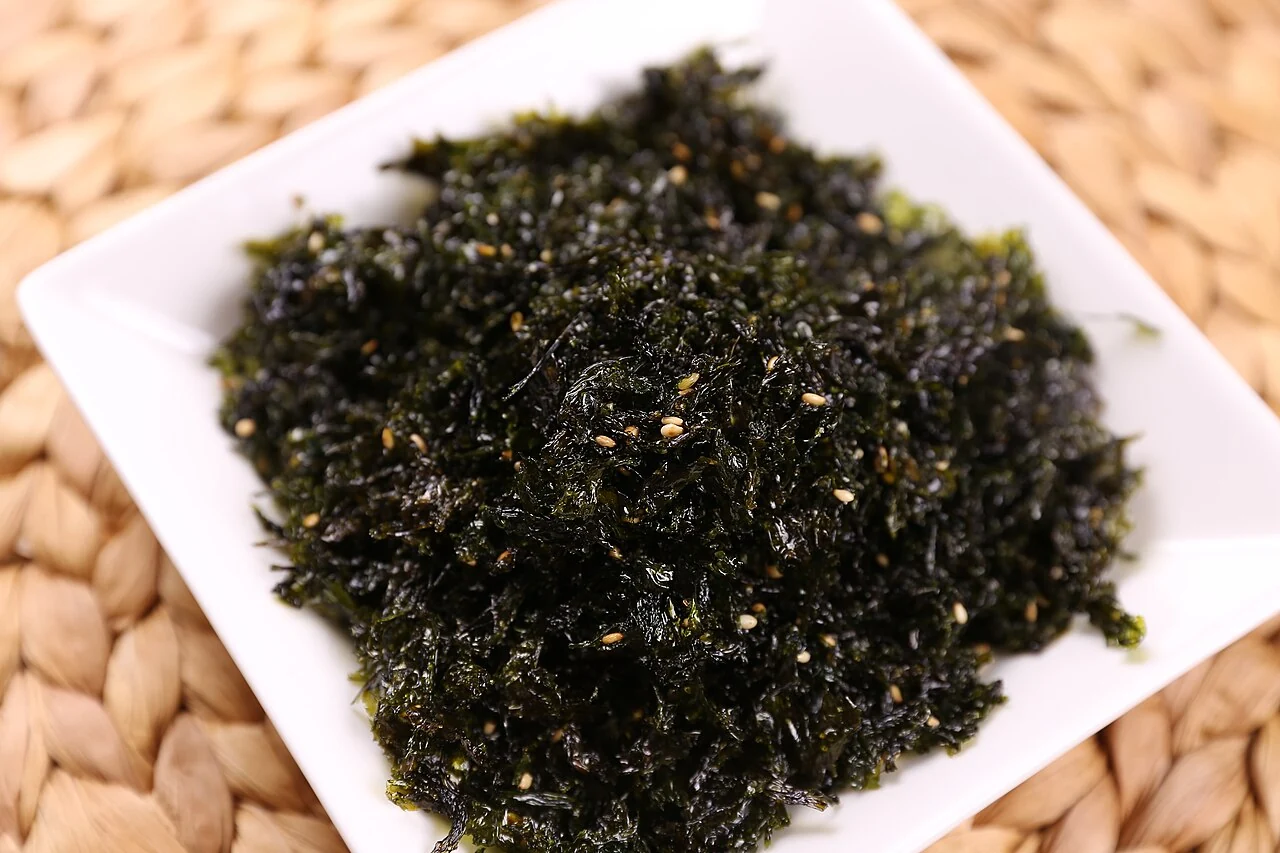
Crumbled gim can coat a rice ball or be mixed into rice. Instead of enclosing the whole portion, fragments distribute themselves across it. A bite then combines areas with gim and areas without it. On noodles, stirring flakes through a moist dish and adding them to the top immediately before eating produce different textures. Contact area and waiting time are part of how the ingredient works.
Gimbugak takes a different route. A Koreana article published by the Korea Foundation describes coating gim with glutinous-rice starch paste, drying it and frying it. The coating creates an additional layer. A roasted sheet breaks as a thin piece; bugak breaks through both seaweed and the fried coating. Its raised surface and greater thickness give it a different bite from a small seasoned rectangle.
These forms also explain useful kitchen choices. Sheets left after making gimbap can be cut to accompany rice, while broken pieces can go into rice balls or onto noodles. When the gim already contains oil and salt, the seasoning added to the rest of the dish needs to take that contribution into account. The balance is described further in our guide to preparing gimbap rice and fillings.
A snack changes the size of the bite
A dated commercial example makes the change tangible. Korea.net’s 2014 report on Dongwon F&B describes Kimmy as a snack product with less salt and a crisper texture. This is a specific product-development example, rather than a claim about everything on today’s shelves.
The underlying kitchen problem is easy to imagine. A salty piece that accompanies a spoonful of plain rice and several pieces eaten alone ask for a different balance. Cutting a sheet at the table and taking a ready portion straight from a packet also involve different handling. Selecting a bite size and an amount to open can become as significant as cooking. The material can stay recognisably gim while the unit of eating changes.
What remains valuable in a thin sheet
For me, gim is most interesting when the same ingredient appears in different textures. Around gimbap it holds rice together and is chewed with it. A roasted piece breaks lightly. In bugak, the fried coating adds another layer to the bite. Washing and forming make the basic sheet possible; later cooking creates those distinct experiences.
That manufacturing story becomes immediate when a cook lays out a sheet or places rice on a small rectangle. It is present in the strength felt by the fingers, the break of a piece in the mouth and the act of closing the remaining packet. A marine crop gains several roles through the technology of making a sheet. Our story of gim’s move from side dish to snack follows what that change means for products and eating habits.
Wet gim becomes a sheet through washing, cutting, forming and drying; later roasting, seasoning and cutting give it different textures and uses.
Sources & scope
Cultivation nets and managed exposure ↗Processing wet gim into dried and seasoned sheets ↗2025-07One producer’s mixing, forming and drying equipment ↗Rice-starch coating and frying gimbugak ↗2019-SPRINGKimmy’s snack-development example in 2014 ↗2014-06-09Modules independently explains the verified sources. The lead image is AI-generated for illustration; it is not a documentary photograph of an actual place, event or product.
Updates & corrections
Dates record changes to this document, separately from the reference dates of its sources.
- Content update
Rewrote the article with fuller production, history, examples and source explanations.
- First published
Created Korean and English documents using verified official sources.