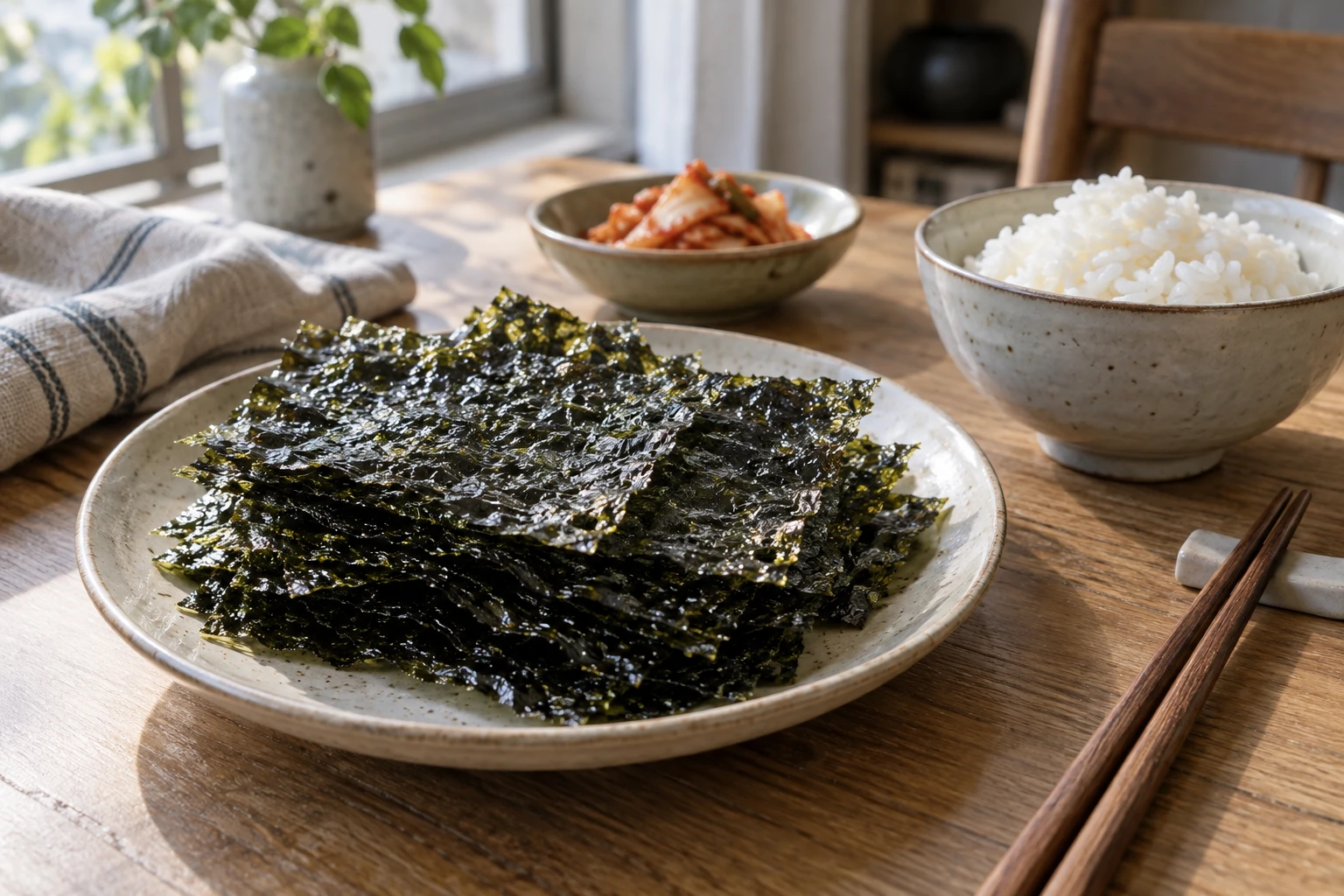
When the sheet becomes the whole mouthful
Lay a piece of gim over warm rice and fold it with chopsticks: the sheet helps gather the grains into one bite. Oil and salt reach the mouth first, while soft rice meets the brittle sheet during chewing. Open a small snack packet instead and there is no rice underneath. Gim changes from something that surrounds another food to something that occupies the whole bite. The ingredient has the same name, but the structure of eating is different.
Moving the eating place overseas does not create that change by itself. Sheet size, cutting, seasoning and the amount released by one opening all matter. A rice-table side dish, a broad gimbap wrapper, flakes mixed through rice and a crisp snack can share a material while becoming different dishes and products. Following those changes makes the work of the sea and factory visible before the small packet.
A farm net does not produce a rectangle by itself
The National Institute of Fisheries Science’s cultivation and processing account distinguishes nets attached to fixed supports from floating arrangements. They place growing material under different immersion conditions. In the fixed system, changing tidal levels expose and cover the net. With a floating system that remains immersed, people turn nets to manage exposure.
Turning is not simply tidying equipment after the harvest. It manages the growing material’s contact with light and air. Equipment seen on the sea can seem permanently stationary, yet work continues during growth. Supports, exposure and the condition of the attached material are managed before there is a wet harvest to send to a factory.
The account does not provide a timetable valid for every sea. Water temperature, light and growing density relate to development, and expanding the equipped area does not improve all those conditions proportionately. A buyer opening a snack pack does not see this earlier work. Gim may resemble a thin industrial object, but its first material is biological and grows at sea.

Wet material is washed, divided and arranged into a sheet
Harvested wet gim does not resemble the rectangle removed from a package. Seocheon Gim FMB’s equipment guide identifies washing and foreign-material selection, cutting, freshwater mixing, wet-sheet formation and drying equipment. In this company’s account, managing the wet material and making a sheet’s shape are different operations.
Smaller cut material is handled with water and arranged over an area during forming. Water is then removed and the material dried into a thin sheet. A rectangle has not grown in the sea and simply been left to dry unchanged. Dividing and rearranging creates the regular outline. NABO’s account based on Ministry of Oceans and Fisheries material similarly separates washing and preparation, drying and later seasoning work.
The sheet can now enter several further routes. A gimbap wrapper retains a broad area to surround rice, vegetables, egg and other fillings. A table accompaniment can be cut into pieces convenient for chopsticks. Broken material distributes through rice instead of keeping the border of a sheet intact. Sheet-making does not determine one final food: a dried sheet can be a product and an ingredient for further processing at the same time.
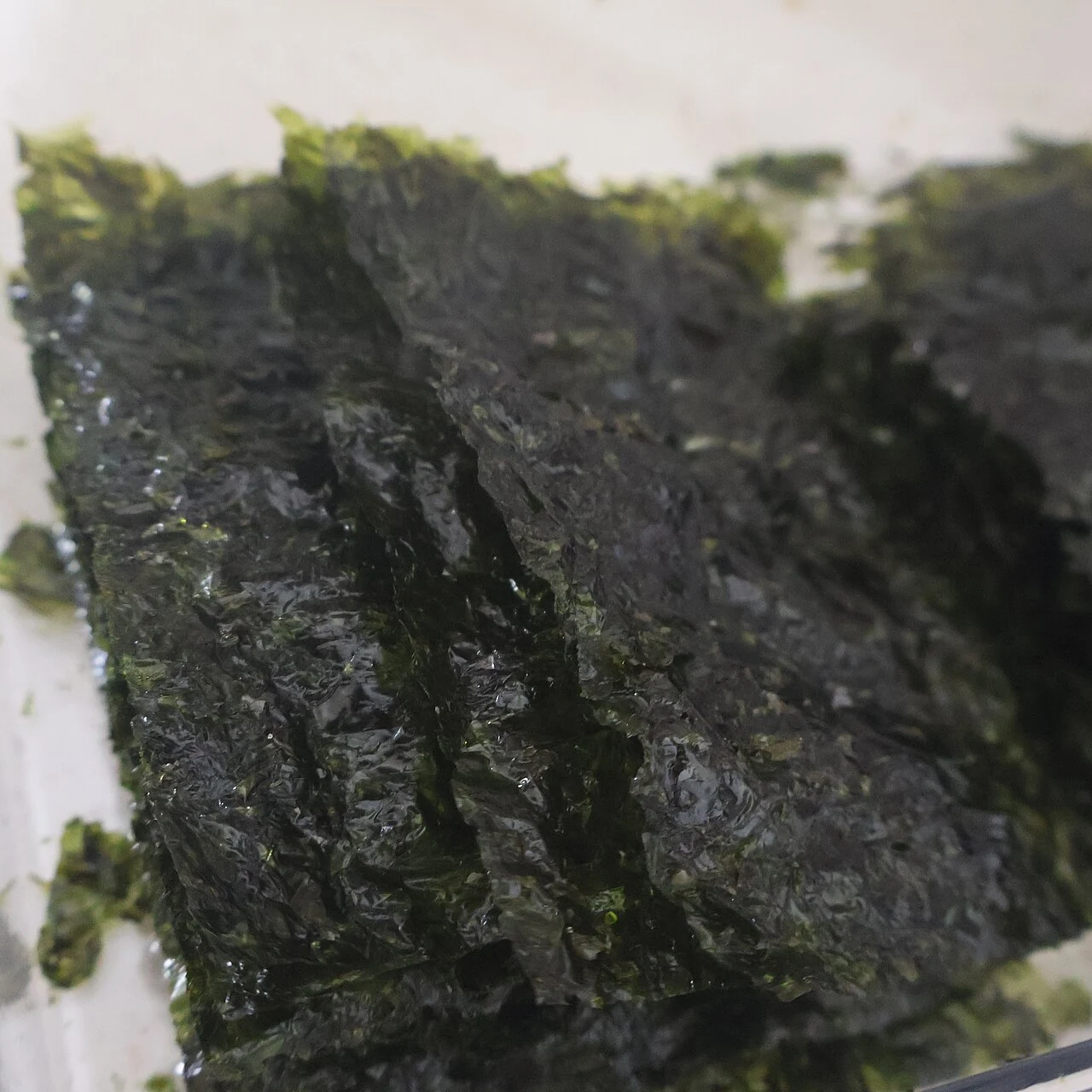
Oil, salt and roasting come after sheet-making
Drying wet gim and roasting seasoned gim are not the same action. After water has been reduced to produce a sheet, already dry material undergoes further heating. NABO’s description gives an initial roasting, addition of oil and salt, another roasting, then cutting, packaging and inspection. That is the process described in the document, rather than a claim that every factory uses identical machines or temperatures.
Oil is an ingredient added to the sheet. The oil on its uneven surface and the salt enter the mouth whether the gim is eaten with rice or alone. The salty taste of seasoned gim cannot be attributed entirely to the original marine material. Added ingredients and the way the sheet is heated meet the material’s aroma in a bite. Even sheets of equal size can deliver different food compositions when one is seasoned.
When making gimbap, a broad sheet receives a thin layer of rice and grouped fillings, then rolls around them. It needs a continuous surface to enclose its contents. A small seasoned piece eaten alone makes handling size and the break in the mouth more immediate. The account of preparing and rolling gimbap follows how rice moisture and filling arrangement join the work of the sheet.
One producer’s products branch into several uses
Yangban’s current official history places its gim launch in April 1986. The date is not the invention of all Korean seasoned gim. It concerns an established food acquiring one company’s brand and distribution units.
The 2014 Korea.net feature identifies Kimmy as a snack-oriented product with reduced salt and increased crispness, and records Sea Veggies entering the United States and Canada in 2011. The substantive change is an intended bite that does not depend on accompanying rice. These are dated company examples rather than a description of every overseas customer’s present taste.
The official history also records Yangban gimbugak in December 2020 and two dipping gimbugak products in October 2024. The product catalogue checked on 12 October 2026 includes gimbap sheets, flakes, gimbugak and dipping versions with wasabi-mayo or barbecue-flavour sauce. Dipping a thicker piece separately differs from taking a thin seasoned sheet directly into the mouth. Products for wrapping, scattering and eating one piece at a time sit together under one brand.
Breaking or coating creates another bite
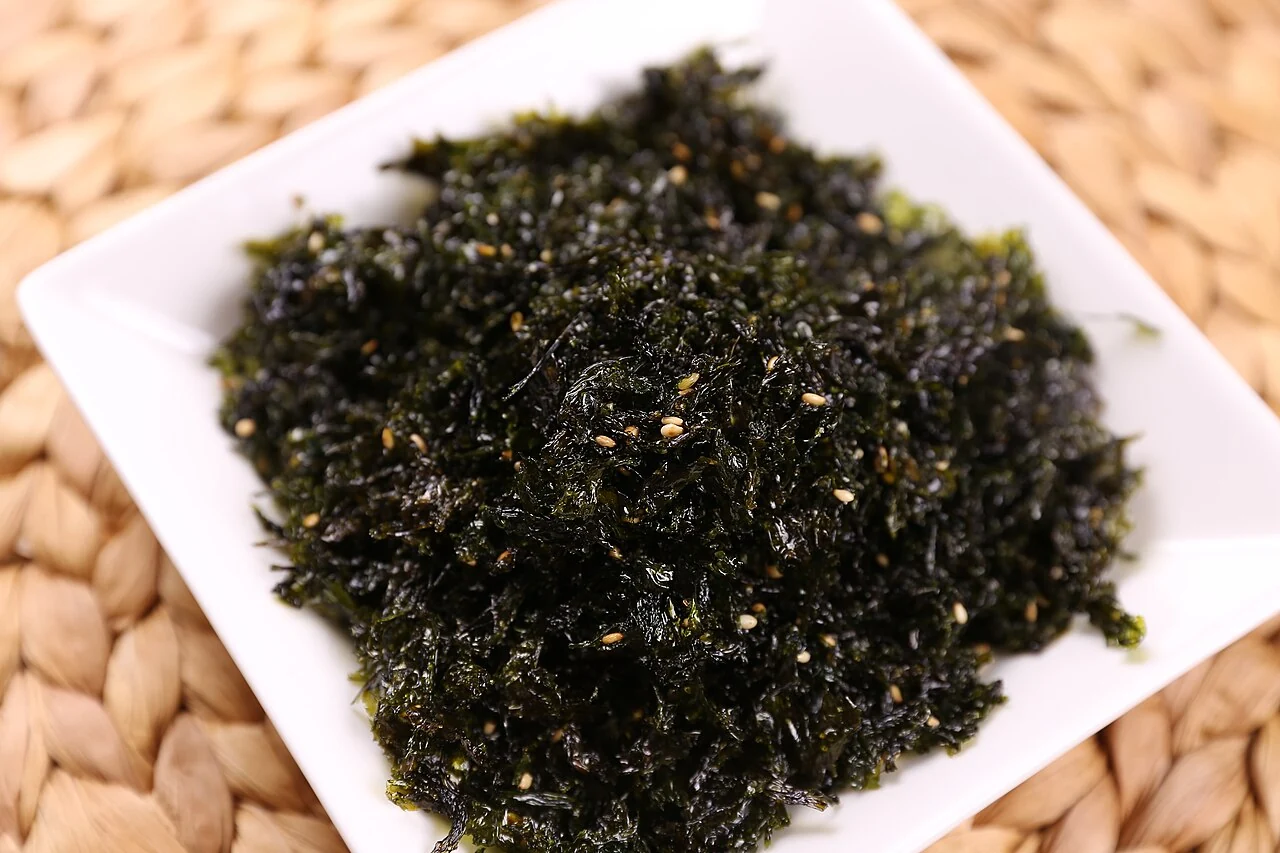
When flakes are mixed into rice, the gim no longer determines the outside of a mouthful. Small fragments travel between grains; their proportion changes a little with each movement of a spoon or chopsticks. That is a different structural direction from a broad sheet holding fillings inside. The documentary photograph of gim flakes shows fragments and sesame scattered on a white plate, where the continuous surface of a sheet has disappeared.
Gimbugak follows another cooking route: apply glutinous-rice paste to a sheet, dry it, then fry it. Koreana’s account identifies those materials and stages. A cereal layer joins the seaweed before further drying and heating. In the mouth, that added layer breaks together with the gim. A snack does not have to take the form of a small seasoned sheet.
Contemporary gimbugak products combine the inherited cooking name with specific commercial arrangements. Sauce flavours or shrimp and garlic in a catalogue indicate particular bites the manufacturer offers. Those product names do not become universal ingredients of gimbugak. Keeping the cooking route distinct from one product’s additions helps explain other products as well.
Back from the packet to the table
Packaging sets the next conditions for sheets and fragments. A bundle intended to be unfolded into whole sheets and a small pack of pieces protect different shapes. A broad sheet can tear along a fold; little pieces can break during movement and leave powder at the bottom. A sealed product and one exposed to humidity after opening are also in different conditions. Reopening a large supply and taking out one eating portion change how long the remaining material must be handled.
These differences reach situations a reader can picture. Rice may escape through a torn corner of a sheet being rolled into gimbap. Fragments left at the bottom of a snack packet scatter rather than behave like a piece lifted by hand. Sprinkle them over rice and they gain another use. Sheets, pieces and powder each allow different actions: lifting, wrapping and scattering.
For me, the interesting part of gim’s overseas spread is that changing mouthful, more than the adjective “popular.” Managed nets supply wet material; that material becomes sheets; seasoning or coatings are added; size and packaging alter what an eating hand does. The hand wrapping rice and the hand lifting a snack do not cancel one another. Read the account of gim’s manufacture and forms and open a packet again: the small sound of its first break can recall the concrete work before it.
Gim’s journey overseas becomes clearer when wrapping, picking up and sprinkling are understood as different results of processing and packaging.
Sources & scope
Gim cultivation and processing ↗Gim and its culinary forms ↗2019-SPRINGYangban Gim: from side dish to snack ↗2014-06-09FY2024 settlement analysis: gim production and processing ↗2025-07Gim processing equipment and stages ↗Yangban product history ↗Yangban gim products ↗Modules independently explains the verified sources. The lead image is AI-generated for illustration; it is not a documentary photograph of an actual place, event or product.
Updates & corrections
Dates record changes to this document, separately from the reference dates of its sources.
- Content update
Rewrote the article with fuller production, history, examples and source explanations.
- First published
Created Korean and English documents using verified official sources.