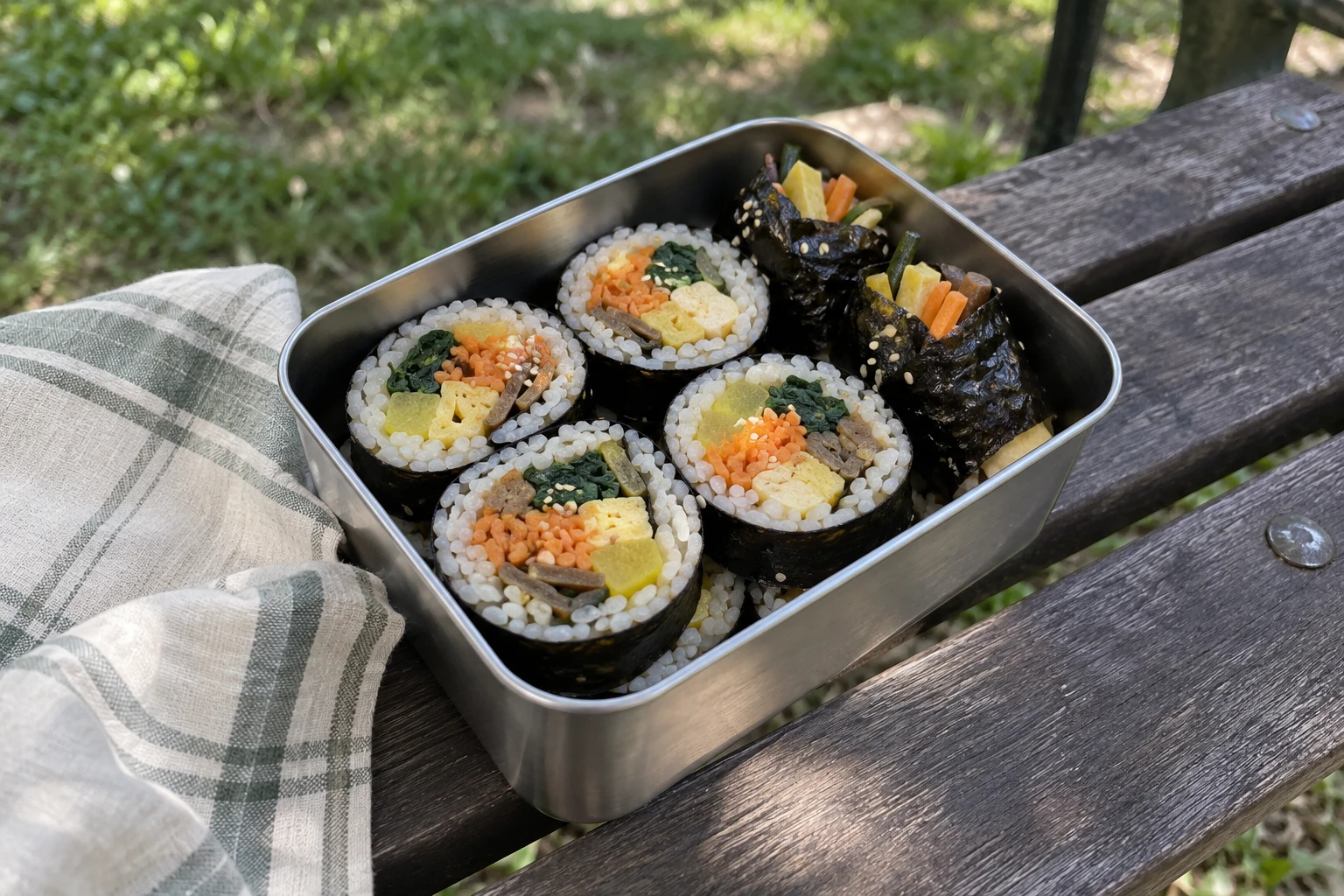
Before the rolling mat moves
Ordering gimbap can make the meal look almost instantaneous. A sheet of gim, the dried seaweed wrapper, receives rice and rows of filling. The cook rolls it, slices it and hands over lunch. But the rolling station is the last stop in a much longer preparation: cooking rice, blanching greens, frying carrots, making an egg sheet and preparing meat. Ingredients that will be eaten together are first cooked apart. That separation gives each one the treatment it needs.
Consider a roll with spinach, carrot, egg and danmuji, the pickled radish commonly cut into long strips. The greens yield easily to the teeth; the carrot provides a finer, firmer bite; egg fills spaces between the vegetables; radish brings crunch and a sharper, salty-sour taste. Braised burdock or beef adds a different chew and seasoning. A long ingredient list alone cannot produce that contrast. Overly wet greens and coarse, hard carrot sticks can turn an attractive section into an awkward mouthful.
At a rice-and-side-dish table, the eater can take a smaller piece of something salty. Inside a finished roll, the proportions have already been decided. Heavily seasoned rice beside generous amounts of pickles and braised burdock makes every slice salty. An especially thick layer of rice leaves the fillings as brief interruptions. The cook distributes not just colours but the balance of an entire bite.
Rice binds; the seaweed has to hold
Rice is both a filling and the layer that keeps other fillings together. Very wet rice forms lumps when spread, making it difficult to build a thin, even layer without crushing the grains. A thick layer also takes away space for the centre. Rice that has become cold and dry presents the opposite difficulty: it spreads reluctantly and can break apart as a slice is lifted.
Salt and sesame oil are familiar seasonings for contemporary gimbap rice. Salt gives the rice its own flavour, while sesame oil adds aroma between grain and wrapper. Strongly steaming rice can release moisture against the gim once enclosed. Spreading it out to lose some excess heat, while keeping it from drying out, helps the rolling stage. The wrapper starts changing when rice touches it, rather than only when the lunchbox is opened.
A full sheet made for rolling must withstand rice, fillings and the pull of assembly. Thin patches or large holes can become the place where a tightly packed roll tears. Leaving a strip of seaweed uncovered at the far edge gives the seam room to overlap. Packing rice right to every edge can force grains out between the meeting ends. The wrapper cannot close neatly if the filling has already occupied the space needed to close it.
Preparing greens, carrots, eggs and meat separately
Blanching spinach softens its leaves and reduces its bulk. After cooling, excess water is squeezed out before seasoning. Otherwise, pressure from rolling releases water into the rice and wrapper. Aligning the stems loosely along the length of the roll also distributes the greens through successive slices, rather than leaving a ball of spinach at one end.
Carrots respond to a different treatment. Cutting them into fine strips and sautéing them softens their hard structure while retaining some bite. A thick raw stick can resist the teeth after the neighbouring rice and egg have already compressed. Several finer strands combine more easily with those softer ingredients. The width of the cut matters as much as the decision to use carrot at all.
Egg is convenient as a cooked sheet cut into strips. Several narrow strips can fill gaps around other ingredients; a single thick piece demands more space. Pickled radish and braised burdock arrive with seasoning already inside them. Draining excess liquid keeps that liquid from being pressed into the rice. Preparing these components in separate rows makes the final assembly quick because their lengths and consistency have already been managed.
Beef can be cooked as thin strips or as minced meat. Soy sauce, garlic, sugar and sesame oil connect its flavour to familiar Korean meat preparations. Cooking the meat and reducing free liquid before assembly produces a filling, rather than a sauce poured across the rice. Each component reaches an edible state before the roll is formed. The seaweed wrapper does not finish cooking an underdone centre.
Building a roll that survives the knife
Long fillings run along the same direction so that each slice receives a similar mixture. A large clump of greens near one end and most of the beef at the other would create different meals inside one cylinder. Simply cutting more slices cannot correct that distribution. The arrangement has to be made before the wrapper closes.
The first turn brings the near edge of rice and seaweed over the filling towards the opposite rice surface. Fingers gather the centre while the mat guides the next movement. The mat itself must be drawn clear rather than trapped inside. Too little pressure leaves large gaps; excessive pressure can rupture the wrapper or squeeze soft egg out of position. A compact roll comes from even gathering, not from crushing its contents.
Resting the seam underneath helps the roll stay closed. A sharp knife then cuts through wrapper and rice without flattening the top. Sticky grains left on the blade can drag the next slice out of shape, so cleaning it between cuts has a practical purpose. A neat slice should be easy to lift and eat. The end piece, where fillings protrude, offers a different pleasure without making the rest of the roll a failure.
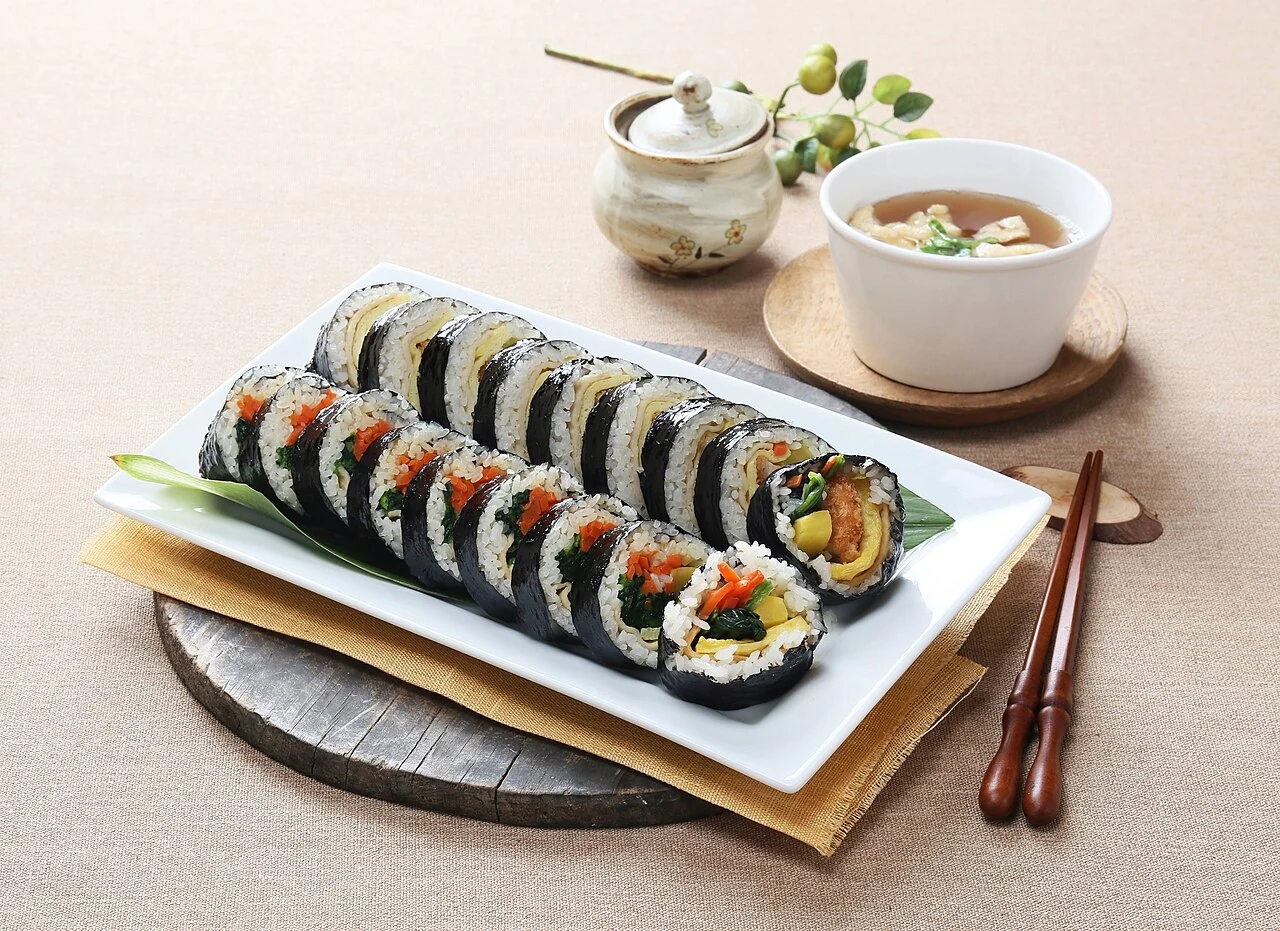
A preparation problem recorded in older cookbooks
Cha Kyung-hee’s gimbap entry in the Encyclopedia of Korean Culture discusses a 1966 cookbook that instructed cooks to squeeze moisture from braised fillings, and a 1976 cookbook that used vinegar-seasoned rice. These recorded details show that both liquid control and rice seasoning have a history. Today’s familiar sesame aroma was not the only seasoning used in published preparations.
New fillings keep bringing the same practical problem back. Liquid from braised ingredients, water remaining in greens and liquid from canned tuna have little room to escape after assembly. The techniques of cutting, draining and separate cooking help turn those ingredients into a roll that stays together. An older food record becomes more revealing when it preserves the work of making dinner, rather than just the name of dinner.
When accompaniments move outside
Flaked tuna has a different structure from a firm radish strip. More liquid or mayonnaise makes it less able to hold its shape; a perilla leaf can provide an aromatic layer around a loose filling. A cheese slice adds salty richness, while a broad piece of breaded cutlet changes the space available for rice and vegetables. A new menu option can require a new arrangement as well as a new ingredient.
Chungmu gimbap, associated with Tongyeong, serves small rice-only rolls beside radish kimchi and seasoned squid. The accompaniments supply the seasoning between mouthfuls. What sits inside an ordinary filled roll sits alongside these smaller ones. The meal is completed across the plate and in the eater’s chosen sequence. How gim is produced and processed follows the ingredient that provides both kinds of wrapper.
Lunchboxes and the freezer
A lunchbox roll makes rice and several side dishes easy to pick up together. Soup stays outside, and another dish such as ramyeon or tteokbokki can supply a stronger flavour beside the rice. How one roll became one meal examines the changing settings and businesses around that portable form.
Frozen products leave another preparation stage for the buyer. After cold storage and distribution, the slices need the thawing and heating specified for that particular package. A loosened outer wrapper and a centre warmed through are different stages. Instructions belong to the product’s quantity and arrangement, rather than to every food called gimbap.
I value a roll whose rice and fillings stay together when lifted more than one with the largest-looking centre. The seemingly quick meal contains many earlier decisions: how finely to cut, how much moisture to remove, how thinly to spread and how evenly to gather. Their result is simple to enjoy. After one bite, the next slice still waits intact in the lunchbox.
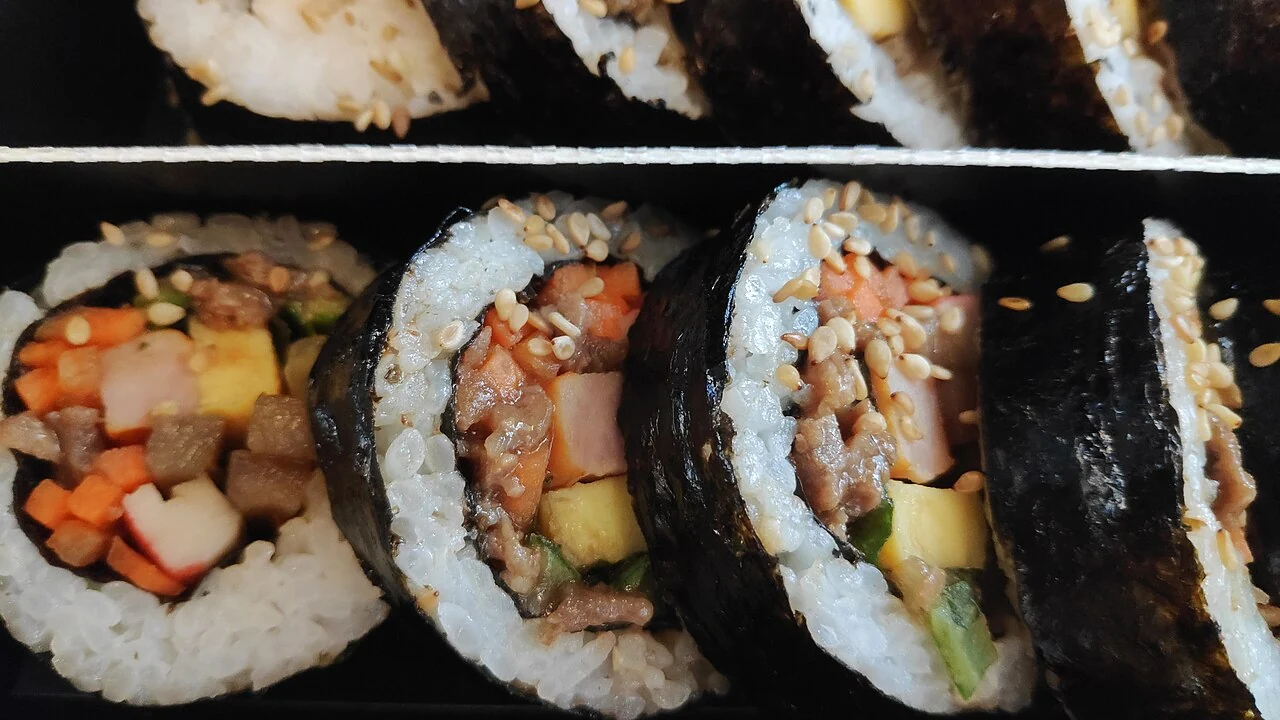
Separate preparation and even placement turn contrasting ingredients into an intact bite.
Sources & scope
Gimbap: preparation recorded in older cookbooks ↗2023-09-21Maangchi’s classic gimbap preparation ↗2023-06-24Korean Bapsang: gimbap ingredients and preparation ↗Chungmu gimbap and separate accompaniments ↗2023-10-19Modules independently explains the verified sources. The lead image is AI-generated for illustration; it is not a documentary photograph of an actual place, event or product.
Updates & corrections
Dates record changes to this document, separately from the reference dates of its sources.
- Content update
Rewrote the article with fuller production, history, examples and source explanations.
- First published
Created Korean and English documents from verified sources.