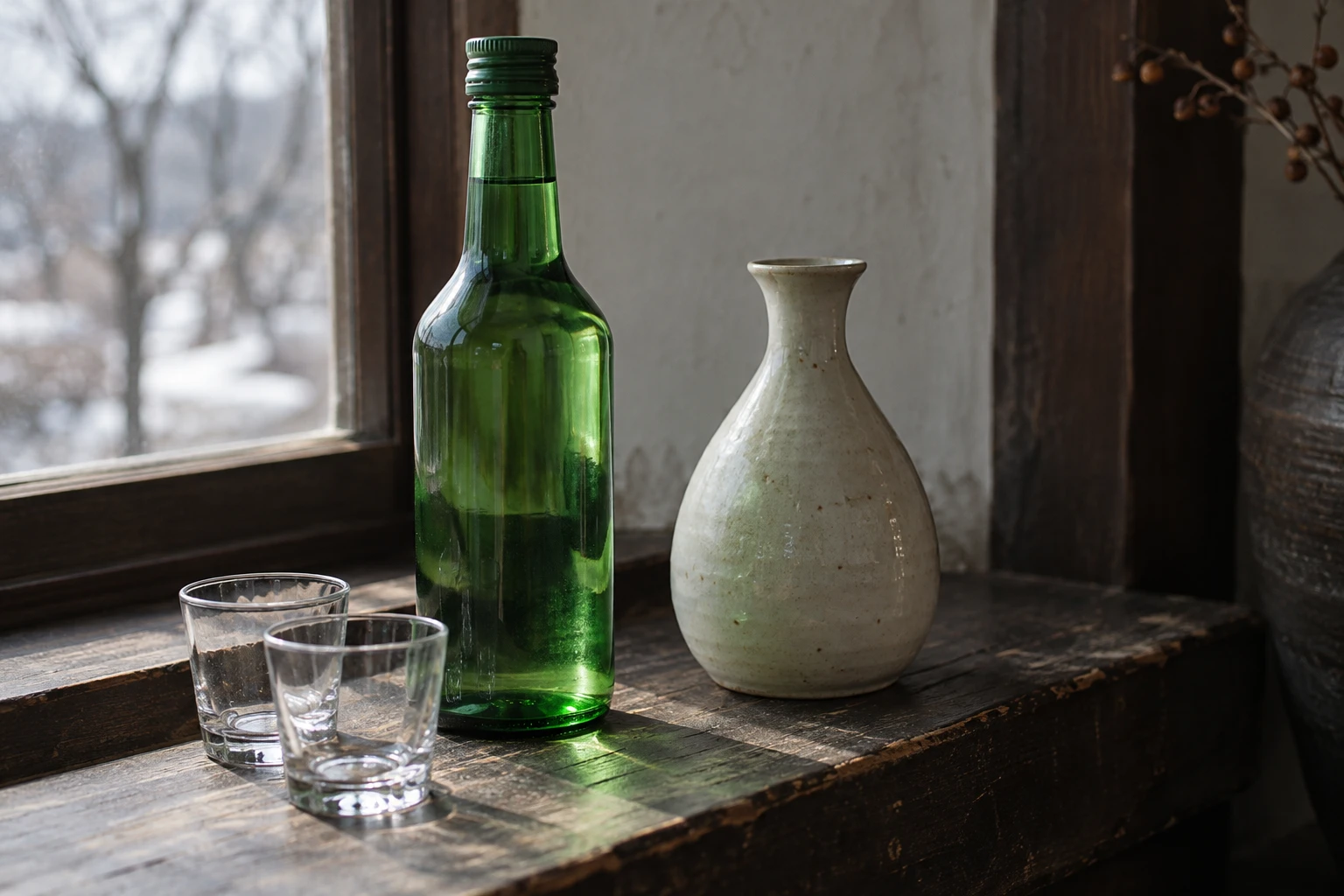
The work before a clear drink
There are no rice grains or pieces of fermentation starter visible when soju enters a glass. Its clarity can make the entire manufacturing process seem like mixing something into water. Yet obtaining a distillate from fermented grain and blending a finished product from refined base alcohol are different production routes. Both can end in a transparent liquid. Before the bottle, however, there is preparation and fermentation, heating and cooling, management of a distillate or refinement and blending of base alcohol.
Soju is not the name of one company or one strength. Historical accounts of traditional stills, regional transmission, modern factories and fruit-flavoured products sold overseas sit around the same category. Following what actually happens to the materials makes those differences easier to see. Preparation, fermentation, distillation and bottling each contribute something that the finished colour cannot show.
Nuruk is prepared before the mash
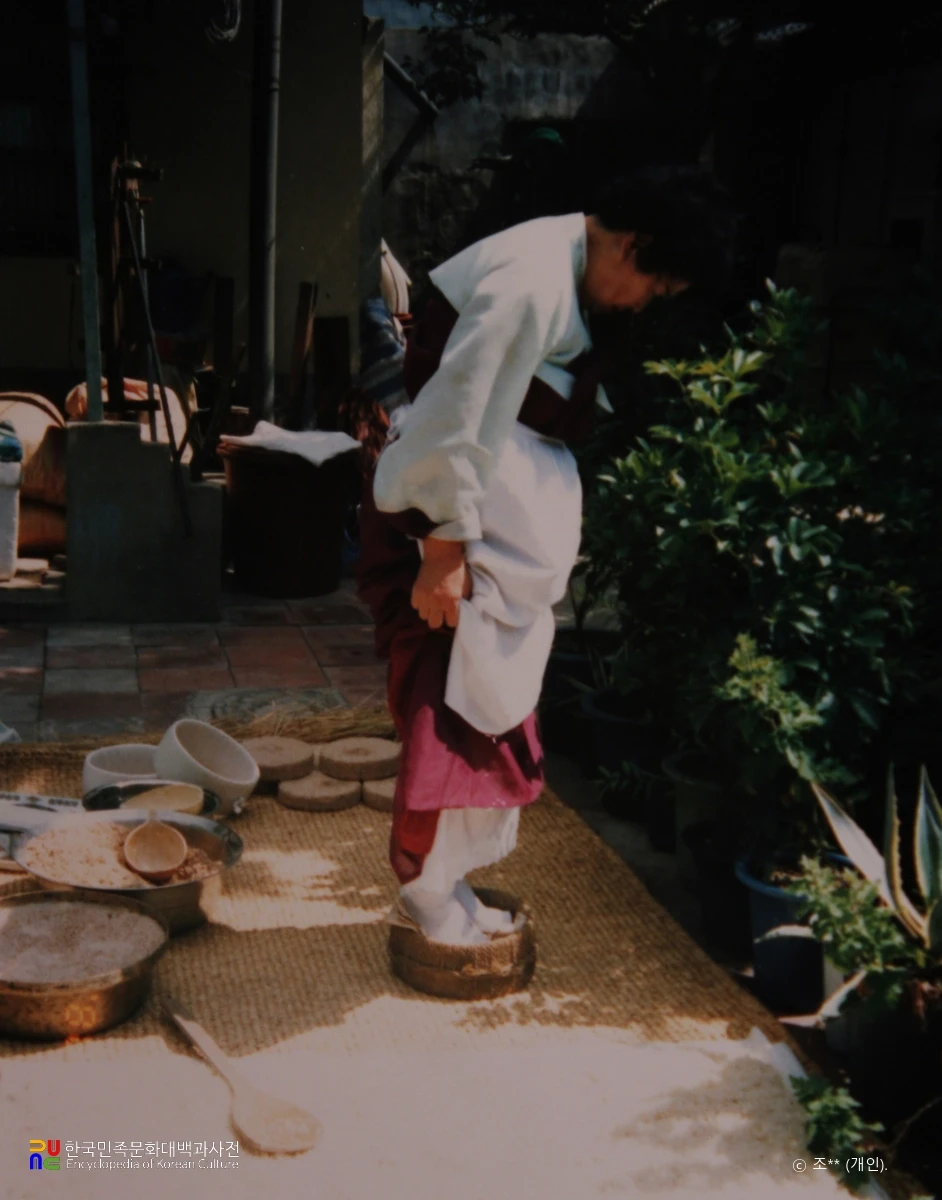
The Encyclopedia of Korean Culture’s nuruk entry describes a fermentation starter made by growing enzyme-producing molds on grain. Nuruk does not begin merely as a powder added on brewing day. Grain such as wheat or rice is broken down, mixed into a dough and shaped before suitable conditions are provided for microbial growth. Traditional accounts describe wrapping the dough in cloth or pressing it in a mold, arranging the pieces with materials such as straw, and turning them while their condition is managed.
Thickness and firmness are part of this work. They influence how moisture leaves the interior and how microorganisms develop. A completed outer shape does not mean that the starter is ready: maturation, inspection and drying still matter. The encyclopedia records regional differences between stacking and hanging the pieces, and between round cakes and other forms. A starter therefore embodies decisions about materials and shape, storage space and repeated handling.
In grain fermentation, breaking starch into usable sugars is connected to the conversion of sugars into alcohol. Nuruk cannot adequately be described as a flavouring added to soju. Steaming the grain, providing a fermentation starter and allowing the mash to develop each alter the conditions in which the drink is made. Some modern producers use cultured microorganisms, so the traditional cake of nuruk is not an object reproduced unchanged in every factory.
From steamed rice to fermented mash
The encyclopedia’s soju entry records washing and steaming grain before combining it with starter and water. Steamed rice does not become soju simply by entering a still. The cooled grain, water and starter first form a material that can ferment. Alcohol develops while grain and liquid remain together, producing a mash that can subsequently be distilled. The clear bottle has a preceding history of visible grains and wet fermented material.
The regional accounts do not supply one universal recipe. A Seoul example combines steamed rice, water and powdered nuruk in a vessel, with daily stirring during roughly three weeks of development. A Pyongyang account begins with starter and sorghum, later adds rice and cooled glutinous-rice porridge, and describes fermentation over 25–40 days. Hamhung is described with different proportions and a shorter period. These are recorded regional examples, not prescribed timings for every soju currently sold.
The interesting difference is more than a number of days. Adding everything initially and adding grain to an established base create different sequences of work. Fresh rice must be steamed and cooled; a vessel’s contents must be handled at the appropriate stage. Skipping these actions leaves only the image of a spirit obtained with fire, while concealing the material that arrived at the fire after fermentation.
A traditional still heats and cools at the same time
Heating fermented liquid produces vapour; cooling and collecting that vapour produces a distillate. A traditional sojutgori connects the heated lower part to a cooling arrangement and an outlet for the liquid collected. Distillation works with alcohol already produced during fermentation. Rice starch does not turn directly into alcohol inside the still.
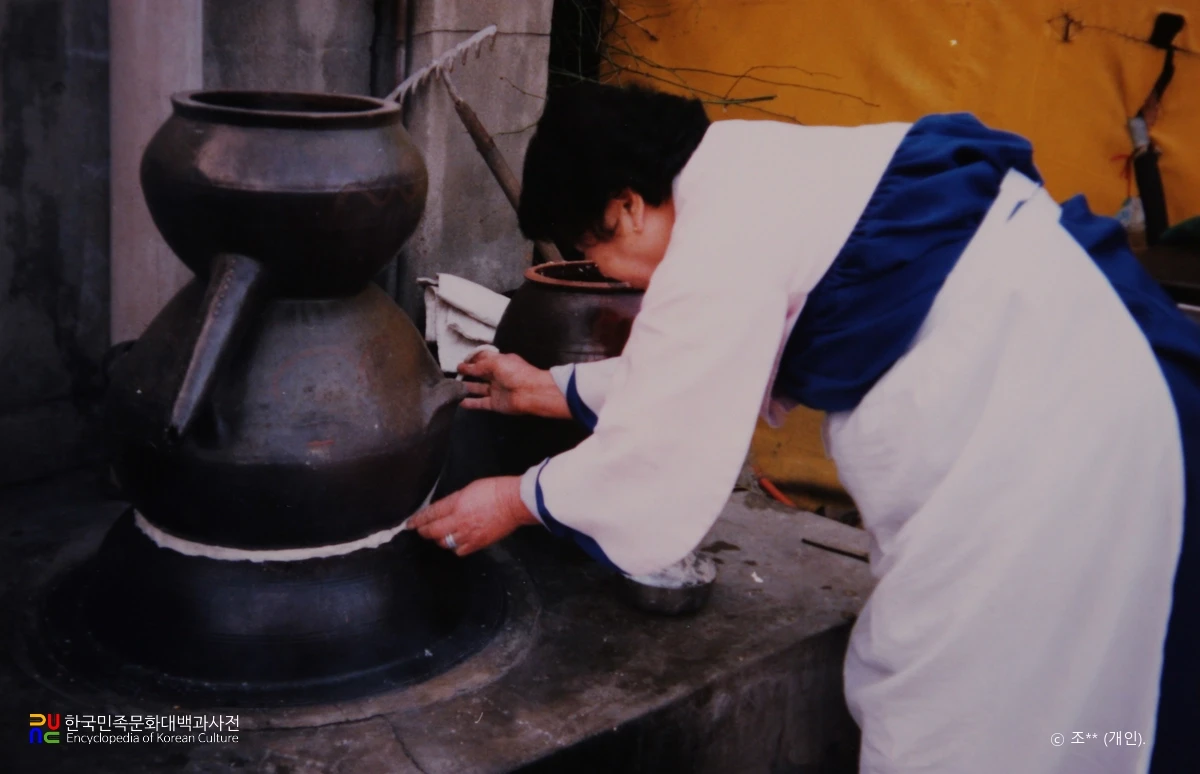
The encyclopedia’s Andong production photograph shows the still being positioned above a pot and its joint being worked. The accompanying account also describes replacing cooling water and collecting the liquid. Heat is supplied below while the upper arrangement maintains conditions in which vapour can condense. The two actions must continue together for liquid to emerge from the apparatus.
That is why fire alone is an incomplete explanation. The entry records that stronger heating can increase output while producing an unwanted smoky character, and that managing cooling water matters. Fermentation is one influence; heating and cooling are others. The practical experience embedded in a traditional apparatus involves watching their relationship and the emerging distillate, rather than simply maintaining the largest possible flame.
Diluted soju also has fermentation and distillation upstream
Diluted soju blends refined base alcohol with water and other ingredients. This alcohol does not initially arrive at the strength of the finished bottle. The soju entry describes fermentation of materials containing starch or sugar followed by distillation to a high concentration. Raw-material preparation, fermentation, distillation and refinement therefore precede the blending stage. Looking only at water being added in a finished-product plant hides that upstream work.
The producer then adjusts the final concentration and formulation. Water is an important component determining alcohol strength, rather than a material that merely fills the remaining space. Other ingredients can depend on the producer’s formulation, and individual labels and specifications identify what a particular product contains. A list of additives in an older manufacturing account cannot be assigned to every contemporary bottle. Equally, transparency does not prove that a drink has no other ingredients.
Distilled soju can also have its final strength adjusted, so water addition alone does not identify the diluted category. The difference concerns whether a product is developed from its fermented-mash distillate or blended on the basis of refined alcohol. A distiller seeking to retain material character and a producer managing a repeatable blend focus on different parts of manufacture. Seeing those actions is more informative than ending with a simple ranking of the two categories.
Changed equipment in a contemporary distillery
Hwayo’s official production account describes rice fermentation, vacuum distillation and maturation in onggi earthenware. Reducing pressure changes the temperature at which a liquid boils. The apparatus need not resemble a traditional sojutgori for the underlying relationship to remain: fermented liquid is heated, its vapour cooled and a distillate collected. Equipment and control conditions have changed; fermentation has not been replaced by the mere installation of a still.
An onggi in this example is also a vessel used after distillation, rather than only one in which materials are initially mixed. Rice identifies the starting material, reduced pressure a condition of distillation, and the earthenware vessel a later storage stage. Traditional materials or vessel names can therefore coexist with contemporary equipment in one product. The account of jang manufacture likewise connects transmitted material knowledge with changing production systems.
The 2003 beginning stated by Hwayo belongs to a modern brand. It is not the birth date of soju itself. When a transmitted manufacturing method becomes a contemporary company’s product, inherited knowledge and newly organised equipment and business activity enter the same bottle.
Regional transmission and industrial supply
A familiar account links the arrival of distillation in Goryeo to Mongol movements. The proposed route through Persian and Arab worlds is nevertheless presented as an inference in the soju entry. Rather than fixing it as one inventor’s journey on an exact date, the subsequent records of regional production provide a more secure way to follow the technology’s presence.
The Gyeongsangbuk-do record for Andong soju describes a transition from household transmission to Kwon Tae-yeon’s factory and commercial production in 1920. The heritage designation dates to 13 May 1987. These events concern different activities: organising production as a business and recognising transmitted manufacturing knowledge for preservation. The regional name consequently carries both a production place and an experience of transmission.
Raw-material supply matters to the history of mass production. The encyclopedia records grain-use restrictions associated with food policy in 1965 and base-alcohol materials including sweet potatoes, molasses and tapioca. A change in available ingredients changes the basis of fermentation, the supply of alcohol and the organisation of final manufacture. A contemporary green bottle cannot simply be projected back onto a regional spirit in Goryeo. The name persisted while the systems supplying drinks under it changed.
Strength and flavour belong to the finished product
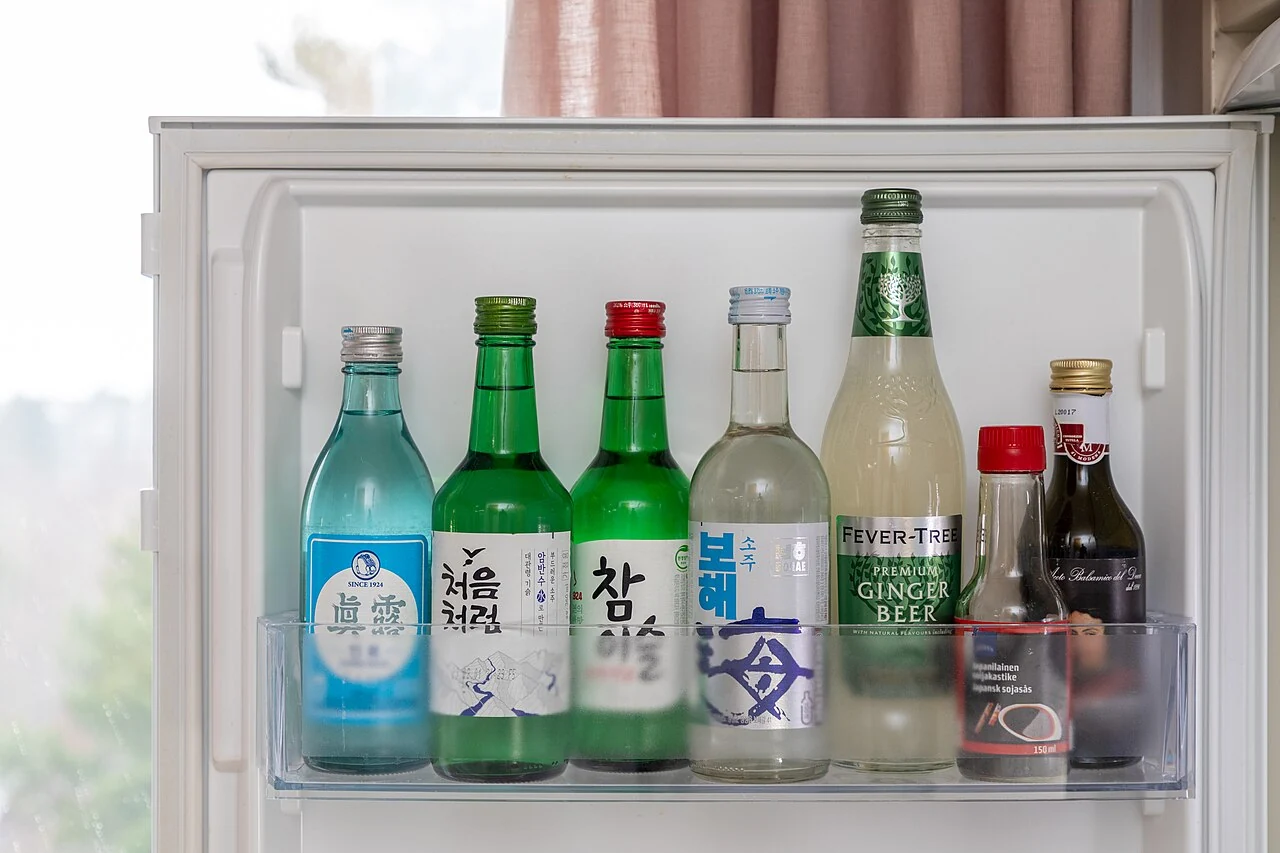
The Jinro international catalogue checked on 12 October 2026 lists fruit products such as grapefruit and strawberry at 13.0%, Chamisul Fresh at 16.0% and Chamisul Original at 20.1%. One brand’s catalogue contains different strengths and flavours. These are specifications of those listed products, not a shared percentage for every domestic or overseas bottle. An older product visible in a photograph can also belong to a different point in the product’s history.
Strength can be read alongside the volume poured. In an illustrative 50mL serving, 16.0% alcohol by volume corresponds to approximately 8mL of alcohol; 20.1% corresponds to approximately 10.05mL. This is a simple calculation showing that equal liquid volumes need not contain equal alcohol volumes. Bottle colour and fruit imagery do not replace the numerical information. A flavour name and a strength appear together but communicate different things.
To me, the most engaging part of a soju account is being able to work backwards from a bottle to the actions before it: a foot pressing nuruk, rice being steamed and cooled, a vessel of mash, cooling water on a traditional still, and a contemporary blending and packing operation. The story of the name before the green bottle follows those changes further through time. A clear glass is the outcome of work on materials, rather than evidence that there were never materials to begin with.
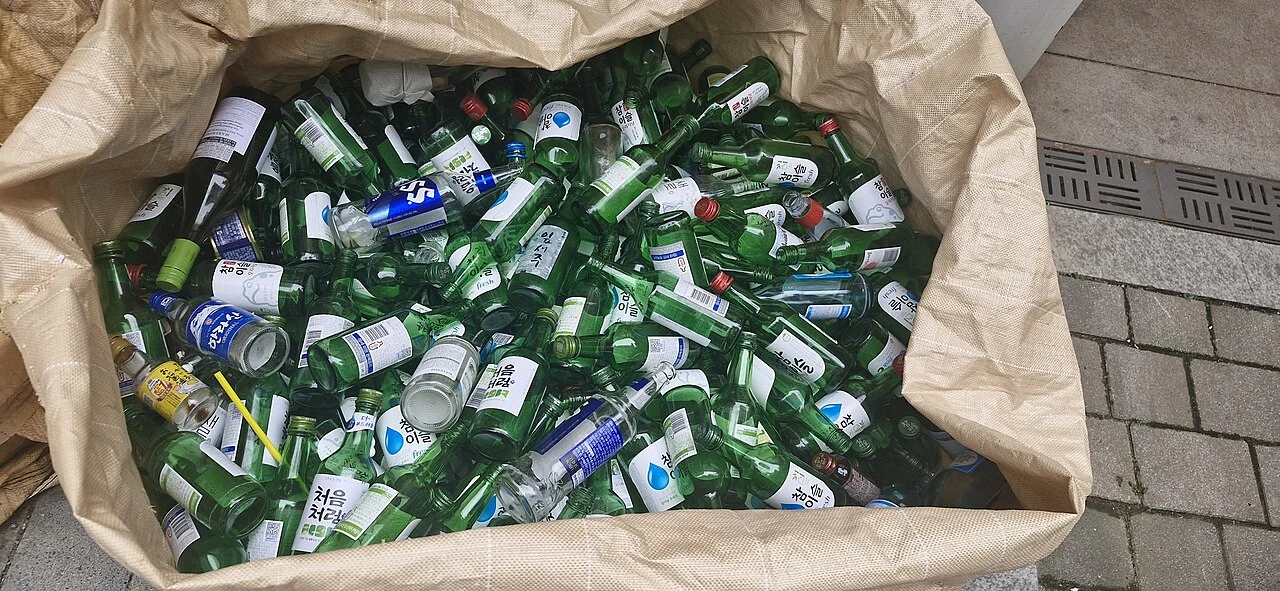
A clear bottle follows work on grain, fermentation, distillation or refined-alcohol blending.
Sources & scope
Soju production and regional accounts ↗Nuruk materials and shaping ↗2022-11-20Hwayo manufacturing ↗Hwayo brand beginnings ↗Andong soju transmission ↗Strengths of internationally listed products ↗Modules independently explains the verified sources. The lead image is AI-generated for illustration; it is not a documentary photograph of an actual place, event or product.
Updates & corrections
Dates record changes to this document, separately from the reference dates of its sources.
- Content update
Rewrote the article with fuller production, history, examples and source explanations.
- First published
Created Korean and English documents using verified official sources.