
When a Bukchon wall enters the screen
The house in the photograph carries the slope of its street. Doors and windows sit at different heights. Dark bricks alternate with rounded stones; tiles overlap above wood touched by morning light. These differences make the place more distinct than the word hanok alone. Looking at it before remembering the Seoul of KPop Demon Hunters gives physical substance to the idea of a city becoming material for animation.
The film was made in partnership with Sony Pictures Animation and directed by Maggie Kang and Chris Appelhans. Netflix documents Korean visits, photographic references and a Bukchon setting. Roofs and walls enter another kind of space: one where characters can move through composed images. Features of a real neighborhood survive while its screen version acquires the timing of a story.
The credits and the roof supply different information, and their coexistence enriches the work. A cultural connection can be felt in a small detail before the viewer knows its production history. After following several entrances into K-culture, we can stay within individual works and examine how streets, pictures and voices begin another life.
One street, several kinds of image
Imagine drawing this photographed street. Moving from a wide view of the wall to a face leaves only a narrow strip of tiles above the character. In a running scene the slope directs movement; in a conversation a doorway provides somewhere to pause. This is a general drawing exercise, rather than a report of a particular film's shots.
The artist prepares both recognizable features and room for action. Dense stone patterns may hide a hand in front of the wall. Removing every pattern may dissolve the place's identity. Changing brightness, outlines and the relative size of near and distant roofs guides the eye through an image. Background detail and legible movement continually negotiate space.
Sound joins that space. Footsteps on a broad road and between walls invite different expectations. Animation places sound against an imagined street and aligns it with the next cut. Copying building shapes alone cannot create the whole encounter. A memorable city consists of lines and colors, but also bodies and time passing between them.
From a painted tiger to a moving character
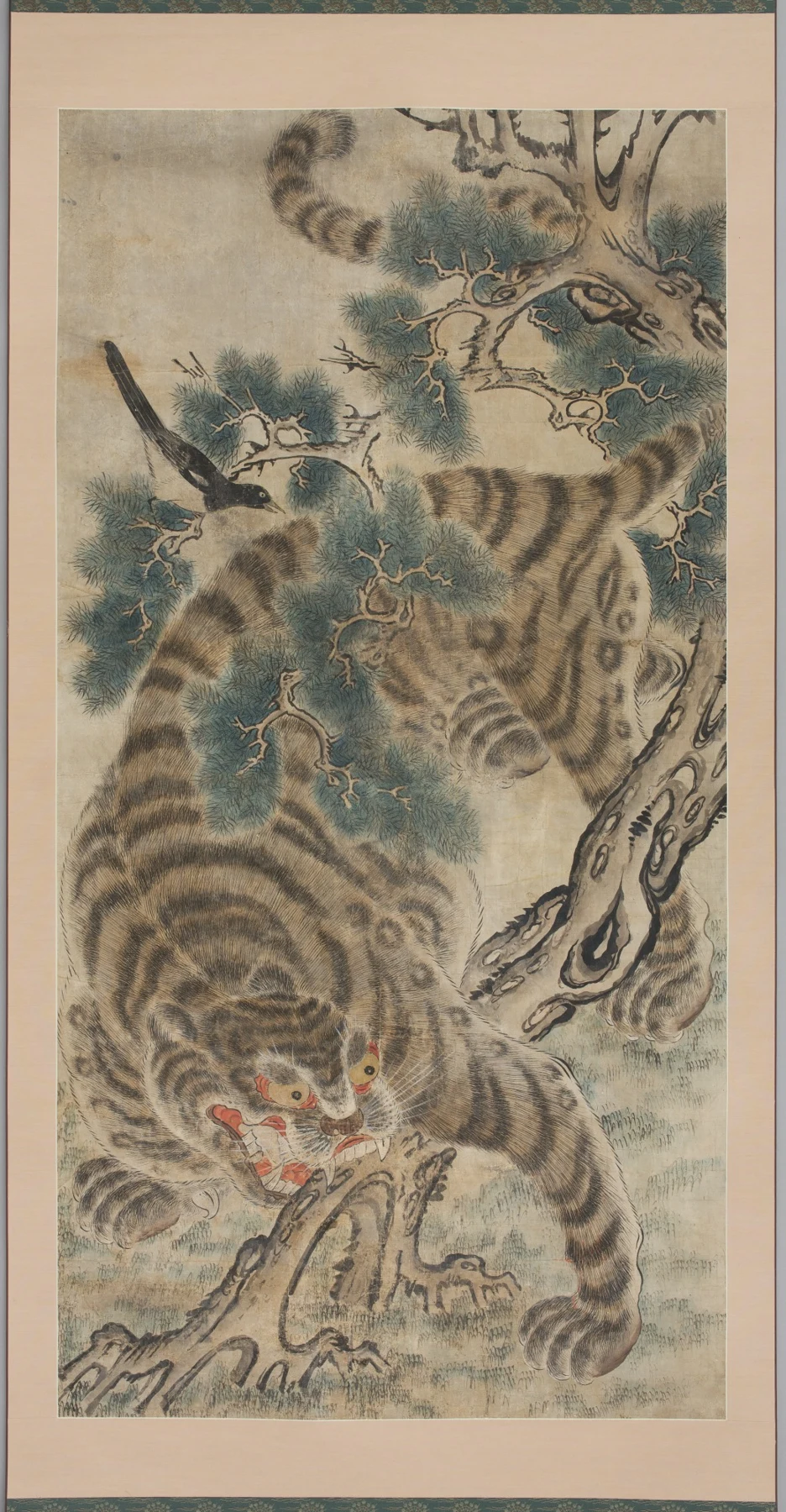
The historical Tiger and Magpie reproduced here gives its large body and face different impressions. Stripes follow a strong curve, while rounded eyes and exaggerated mouth lines complicate the animal's expression. A small magpie sits above among pine branches. The anonymous painting belongs to the Detroit Institute of Arts; it illustrates an older visual form, not an identified direct source image for the film.
Netflix connects Derpy's design with the babo horangi motif in Korean minhwa. The interesting transformation is from a face held still on paper to a character that can react. Reading a painted expression and waiting for a moving response are different encounters with an image.
Imagine a character turning its head immediately, then a version whose eyes move while its body remains still. The second creates hesitation. Eyes, face and body have an order even within one reaction. This invented comparison shows why animating an inherited image involves new creation. The earlier form offers a starting point for behavior, rather than a complete set of actions.
Several people behind a remembered voice
A character need not have only one contributing voice. KPop Demon Hunters credits Arden Cho, May Hong and Ji-Young Yoo for voice acting, and EJAE, Audrey Nuna and REI AMI among its singers. Dialogue and song that meet on screen were completed through distinct roles. A viewer who first knew the character can subsequently discover actual performers.
Danny Chung describes weekly meetings connecting Korea, New York, Los Angeles and Bangkok. The official interview also credits Leejung's choreography. The geography becomes more interesting when read as cooperation between sound and movement, rather than a slogan about global reach. Simultaneous results on screen emerge from different kinds of work.
Consider an imaginary transition: music begins immediately after a line, making speech seem to lead into song. Leave a beat instead, and the viewer has time to notice a face. The same melody gains emphasis from when the picture changes. Several decisions inhabit a brief moment that eventually feels natural to an audience.

Maknae and hoobae carry relationships
Maknae means a group's youngest member; hoobae describes a junior in a shared field. Both appear in Netflix's film glossary. Their basic meanings introduce unfamiliar viewers to a vocabulary, but hearing a relationship requires more than a definition. Situation and response change how an address feels.
Imagine someone calling the youngest member after rehearsal while handing over water. In another invented scene the same address accompanies a gesture to begin again. Care is more visible in the first, responsibility in the second. The word remains while objects, vocal tone and the speed of the reply change around it.
Subtitles occupy limited space beneath an image. A lengthy explanation can fall behind the exchange; replacing an address with a name can weaken its relational meaning. Translation considers actions already visible. A smile carries part of an explanation, while a cold response may make the chosen word more important. Cultural traces move between retaining unfamiliar language and conveying relationships in another language.
The distance created by Pachinko's three languages
Pachinko began its release on March 25, 2022. Apple's announcement identifies Korean, Japanese and English, a story moving through Korea, Japan and America, creator Soo Hugh and directors Kogonada and Justin Chon. Minha Kim plays teenage Sunja and Yuh-Jung Youn older Sunja. A character's time encounters different bodies and voices, while family movement also involves movement between languages.
The pleasure of hearing several languages extends beyond counting them. A language familiar at home and one demanded at work can give the same self-introduction different lengths and tones. Speaking to a stranger may require explanation; relatives may understand a shortened phrase. Migration stories allow speech to perform tasks beyond carrying information.
Imagine a person pointing at an object with a brief phrase at home, then describing its price and use in complete sentences at a shop. A change of listener changes the length of speech. This invented example is not a retelling of an episode. It makes audible one possibility of multilingual narrative: a linguistic change may carry intimacy or tension alongside geography. Actors' voices and the established setting give such changes their particular weight.
The pleasure of recognition
Recognizing a roof, a tiger's eyes or a familiar address offers real pleasure. For a newcomer it is a new form; for someone familiar with it, memory meets another use. Different viewers find different attractions within the same work. A Korean location remains connected to Korea when people elsewhere transform it into an image, alongside the contributions of those makers.
Familiarity also leaves room for disagreement. A tiger's design may appeal while the music does not. A favorite singer may lead someone toward the speaking voice of another performer. Recognition and liking can meet or diverge. Different overseas encounters with Korean culture continue this question through audiences' experiences.
What lasts is often how an identifiable feature finds work in another medium. A slope organizes movement, an old face acquires a new reaction, and an address enters dialogue in another language. I find that transformation more rewarding than demanding an unchanged cultural original. A familiar piece begins doing something again inside somebody else's story.
A familiar piece begins doing something again inside somebody else’s story.
Sources & scope
Everything to Know About KPop Demon Hunters: Songs, Awards, Lore, and More ↗2026-03-26Explore Seoul with This Guide to the Real Locations of KPop Demon Hunters ↗2025-12-05Derpy Tiger in KPop Demon Hunters ↗2025-11-04How to Talk Like a K-Pop Fan: A KPop Demon Hunters Dictionary ↗2025-11-14Danny Chung on Creating KPop Demon Hunters Music ↗2025-12-22Apple’s highly anticipated drama “Pachinko” set to premiere globally March 25, 2022 ↗2022-01-26Bukchon, Seoul, June 4, 2024. Photograph by Basile Morin.
Basile Morin · CC BY-SA 4.0 · Resized and converted to WebP; no croppingUpdates & corrections
Dates record changes to this document, separately from the reference dates of its sources.
- Content update
Rewrote the article with fuller production, history, examples and source explanations.
- Document connections
Organised representative-document links, search descriptions, paragraph links and revision history. No factual correction.
- First published
Initial creation of the Korean and English document.